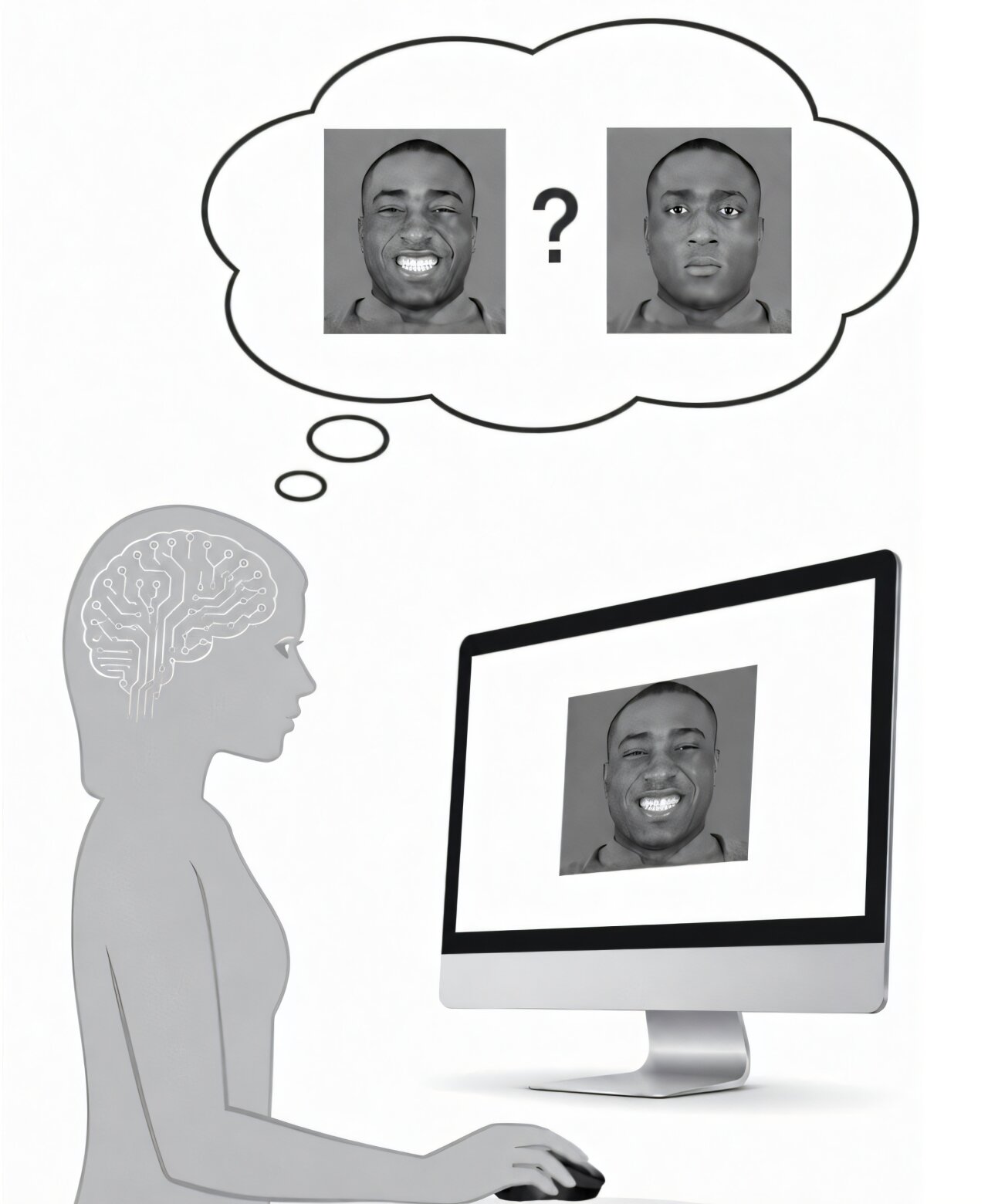
An example of a participant looking at one of 12 people’s faces showing a variety of expressions - anger, disgust, fear, joy, sadness and shame. Credit: York University
The human brain can recognize a person's face and expression in less than a blink of an eye, but current artificial intelligence (AI) models, although fairly accurate at doing the same, use a different process than the brain. That may not be good enough for applications in health care or education, according to new research from York University.
"Faces are critical to human communication. Very small changes in facial appearance can influence how we understand a conversation, whether we think someone is comfortable or distressed, and how we respond socially. We need to understand how those AI systems arrive at their judgments and where their interpretation of human social signals differs from ours," says York University senior author and assistant professor Kohitij Kar.
"A major long-term benefit is that this work gives us a way to move beyond simply describing differences in social perception and toward understanding the neural mechanisms that produce them."
The study, Facial expression discrimination emerges from partially overlapping neural subspaces of detection and identity, was published in Nature Communications.