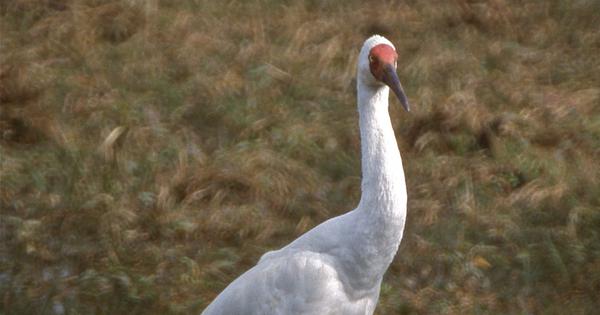
Bharatpur! The name always makes birdwatchers like me most excited since this town in Rajasthan is famous for the Keoladeo Ghana National Park, where thousands of waterbirds congregate. Migratory birds from far-off Arctic countries spend the winter months, escaping frozen landscapes to enjoy the warmer water of the Park’s wetland. Here they feast on abundant fishes, insects and water plants. It is certainly a birder’s paradise to be able to see so many species of ducks, geese and teals swimming in the deeper water, the waders along the shore, the raptors in the sky above, and arboreal birds on the bushes and trees surrounding the waterbody. Unlike other national parks and sanctuaries where the only way to see wildlife is on a jeep safari, here there are cycle rickshaws and bicycles for tourists to go around and one can even walk along the bunds of the waterbody. The rickshaw drivers are all trained guides who know the names of the hundreds of bird species – including their scientific names! Rickshaws were ideal when I was with a family group, but when I was on my own, I far preferred to hire a bicycle to be alone among the birds, watching them quietly as they went about their daily lives and listening to their voices.My main reason for going again and again to the Keoladeo Ghana was to see its most iconic bird – the Siberian crane. Known as the “lily of birds”, Dr Salim Ali described it as “a magnificently beautiful, immaculately white crane” for its gleaming white feathers, tall, graceful body, long neck and contrasting bright red “mask” on its face. Once, this lovely bird used to be a regular winter visitor to Ghana as well as to many other wetlands in north India. Family parties of Siberian cranes used to be seen in water bodies around the area but when those became unsuitable or too dry, the birds would come only to the Keoladeo Ghana in Bharatpur. Unfortunately, from the last decade of the previous century onwards, fewer and fewer had been coming to the Keoladeo wetland. Eventually, the last pair was seen in 2001 and after that there were none. Now no one visiting Bharatpur is going to see those birds again.Only when the birds stopped coming, did I realise how lucky I was to have seen them at all. During my earlier visits, I used to see small groups of “Sibes” (as birders called them affectionately) walking with their typically dignified steps in shallow water, probing the soft mud to pull out tubers of sedges and fleshy roots of other aquatic plants that are their main food. Sometimes there were parties of several adults with a few juveniles along with them while at other times there were small families with just one young. On misty days, their slim white fairy-like figures in the distance were a magical sight. On my last visit, I saw just one adult pair with their young one. Unlike its snowy white parents, the chick was brownish coloured with streaks of white on its body. It was fairly big, almost as tall as the adults, yet I couldn’t help wondering how it was strong enough to fly at such a young age all the way on the long journey from its nest in Siberia. Perhaps that was the last family that came to Bharatpur.In Siberia, the cranes’ habitat is very remote, almost inaccessible to humans. It lives in swampy places where there are large areas of moss-sedge bogs in tundra and extreme north taiga ecosystems. These regions are severely cold, particularly the tundra, which has no trees and is windy, whereas the taiga areas have low bushes and coniferous trees. Their mossy ground with sedges and lichens are perfect for the cranes to feed on. The summer months are very short in these northern regions near the North Pole and there is daylight for almost 24 hours, which is why it is called the “land of the midnight sun”.The cranes lay their eggs and raise their little chicks during this relatively warm season. The extra sunlight stimulates the plants to grow faster and the chicks grow up quickly as well since they are fed with fresh nourishing food for more hours. By the time winter sets in, the hours of darkness increase and there is hardly any sunlight even at midday. The freezing cold makes the habitat difficult for the birds to live in. Water bodies get covered with ice and the vegetation is blanketed with frost and snow. It is then time for the birds to leave.The flock that used to come to Bharatpur was from a population that bred near the great Ob river in the western part of Siberia. Once the summer season was over and the chicks had grown big enough, the cranes would start on their incredible migratory journey to India. Their route via Kazakhstan, Iran, Afghanistan and Pakistan covered thousands of kilometres, flying high above mountain ranges to reach their warm wintering ground.Unfortunately, during this journey, they were hunted in some of the places where they stopped to rest along the way. Poaching was also a problem. These threats and the Indian wetland becoming unsuitable for the “Sibes” were among the reasons for their numbers coming down so drastically from 100 birds counted in the year 1968 to 0 in 2002. There was a terrible drought in 2001-2002 that made the Keoladeo wetland dry up completely. The hard ground would have made it impossible for the cranes to find food, since they needed to feed on sedges and tubers that they pulled out from under soft, moist mud with their long beaks. Even though the water filled up during subsequent years, the cranes never returned.There were threats to their breeding habitat in Siberia too. Being accustomed to wide open spaces with no humans anywhere around, when people come into their area or send livestock like reindeer for grazing, they get disturbed. These cranes are particularly sensitive to any kind of disturbance when they are nesting. Even the sight of people far away is enough to cause eggs and chicks to not survive perhaps because the parents abandon them when they feel threatened. I had observed this kind of sensitive behaviour with another crane species, the common crane which was breeding in Norway. While on a birdwatching tour, I saw from a distance a crane standing far away in the middle of a patch of tall grassy plants. As soon as it noticed me and my companions, it ducked to hide its head below the level of the grass and disappeared from our sight. It was so shy and secretive because it must have had its nest nearby and was protective of its eggs or chicks.For me, this was a most surprising and extraordinary experience. I was used to seeing huge gatherings of common cranes that migrate to India. Once they arrive, they are noisy flocks that are not particularly frightened by humans, though the Indian wetlands have villages and farms all around. The contrast between their summer breeding habitat and their winter migration one is so dramatic; I am always amazed at how they adapt to such extreme changes year after year. This contrast must have been even greater for the Siberian cranes whose breeding ground was totally pristine and too remote for people to get to easily. Yet the birds adapted to the Keoladeo Ghana habitat of Bharatpur, where tourists, birdwatchers like me, as well as local people were nearby all the time.Ornithologists and scientists all over the world were very concerned that the Siberian crane had become critically endangered. It was not breeding well in its natural habitat and those that did grow to become adults were not able to survive when they migrated. The International Crane Foundation and scientists teamed up to start artificial breeding programmes so that the species doesn’t die out completely. They incubated Sibes’ eggs in laboratories, and from the time the chicks hatched till they grew, they were kept away from people, so that they don’t see any humans or even hear their voices. The people who looked after these chicks wore white costumes and masks to cover their faces. To feed them, they used puppets that looked like a Siberian crane’s head and neck, with the same shape of its beak. Later, these puppets were improved and replaced by a better replica made by a professional artist. They also used portable players with audio recordings of real adult birds’ voices for the chicks to get familiar with these sounds. Unlike the loud honk-like calls of other crane species, the Siberian crane’s call is softer and more musical.At a conference of the International Crane Foundation, I saw a documentary on how the chicks were raised with care so that they don’t bond with humans and remain wild. It was amusing yet very interesting to see the veterinarians and their helpers completely covered in white costumes to resemble adult cranes gently train the young ones to fend for themselves. They were then made to meet adult cranes so that they could learn to feed and also join them when they migrated. When the birds were big enough to be released, they were fitted with satellite tags so that they could be monitored continuously after they flew away. From the tags’ signals, the research and conservation team could find out exactly which route the birds took for their migration and where they stopped to rest on the way. In this way, the bird conservationists in the places along their route could be alerted to protect them.Sadly, the Siberian crane is extinct in India now. Once, we were proud to host these exquisitely beautiful birds every year. The pleasant weather of Bharatpur and the wetland ecosystem of the Keoladeo Ghana were ideally suited for them to get away from the harsh winter of their Arctic home. I can only hope that with the serious conservation efforts that are being made now, these lovely birds will return to India once again.Excerpted with permission from Gentle Sharks, Glowing Worms and Other Wonderfully Wild Creatures, Tara Gandhi, Talking Cub.
For children: Why the Siberian crane that used to spend every winter in Bharatpur stopped visiting
An excerpt from ‘Gentle Sharks, Glowing Worms and Other Wonderfully Wild Creatures’, by Tara Gandhi.
1,703 words~8 min read