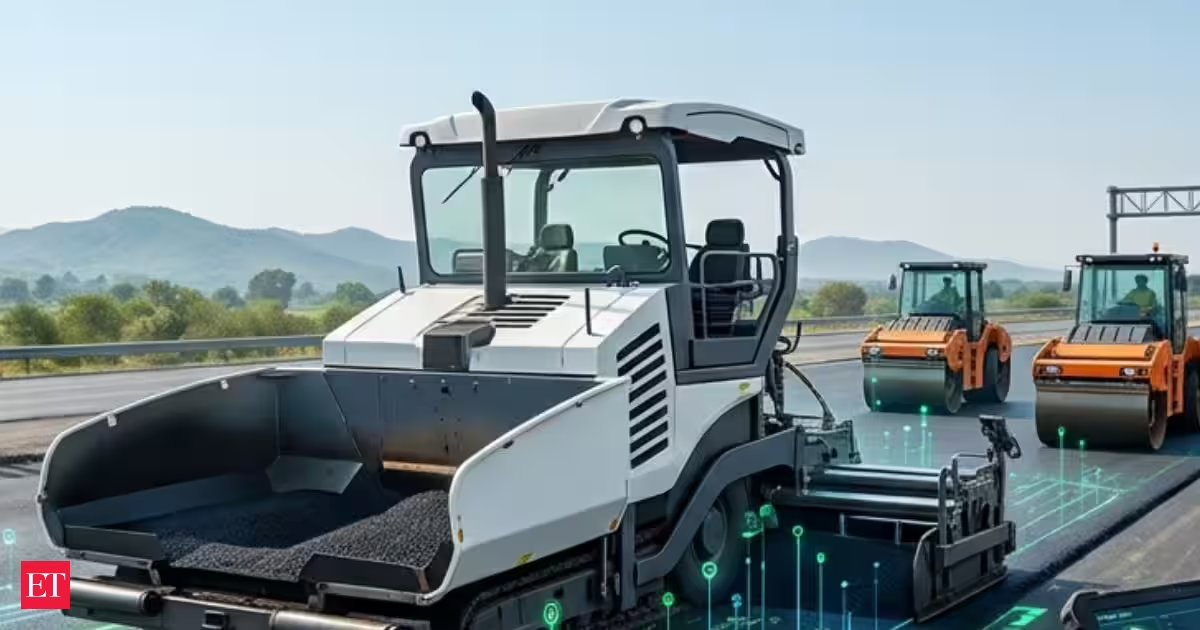
NHAI's new AI rule for pothole-free, top-quality highways: How projects above Rs 500 crore will now have to use AI-powered machines to prevent quality shortcutsSynopsisNHAI has mandated the use of automated construction technology for major highway projects. The technology will be deployed across key layers of highway construction, with real-time data sharing expected to minimise human error and ensure uniform construction standards. Industry players, however, have cautioned against implementing the mandate in a piecemeal manner. The move aims to strengthen accountability across the highway construction ecosystem.Listen to this article in summarized formatET OnlineNHAI makes AI-based construction technology mandatory for major highway projectsThe National Highways Authority of India (NHAI) has made Automated and Intelligent Machine-Aided Construction (AI-MC) compulsory for all highway projects longer than 20 km and costing over Rs 500 crore, in a move aimed at tackling quality concerns that have long troubled the government.What the NHAI circular saysAccording to an NHAI circular, contractors will be required to use the AI-MC system while building roads from the ground up, and continuously across the entire spatial footprint of each project. The technology must be deployed across every major layer of highway construction, including the embankment (the raised earth foundation), the subgrade (the compacted soil base) and the Granular Sub-Base or GSB, the first layer of crushed stone, sand and gravel laid over the compacted soil before the road surface itself is built.Read more - Indian Railways will fine you Rs 1,000 if you do this inside a train or at a station; refuse to pay and you could face a Rs 2,000 fineHow AI-MC worksAI-MC is a construction technology that relies on on-board computers and sensors fitted to heavy machinery such as graders, pavers, compactors and dozers. Its deployment is intended to improve the quality, durability and transparency of road construction by replacing manual monitoring with technology-driven, real-time execution and quality control, ensuring roads are built with greater accuracy and uniformity.Piloted on Lucknow-Kanpur Expressway, but not fullyAlthough AI-MC was first deployed during construction of the Lucknow-Kanpur Expressway, it was not used across the entire stretch or at every grade of construction, a gap the new mandate is designed to close.Why NHAI wants real-time data from contractorsOfficials said the move is designed to minimise human error, ensure uniform construction standards, and generate digital records of every stage of construction, from earthwork through to pavement laying."The new norms make it mandatory to share real-time data with NHAI officials. This is good for contractors and for us as well. Once the contractor gets real-time data, there will be hardly any scope for sub-contractors to cut corners," said an official.Industry players warn against "piecemeal" rolloutSome players in the AI-MC segment said contractors have so far been reluctant to share real-time data with NHAI and other highway construction agencies, as doing so makes them directly accountable.“Unless NHAI and other agencies receive the data in real time, the impact of using this technology will be negligible. It should not be implemented in a piecemeal manner if the government is serious about improving the system,” an industry representative told TOI.With the mandate now in place, large-scale highway projects will be expected to move away from manual oversight towards continuous, sensor-driven quality checks, a shift NHAI hopes will curb corner-cutting and strengthen accountability across the highway construction ecosystem.(With inputs from TOI)Read More News on...moreless
NHAI's new AI rule for pothole-free, top-quality highways: How projects above Rs 500 crore will now have to use AI-powered machines to prevent quality shortcuts
NHAI has mandated the use of automated construction technology for major highway projects. The technology will be deployed across key layers of highway construction, with real-time data sharing expected to minimise human error and ensure uniform construction standards. Industry players, however, have cautioned against implementing the mandate in a piecemeal manner. The move aims to strengthen accountability across the highway construction ecosystem.
555 words~3 min read