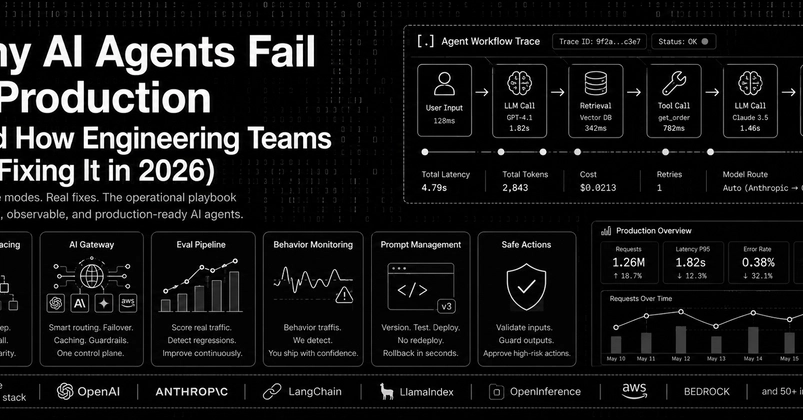
Most AI agent demos work beautifully. Then they hit real users, real data, and real edge cases — and start booking the wrong meetings, leaking context, or looping forever on a task they can't finish. The gap between "impressive demo" and "dependable system" is almost never the model. It's the guardrails around it.
This is a practical guide to why agents fail once they leave the demo, and the concrete controls that make them safe to run in production.
Why demos lie
A demo is a controlled environment: a clean prompt, a cooperative user, a happy-path tool call. Production is the opposite — messy input, adversarial content, flaky APIs, and actions that cost money or touch customer data.
Agents amplify small failures because they act in loops. A chatbot that hallucinates gives one bad answer. An agent that hallucinates takes a bad action, observes the messy result, and reasons on top of it — compounding a single mistake into a chain of them. The four failure modes below cause most production incidents, and each has a matching guardrail.