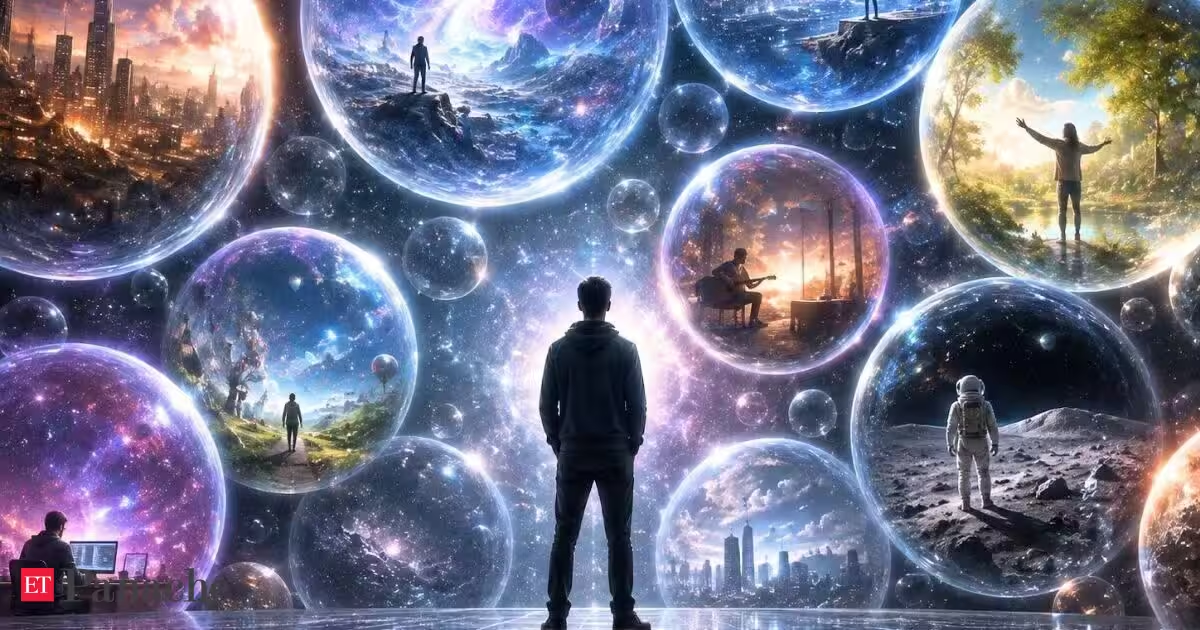
What if the ‘best version’ of you is not the person you could become in this universe, but someone already living in another one? What if the outcome you got of your life choices was not the only one that happened? One interpretation of quantum mechanics suggests that whenever a quantum event has several possible outcomes, all of them occur, with each one unfolding in a different branch of reality. If that ever gets proved, the version of you who made a different choice would not simply exist as a thought experiment or an unrealised possibility. It could belong to another world, living out the path you did not take, doing that other job, staying in that relationship, or simply turning left instead of right.That idea comes from the Many-Worlds Interpretation (MWI) of quantum mechanics, but it is only one route by which scientists have arrived at the possibility of multiple universes. Other ideas involve the rapid expansion of the early universe, bubble-like regions of space and the huge number of possible solutions allowed by string theory.None of these theories has proved that another universe exists. But taken together, they show why the multiverse remains a serious subject of discussion in theoretical physics rather than simply a science-fiction idea.1. Many-Worlds says every quantum outcome happensThe Many-Worlds Interpretation, going back to Hugh Everett's work in 1957, proposes that there are many worlds within a single Universe. Whenever a quantum experiment has different possible outcomes, all the outcomes are obtained, with each occurring in a different world.The splitting is not restricted to laboratory experiments. The supplied material notes that the creation of worlds could occur everywhere, including during events such as a star exploding in a supernova.Under this interpretation, our present world has a definite history, but its future can branch into multiple worlds. A person before a quantum experiment corresponds to several versions of that person afterward, each experiencing a different result.The idea provides a way of interpreting quantum mechanics without treating one particular outcome as fundamentally selected by randomness. But it also has unresolved conceptual problems, particularly around how the mathematical quantum state connects to our conscious experience.2. Eternal inflation could create countless bubble universesInflation is the extremely rapid expansion thought to have occurred shortly after the Big Bang. NASA says observations of the cosmic microwave background, or CMB, are consistent with predictions of inflation, although the physical process behind inflation remains unknown.The CMB itself originated about 380,000 years after the Big Bang and is observed today as a 2.7-kelvin glow stretched by the expansion of the universe.Physicist Alan H. Guth's work on eternal inflation takes the inflationary idea further. According to his paper published in the Annals of the New York Academy of Sciences, essentially all inflationary models lead to future-eternal inflation, implying that an infinite number of “pocket universes” could be produced.That would make our observable universe one region inside a much larger inflating multiverse.3. Scientists have actually looked for signs of bubble collisionsThe bubble-universe idea is not entirely detached from observation. Stephen M. Feeney, Matthew C. Johnson, Daniel J. Mortlock and Hiranya V. Peiris carried out an observational test using cosmic microwave background data from NASA's WMAP satellite.Their study searched for possible signatures left by collisions between bubble universes. The result was cautious: the WMAP seven-year data did not justify adding bubble collisions to the standard cosmological model. The researchers constrained the average number of detectable bubble collisions across the full sky to fewer than 1.6 at 68% confidence.They also noted that data from the Planck satellite could provide a more definitive test.So far, the search has not delivered evidence confirming that another bubble universe collided with ours.4. String theory allows an enormous landscape of universesString theory introduces another route to a multiverse. The theory allows extra dimensions, with six dimensions potentially curled up at extremely small scales. Different ways of arranging those hidden dimensions can produce different physical properties in the observable universe.The supplied material describes at least 10,000 different Calabi-Yau spaces, each associated with different possibilities for the shape of the hidden dimensions.The resulting “landscape” is not itself a collection of physical universes. It is a mathematical space of possibilities. Different points can correspond to different particles, forces and values of fundamental constants.Work by Shamit Kachru, Renata Kallosh, Andrei Linde and Sandip Trivedi found evidence for a de Sitter solution in string theory. Later estimates by Sujay Ashok and Michael Douglas put the number of different solutions at at least 10^100 in the framework discussed in the source material.5. The “populated landscape” combines string theory and inflationThe most expansive version comes from putting the two ideas together.If inflation continuously creates bubble universes and string theory provides an enormous landscape of possible physical environments, then different bubble universes could realise different solutions from that landscape. The result is what the supplied material describes as a “populated landscape”.Leonard Susskind described the distinction neatly: the landscape is a collection of possibilities, while the pocket universes of the multiverse would be actual places.This idea also connects to the anthropic principle. Steven Weinberg argued that if the cosmological constant were only about an order of magnitude larger than the tiny value associated with our universe, galaxies, stars and planets would not have formed. The argument suggests that our universe's particular conditions may be compatible with life because we could only observe a universe in which observers were possible.That does not prove a multiverse. The major problem remains the same: the other universes are, at present, unobservable. Eternal inflation predicts pocket universes, Many-Worlds predicts branching worlds, and string theory offers a vast landscape of possible universes, but science has yet to establish that these possibilities correspond to independently observable realities.
What if the 'best version' of you is actually living in another universe? 5 scientific theories that could actually prove existence of multiverse
What if the life you did not choose is actually being lived somewhere else? From the Many-Worlds Interpretation of quantum mechanics to eternal inflation and string theorys vast landscape of possible universes, several scientific ideas leave room for realities beyond our own. Here are five theories that could point towards the existence of a multiverse, and what science has actually found so far.
949 words~4 min read