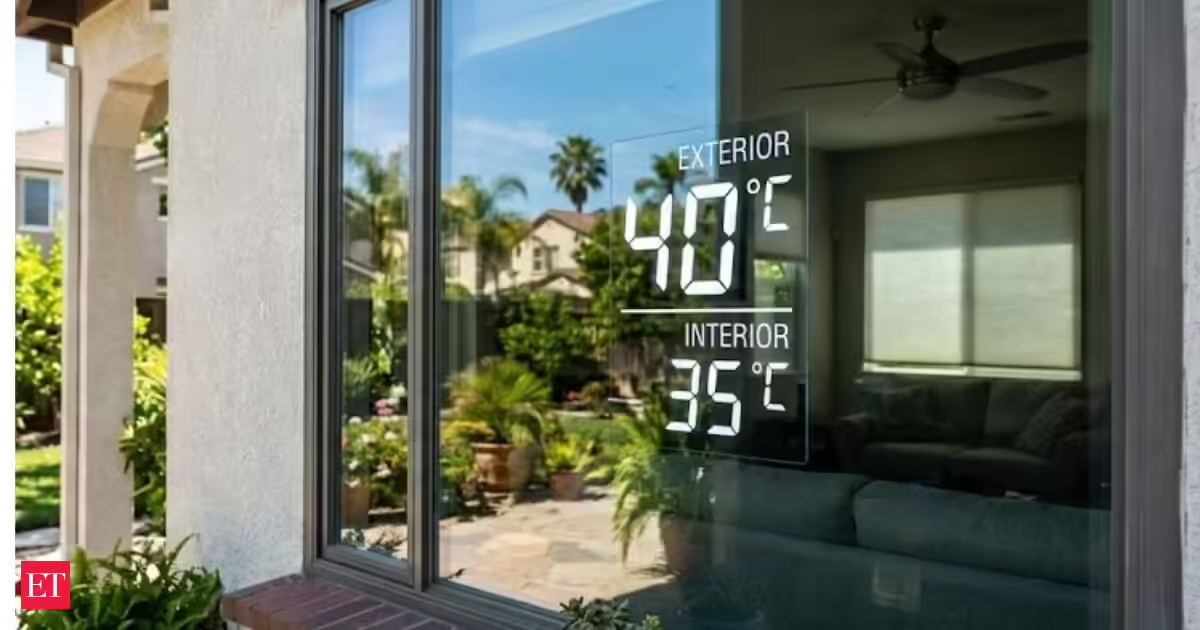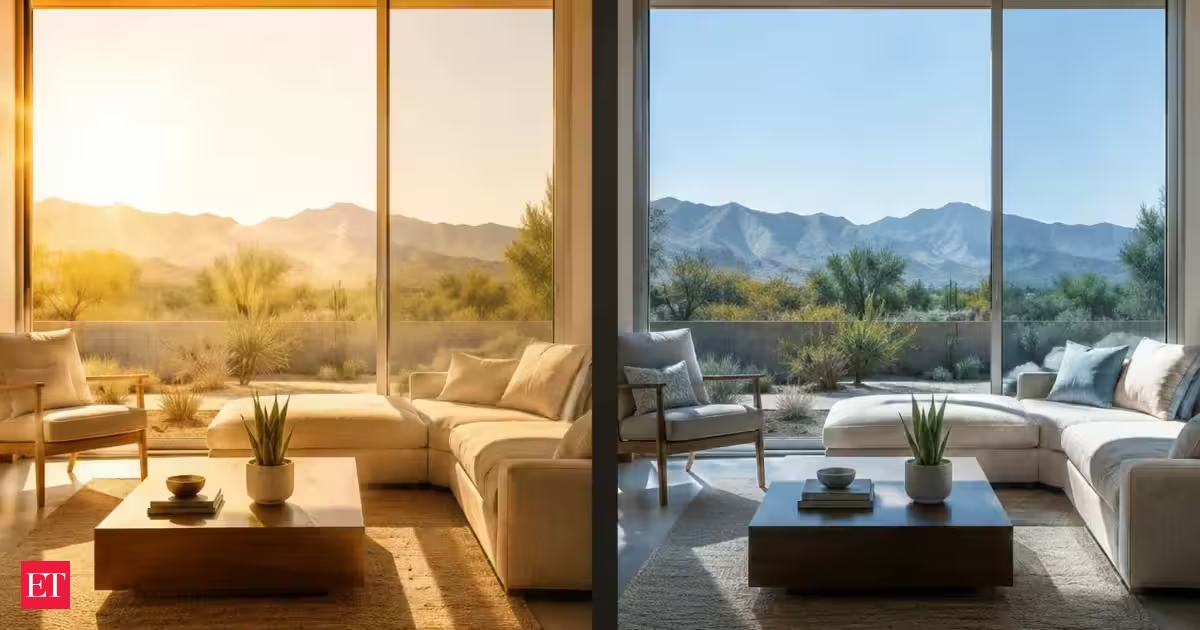
For those who live anywhere from Phoenix to Philadelphia, you're familiar with the process: adjusting the thermostat, preparing to pay a lump-sum bill, and repeating. However, as reported in a 2024 Notre Dame News article, engineers there built and tested: a super-thin, transparent coating that blocked heat coming from the sun while letting sunlight through, without any connection to a power source. It is electricity-free, shade-free, and vision-friendly all at once.The science, minus the jargonThat is the problem scientists have been trying to deal with for some time. Sunlight is composed not only of visible light (the desirable one) but also of ultraviolet and infrared radiation (the ones making your living room feel like a greenhouse). Most solar shading films on the market are optimized to work best when sunlight strikes the window perpendicularly, at 90 degrees. Yet a window's angle to the sun changes constantly over the course of a day, and rarely sits at that ideal 90 degrees, including around noon, when the thermal load is often at its highest.Anti-reflective coatings show how ultra-thin materials can change a glass surface’s interaction with light while remaining largely invisible. Image credits: Wikimedia CommonsTengfei Luo and his team addressed that gap in a 2024 study, titled “Wide-angle spectral filter for energy-saving windows designed by quantum annealing-enhanced active learning,” published in Cell Reports Physical Science. Their solution was an AI-assisted model coating that designed a coating able to stay efficient across that whole range of sun angles, rather than just the ideal 90-degree case. The scientists deposited layers of ultra-thin silica, alumina, and titanium oxide films on the glass surface and then added a thin layer of a polymer film made of silicone, which is able to emit the absorbed heat into space through the atmospheric transparent window in a highly exotic way. In their miniature test chamber, this setup kept the indoor temperature lower by 5.4 to 7.2 degrees Celsius compared to untreated glass for various angles of the sun's rays.This isn't the team's first rodeoAnd this is not even a one-time laboratory anomaly. It is influenced by previous research by the same group at Notre Dame. As noted in Kim et al.’s 2022 paper titled “High-Performance Transparent Radiative Cooler Designed by Quantum Computing,” published in the journal ACS Energy Letters, a previous version of this "transparent radiative cooler" has been tested in a rooftop enclosure in Phoenix, Arizona, and it was found to potentially reduce electricity costs for cooling by about one-third in hot and dry environments compared to conventional glass. This latest, wide-angle version is the newest step in an active, multi-year research thread with real outdoor testing behind it, not a brand-new, untested idea.Why this matters and what's being left outHere are some statistics that actually matter. The U.S. Energy Information Administration stated in a 2017 report that air conditioning already takes up almost 18 percent of yearly electrical consumption in the average American household, which peaks heavily each July and August. About 90 percent of American homes utilize some kind of air conditioning system. A window film that reduces heat before you even start your air conditioner is not some magic trick, but an actual reduction in bills that are rising every summer.Sunlight reflections from glass buildings. Image credits: Wikimedia CommonsHowever, here comes the slightly critical part. Research shows the coating works only on small-scale models of a room and a roofed test chamber, but may not work the same way on your bedroom window. There is no official information about how soon the product will be available for commercial use, what its price will be, or whether its performance has been independently verified beyond the Notre Dame team's own collaboration with Kyung Hee University in South Korea. Retrofit coatings tend to fail to live up to expectations after moving from the laboratory stage to the world of dust, scratches, and poor quality of installation. The translation of promising research into a product available in hardware stores requires quite some time.None of that makes the underlying idea any less worth watching: cutting a home's cooling load without adding to its energy use is a genuinely useful goal, even if the coating itself is still a research prototype facing real manufacturing and commercialization hurdles rather than a near-term, ready-to-install product. Whether it appears in your windows in three years or thirteen is another matter, and the answer remains unknown for everyone, including the researchers themselves.
Notre Dame engineers tested a clear window coating that filters solar heat; model interiors stayed up to 7.2°C cooler without electricity
Notre Dame researchers developed a transparent window coating that filters solar energy, keeping indoor spaces significantly cooler without using electricity. Discover the implications for air conditioning and energy savings.
737 words~3 min read