I wrote this post for the purposes of entering Google's **All Things Agentic Hackathon* (Track: Fortified Enterprise Fleet).*
The Silent Threat in Multi-Agent AI Architectures
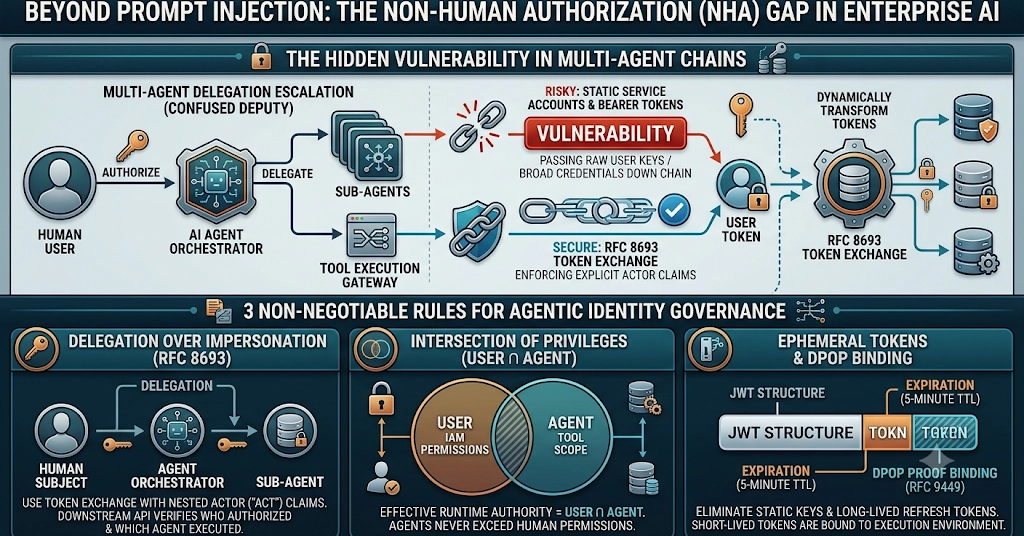
Autonomous AI agents are rapidly evolving from simple conversational interfaces into distributed, multi-tier agent fleets. In these architectures, an Orchestrator Agent decomposes complex enterprise tasks and delegates subtasks to specialized worker agents—such as database query bots, reporting engines, and alert dispatchers.
However, as permissions flow through delegation chains, standard multi-agent systems suffer from a severe architectural vulnerability: Implicit Privilege Escalation & Compounding Ambient Risk.
When an agent delegates a task, how do we guarantee that a sub-agent only receives the minimum necessary permissions? What prevents a compromised analytics agent from requesting destructive WRITE or ADMIN access? And if an adversary alters the delegation logs, how can compliance auditors mathematically prove non-repudiation?