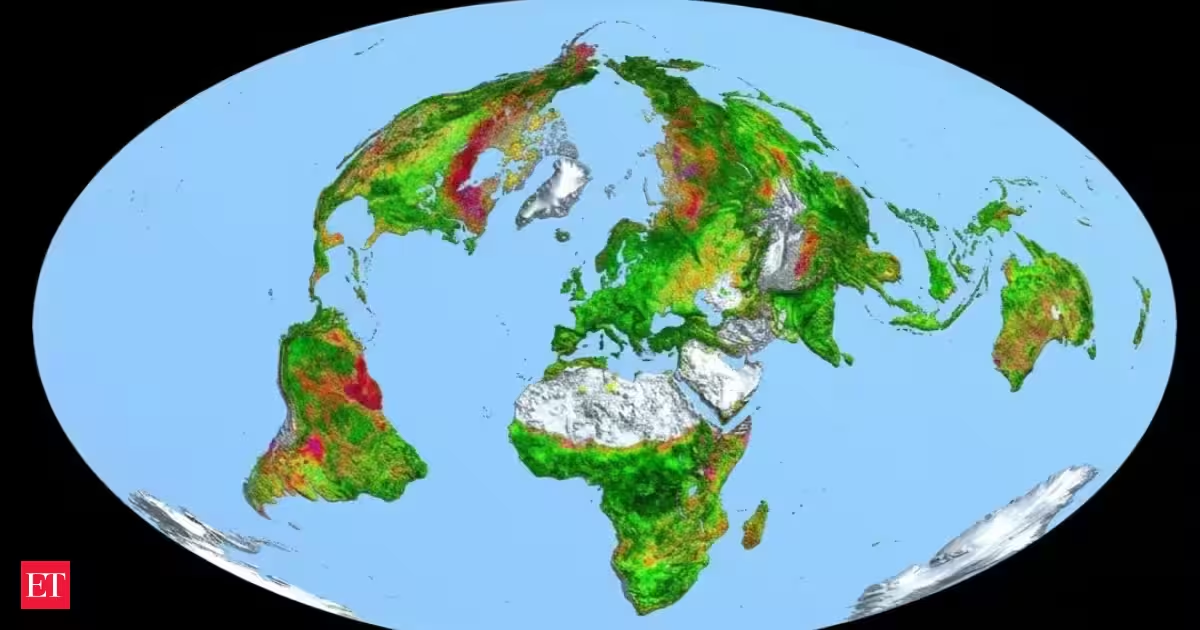
For decades, satellites have watched something remarkable happening across large parts of the planet: Earth has been getting greener. But scientists have disagreed over one of the biggest questions behind that transformation. Is the effect of rising carbon dioxide, the primary driver of modern climate change, on vegetation beginning to weaken, as plants face limits from water shortages and nutrient availability? Or has CO₂ continued to make a major contribution to global plant growth?A new study published by scientists at NASA's Ames Research Center on Research Square in January 2026 strongly argues for the second explanation.The international team found that Earth experienced sustained global greening between 1982 and 2021, and concluded that the continuous fertilization effect of rising atmospheric carbon dioxide was the dominant driver behind the trend.The researchers reported that CO₂ fertilization accounted for 72% of global greening between 1982 and 2001 and 77% between 2002 and 2021, finding no clear evidence that the global effect had slowed under current climatic and atmospheric conditions.Scientists rebuilt four decades of satellite observationsOne reason scientists have disagreed about global greening is that measuring changes in vegetation over decades is not as straightforward as it might sound.Long-term satellite records can contain inconsistencies caused by changes in instruments, calibration and the satellites' positions over time. Some earlier datasets suggested that widespread greening had weakened or even shifted toward browning after the early 2000s.To address the problem, the researchers developed a refined global record of leaf area index, or LAI, a measure used to estimate the amount of leaf cover in vegetation.Also Read: NASA sent 3 aluminum LEGO figures on a 1.7 billion mile journey; by 2016, the figurines of 2 Roman gods and 1 famous scientist had become the fastest and farthest-traveling toys in history. Still orbiting Jupiter, they now face a fiery fateThey used satellite observations dating back to 1982 and applied corrections for radiometric and geometric uncertainties. The team also trained a machine-learning model using satellite vegetation data and compared the results with more recent MODIS observations.The result was a reconstructed 40-year picture of Earth's vegetation. And according to that picture, the planet kept getting greener.Carbon dioxide emerged as the biggest driverThe researchers then attempted to separate the influence of several factors behind the greening trend. They examined the contributions of rising atmospheric CO₂, air temperature, precipitation and incoming solar radiation.Their attribution analysis found that rising atmospheric carbon dioxide accounted for 82.8% of the overall satellite-derived greening trend between 1982 and 2021, making it the dominant global driver.Temperature made a much smaller positive contribution, while precipitation showed an overall negative contribution at the global scale. The researchers said their results were also supported by a separate machine-learning-based analysis.The basic mechanism is well established: plants use carbon dioxide during photosynthesis. Higher atmospheric CO₂ can increase photosynthesis and leaf growth under suitable conditions, an effect scientists call the CO₂ fertilization effect.But the new study argues that this effect has remained stronger and more persistent than some previous research suggested.The greening did not mean climate change is good for the planetThe finding comes with an important warning. More leaves and greener landscapes do not cancel the damaging consequences of rising greenhouse gas emissions.The researchers were measuring vegetation greenness, not declaring that rising CO₂ is environmentally beneficial overall. Climate change can simultaneously increase drought, heat stress, wildfires and ecosystem disruption, even while additional CO₂ stimulates plant growth in some regions.The study itself found that temperature effects varied around the world. Warming benefited vegetation in some cooler, wetter Northern Hemisphere regions by reducing temperature-related growth limitations. But in warmer, drier regions, higher temperatures were associated with increased water stress and adverse effects on vegetation.India and China also show the role of human activityThe researchers found that CO₂ was the biggest driver at the global scale, but the picture changed considerably at regional levels. Human land management also played an important role.The study identified greening associated with agricultural practices in India and northern and eastern China, while large-scale afforestation programs contributed to increased vegetation in southern China.The researchers also found evidence of changing contributions from land-use management in North America, Europe and South America.That distinction matters because a greener satellite image does not always mean the same thing everywhere. In one region, the increase may reflect forests. In another, it may be driven by intensive agriculture.A finding that revisits NASA's earlier conclusionThe new research builds on a debate that gained widespread attention after a 2016 study covered by NASA concluded that rising carbon dioxide was a major contributor to the greening of Earth.NASA reported at the time that satellite data showed significant greening across large areas of the planet and that CO₂ fertilization was responsible for a substantial share of the observed increase in vegetation.The new 2026 analysis goes further by arguing that the effect continued through 2021 without clear evidence of a global slowdown.The study, therefore, leaves scientists with two connected messages: Earth has continued to become greener overall, and rising CO₂ appears to have played a major role.But exactly where, why and for how long that greening will continue remains a far more complicated question, one increasingly shaped by warming, drought, nutrient limits and human intervention.The planet may be growing greener in satellite records. That does not mean the climate crisis is becoming any less dangerous.
Rising CO₂ is making the planet hotter, but it is also making Earth greener: A 2026 study analyzing 40 years of satellite data found carbon dioxide was responsible for 82.8% of global greening through 2021
Earth has experienced sustained global greening from 1982 to 2021. Rising atmospheric carbon dioxide was the dominant driver behind this trend. This CO2 fertilization effect accounted for a significant portion of observed plant growth. Human land management also played an important role in regional greening. However, this greening does not negate climate change's damaging consequences.
880 words~4 min read