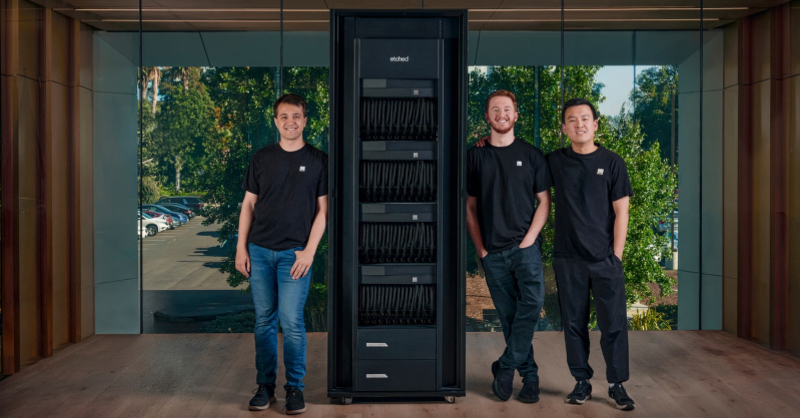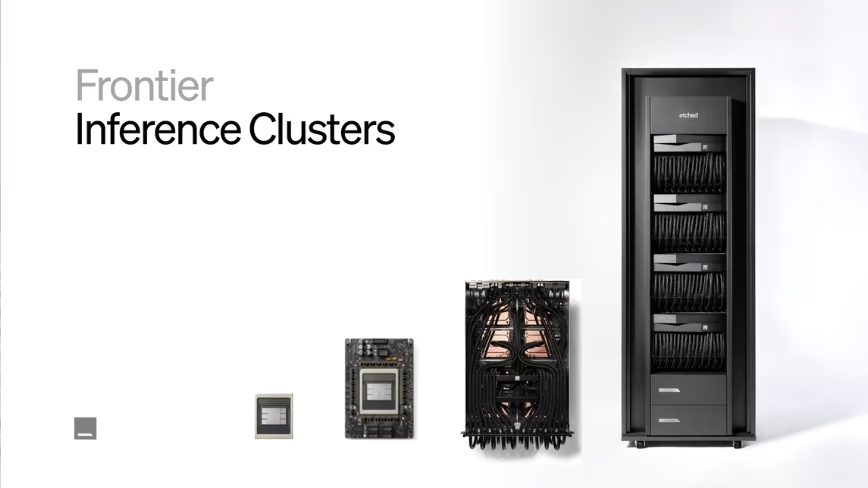
Key Highlights● Etched has raised $1.9 billion in total and quadrupled its valuation in eight months, from $5 billion in December 2025 to $21 billion in August 2026About The AuthorAt heart, I am a storyteller drawn to the watershed moments that bend the technology landscape. I braid narrative with data, humanise statistics, and trace the arc from first spark to world-changing impact. My reportage, features and reviews are witty, sardonic, visual and vivid, using anecdote to illuminate rather than eviscerate.
As a technology journalist with over sixteen years of experience, I have travelled the world and the seven seas, covered every major tech conference worth its lanyard, chronicled the defining breakthroughs of the last decade and a half, and played a pivotal role in launching some of India’s most important technology publishing platforms across web, print and TV.
In my current role as Editor of Gadgets Now Studios, I bring that experience, instinct and editorial firepower to the table, with the mandate of scaling the brand to towering heights.
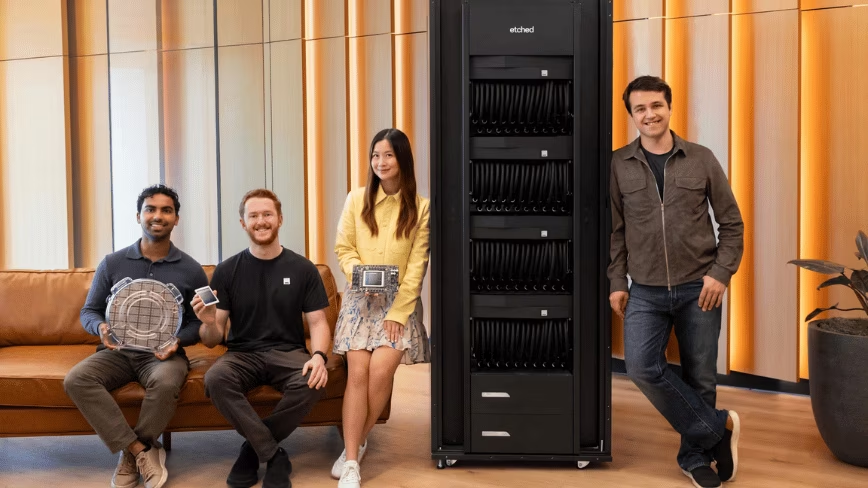
When I am off the clock, I am usually lost in music, from underground electronic and progressive rock to stone-cold blues. I am also an incurable F1 nut, a hangover from my previous life as an auto journalist, and always game for a jam session with friends, where I do my best to make my guitar gently weep.● Its A0 silicon worked on the first attempt from TSMC's N4P process, and ran inference workloads 44 days after the test chips arrived● The only performance number the company has published for its 2026 rack is a utilisation figure of 80 per cent or betterJane Street led a $700 million round on 18 August that values Etched at $21 billion, and Jane Street is also the only customer Etched has ever named. The company has shipped it one rack. Four years earlier, the servers that produced Etched's first chip design sat in the garage of an early employee, and when they froze, he telephoned his wife and asked her to walk out and press the reboot button. Between those two facts lie four years, $1.9 billion and a change of mind the company has left unexplained.Robert Wachen tells the garage story now from a San Jose office holding more than 400 people and a two-megawatt data centre. He had arrived in the Bay Area after telling his parents he was leaving Harvard. A friend's about-to-be-sold house gave him somewhere to stay, and a towel served as a blanket. "I remember staying in my friend's house that they were about to sell, using a towel as a blanket," he said this July, laughing about it. He has a mattress now, and pillows, and a company that investors marked up three times in eight months.The bet underneath all of it has changed shape twice, and a disclosure record this thin makes the change easy to miss. Etched has become one of the most valuable private semiconductor companies on earth while publishing two sentences of performance data.What Etched bet on in 2022, and what it said would happen if the bet failedGavin Uberti and Chris Zhu met in an undergraduate mathematics course at Harvard and left before finishing. Wachen, Uberti's roommate, followed them out. The wager the three made was narrow and total. They bet that the transformer, the model architecture behind ChatGPT and Gemini and Claude, would hold long enough to justify burning it into silicon for good. A general-purpose GPU spends most of its transistors on flexibility, and Etched proposed to spend almost all of its own on one algorithm and live with the consequences.More articles by AuthorTrending StoriesUberti stated those consequences in a 2024 interview with a clarity most founders spend careers avoiding. "If transformers go away, we'll die. But if they stick around, we're the biggest company of all time." Investors have been pricing the second half of that sentence ever since.The company's own website said the same thing in colder language. "If transformers are replaced by SSMs, RWKV, or any new architecture, our chips will be useless." The chip, then called Sohu, would refuse convolutional networks, recurrent networks, recommendation models, protein-folding systems such as AlphaFold 2, and Stable Diffusion 2. Etched published that list of refusals, which is a rare thing for a hardware company to do, and it published the list because the refusals were the product. Stripping out the control logic freed the die for maths units, and those units were the source of the claimed twentyfold advantage over an H100.Picture a Formula 1 car built and tuned for a single circuit on the calendar. Suspension geometry, aerodynamic surfaces and gear ratios all resolve towards Monaco, and every one of them becomes dead weight at Monza. That car will beat anything at Monaco. Every investor who looked at Etched between 2022 and 2024 was asking one question: whether the calendar would keep returning to Monaco.How three Harvard dropouts talked their way to $103 millionThe seed round closed in spring 2023 at about $5.36 million, led by Primary Venture Partners, and it valued the company at $34 million. That money bought a runway which expired well before the chip did. By late 2023 the founders had worked out what a tape-out would cost and understood the answer to be around $100 million for the following twelve months. At that moment the largest Series A rounds in semiconductors were landing near $40 million to $50 million. They spent about a hundred hours writing a thirty-page memo covering the milestones, the market evolution, the new workloads and the cost per token.Every major investor on Sand Hill Road passed at once, and the reasoning was consistent. Two people who had just left Harvard with zero taped-out silicon behind them made a poor place to park nine figures. What followed is the part Wachen and Uberti now tell with little polish. They sat in the Cupertino office late at night working out which half-million they could cut, then which hundred thousand, then how long everyone would keep working with a deferred salary. Uberti has said he started looking up how difficult it would be to return to Harvard.Money began arriving in small pieces instead: a million, then two, then a five-million cheque, then ten. At the board meeting the spreadsheet of soft commitments totalled $103 million, and the founders took it. The June 2024 Series A came in at $120 million, led by Primary with Positive Sum alongside. It brought Peter Thiel, Replit's Amjad Masad, GitHub's Thomas Dohmke and Cruise's Kyle Vogt onto the cap table. Etched has withheld the valuation attached to that round ever since.Wachen's conviction has an origin that predates the company by years. At the end of his sophomore year of high school he was told that a lump on his back was stage-four bone cancer, with survival odds under 30 per cent. Two years of chemotherapy, surgery and relearning to walk followed. When GPT-4V arrived with image understanding, he found the photograph he had taken of his own back before the diagnosis. He described the symptom to the model and asked what it might be.The model said tumour, said get an MRI, said see a doctor. His own medical system had taken six months to reach the same place. He has described sitting still afterwards, and what he took from it was a calculation about cost: every product he wanted to build would run tens of millions of dollars a year in inference, and inference was the one workload lacking purpose-built hardware. That calculation became the company's founding premise.What the founders are, and what the website claims they areUberti's best-documented credential is the one his company mentions last. He is a committer on Apache TVM under the handle guberti, credited in the project's own December 2022 announcement as a prolific microTVM contributor working on complex performance issues with well-tested and documented patches. His industry biography describes leading a rewrite of the Cortex-M convolution kernel and reaching state-of-the-art results with it on MLPerf Tiny. He wrote matmul kernels at OctoML before that, and interned at Xnor.ai at seventeen.Etched's website opens his entry with a louder claim, calling him a world math champion. Public records for such a title stay absent, and the competition, the year and the placing all remain unnamed. Invited on a podcast this June to talk about the high-school competitions he had won, Uberti described robotics rather than mathematics. He recalled a two-person FIRST Tech Challenge team and a world-record score, and the maths title went unmentioned.Zhu's mathematical record, by contrast, holds up on inspection at every point. He published a sole-authored combinatorics paper on arXiv in October 2019, on permutations and rim hooks characterised by double descent sets, and reached the finals of the Yau High School Science Award for the USA region while still at school.A second oddity on that leadership page concerns Zhu's own role inside the company. Every other person listed holds a functional title, and Zhu appears as co-founder and stops there. An older recruiting write-up gave him the title of director of compilers. He is absent from this year's funding coverage as a spokesman, which for a technical co-founder at a company defined by its compiler stack is a gap the company has left open.What low-voltage inference does, in plain termsModern AI chips share an awkward secret about their own specifications: push utilisation towards the advertised peak and the chip draws more power, heats up, and drops its own clock speed to survive. Sustained throughput then lands well under half the number printed on the box, and the gap between that box and the rack decides inference economics.An engine on a dynamometer makes its headline figure for thirty seconds, and an engine that wins a Grand Prix makes a lower figure for two hours while the driver stops lifting and coasting to hold temperatures down. Low Voltage Inference, the first of Etched's two claimed inventions, is an attempt to build the second engine, because Etched wants the race pace rather than the qualifying lap.The company says it runs its maths blocks at under half the voltage of a typical AI chip, and since power scales with the square of voltage, halving voltage cuts power to a quarter. That headroom buys transistor density, density buys maths units, and Etched says the result holds trillion-parameter sparse mixture-of-experts models at 80 per cent or better of peak FLOPs while keeping temperature in hand.Uberti's argument for why this is achievable rests on an industry that solved the same problem for money rather than for tokens: bitcoin mining chips run at a fraction of the voltage of AI accelerators, because in mining the only currency that counts is work per watt. Etched's claim amounts to importing that discipline into a market whose specification sheets have rewarded peak numbers over sustained ones for a decade, and mining hardware also enjoys a target that stays still, which transformers have yet to offer anyone.Watch what happened to the figure between 2024 and 2026: the Sohu-era claim was more than 90 per cent FLOPs utilisation against about 30 per cent for GPUs, and the 2026 claim is 80 per cent or better. Silicon met a thermal budget somewhere in between, which is the usual outcome when a simulation becomes a rack.How cluster-scale memory attacks the delay in every answerAn AI system answers a prompt in two movements, and they stress a machine in opposite directions. Prefill is reading: the system ingests the prompt and its context, and the work is dense in maths. Decode is writing: the system produces the answer one token at a time. Every token requires fetching model weights and cached attention state, which makes that half of the job dense in memory. Both halves run on the same silicon, which is where the trouble starts.Decode is where interactivity lives, and decode is where delay accumulates. Each layer of memory a chip must reach through adds time to every token. A chip with fast on-die SRAM has almost zero delay and a fraction of the capacity. A chip with HBM has capacity and a longer walk to reach it. Serving a large mixture-of-experts model makes this harder still, because routing a token to the right expert can mean crossing a network switch to another chip altogether.Picture a DJ booth on a busy night, mid-set, with the floor full: twelve records sit within arm's reach and come up at once, and the rest of the collection lives in a back room, where every trip costs the mix its flow. Cluster Scale Memory, the second claimed invention, rebuilds the booth so that every deck in the room shares one crate, because Etched wants the whole collection inside arm's reach.The company describes a hybrid SRAM and HBM subsystem bound by a proprietary interconnect, built above the second layer of Ethernet, pooling memory across a whole scale-up domain. Uberti has said the approach cuts chip-to-chip latency by better than a factor of five, which lets one chip use a neighbour's memory as though it sat on the same die.Should the claim hold, it dissolves a trade-off the industry has treated as physics: Cerebras chose enormous SRAM and accepted the capacity ceiling that comes with it. Groq chose SRAM arrays and accepted the same bargain, and everyone building on HBM accepted the walk instead.Why the transformer-only chip stopped being transformer-onlyEtched's press release of 18 August says its clusters are "already running massive MoE models and non-transformer designs", and the July release named Mamba, a state-space model. Set that against the company's own 2024 statement, which said state-space models would render its chips useless, and the two positions sit at right angles, with a bridge between them yet to appear.The reconciliation Etched has available is straightforward, and it has declined to make the argument out loud. The 2026 part is new silicon, taped out on TSMC's N4P process this year, built around Low Voltage Inference and Cluster Scale Memory, and it may share little with the 2024 design beyond a founding team. Etched has stayed silent on the relationship between the two chips. One sentence from the company would settle it.What the company has done instead is remove the evidence from view. The page at etched.com/announcing-etched, which carried the 2024 claims, now resolves to a 404. The current sitemap holds twelve URLs and a Sohu page is absent from all of them. The word Sohu has vanished from the homepage, the media kit and all three progress posts, and the last confirmed use of the name by Etched or a named partner was a Rambus blog post in June 2025, written to mark the memory-controller IP that Rambus supplied. Trade coverage still calls the product Sohu, because journalists carry names forward. The company has stopped.Trademark filings tell the same story from a different angle altogether: Etched AI holds four filings with the US Patent and Trademark Office, being two ETCHED word marks from December 2023 and two image marks from October 2025. A SOHU mark is absent, and so are marks for Low Voltage Inference and Cluster Scale Memory, the two technologies the company now says carry its product, which matters because a company registering a mark intends to keep the name.Google reached the same fork in the road and has documented which way it turned. Reporting in July described a Google server chip called Frozen v2 that would etch part of Gemini's architecture into silicon, with engineers projecting six to ten times the tokens per watt of the newest TPUs and deployment as soon as 2028.The original Frozen concept would have baked Gemini's weights into the transistors, and Google abandoned that version because silicon tied to a single model release would have too short a life. It froze the architecture and left the weights updatable, which is about where Etched has arrived four years and $1.9 billion later, having started at the harder end of the same idea.How Etched went from $5 billion to $21 billion in eight monthsPlate 1 Valuation against shipped product, April 2023 to August 2026. Each step is a post-money figure from a funding announcement; milestones count only events the company has stated and dated.DateRoundAmountValuationLeadSpring 2023Seed$5.36m$34mPrimary Venture PartnersJune 2024Series A$120mUndisclosedPrimary Venture PartnersDecember 2025Series B$500m$5bnStripesJuly 2026Series C$300m$10.3bnSequoia CapitalAugust 2026Unnamed$700m$21bnJane StreetThree further financings, closed between June 2024 and December 2025 and totalling about $300 million, remain undisclosed as to date, size and lead.Etched gives a cumulative figure of $1.9 billion, and the ladder above explains how it gets there. When the company exited stealth on 30 June it described "$800M across four unannounced financings", a phrase that excludes the seed and the Series A because both had been announced. Add the announced $125.36 million, the July $300 million and the August $700 million, and the total lands at $1.925 billion. Three of those four unannounced rounds sit outside the public record altogether, and Etched has withheld their dates, their sizes and their leads.Every step of the ladder moved valuation faster than product. Etched was worth $5 billion in December, $10.3 billion in July and $21 billion five weeks after that. Those steps amount to a quadrupling in eight months and a doubling in a month. Sequoia's July round was described as the highest valuation the firm has ever led at Series C. Between the July markup and the August markup, the verifiable change in the company's position was the delivery of one rack to one customer.That single customer requires some care in the telling of it. Jane Street led the $700 million round, having already put more than $100 million into Etched before it, and having participated in the July Series C. Jane Street is the first customer, the only named customer, and the source of the only endorsement Etched has published: "We tested the chip and are pleased with the early results." Three other proprietary trading firms — Hudson River Trading, Jump Trading and Two Sigma — sit on the same cap table, and Etched's VP of Finance arrived from Two Sigma Securities.All of that can hold at once, and the structure still means the markup and the milestone came from the same balance sheet. Quant firms are a rational first market for low-latency inference, since a trading desk values a millisecond in a way few buyers do. Jump Trading also backs Positron AI, an inference rival that raised $230 million in February at above $1 billion, ships a product called Atlas today, and claims five times the tokens per watt of Nvidia's coming Rubin GPUs. The same money is hedged across the thesis rather than concentrated in one bet on it.What Etched has published about performanceThe quantitative disclosure for the 2026 product runs to two statements. The systems hold 80 per cent or better of peak FLOPs, and the maths blocks run at under half the voltage of most AI chips.Everything else remains unpublished: tokens per second for the rack, FLOPS per chip, memory capacity, memory bandwidth, rack power draw, price, cost per token, latency, and any named model at a named batch size. On 30 June the company wrote, "We'll be sharing more updates on our performance and roadmap this summer." Two publications have followed, the July round and the August round, and both carry a valuation and zero benchmarks. Summer ends next month.The silence extends well past the company's own publishing channels. MLPerf's submitter lists omit Etched; the v6.0 results of April 2026 name 24 organisations, among them AMD, Google, Intel, Nvidia and Oracle. Hot Chips ran at Stanford from 23 to 25 August, and Etched attended as a Rhodium sponsor. Cerebras presented its rack-scale wafer architecture there, SambaNova presented the SN50, Microsoft presented Maia 200, Google presented its eighth-generation TPU and d-Matrix presented 3D-DRAM inference. Etched bought the logo placement and presented zero papers.Technical objections raised against Sohu in 2024 have gone unanswered rather than answered. Independent analysts pointed out that Sohu's estimated 4,800 GB/s of HBM bandwidth sat about 1.4 times above an H100's 3,350 GB/s, a margin that struggles to produce a twentyfold result in a memory-bound regime. They pointed out that the key-value cache for a batch of 1,000 sequences at 8,192 tokens of context would require about 1,280 GB against the 1,152 GB an eight-chip Sohu pool provided. They pointed out that a chip optimised for enormous batches trades away the latency that makes an assistant feel responsive.Even the 2024 memory specification remains contested to this day. Contemporary trade reporting described 144GB of HBM3 across six stacks, while several later accounts say HBM3E. Etched has changed its architecture since, and it has published zero data that would let anyone check whether the objections still bite. The distinction matters, because HBM3E carries higher bandwidth than HBM3 at the same capacity.Why Nvidia became the harder problem, and did so in DecemberEtched spent four years preparing to attack a company that made general-purpose chips. On 24 December 2025 that company stopped being only that. Nvidia paid a reported $20 billion for Groq's inference technology and its leadership in a non-exclusive licensing deal, its largest transaction on record, and Jensen Huang was explicit that Nvidia had bought the IP and the people rather than the company. Groq had raised about $1.7 billion and carried a $6.9 billion valuation three months earlier.Groq's product was the closest thing in the market to the differentiation Etched now claims: SRAM-based accelerators built for low-latency token generation. At GTC in March, Rubin CPX, Nvidia's own prefill-phase accelerator, vanished from the roadmap slides, and Groq 3 LPUs and LPX racks took its place. On 24 August, at Hot Chips, Nvidia announced Groq 3 LPX in full production, with Nebius as launch customer. Eight months carried that technology from deal to production.Each LP30 carries 500 MB of SRAM at 150 TB/s and 1.2 FP8 petaflops, and a rack holds 256 of them for 315 FP8 petaflops, 40 PB/s of SRAM bandwidth and up to 160 kW. Nvidia quotes 3,400 output tokens per second on a 31-billion-parameter model at 100,000 tokens of context, benchmarked by a third party, and up to 35 times the inference throughput per megawatt of a GB200 NVL72 on long-context work.The architecture it now ships is disaggregated the same way Etched describes: Rubin GPUs handle prefill, LPUs handle decode, and Dynamo orchestrates between them. Every one of those numbers sits on a public product page, where a buyer can hold them against a rival's.Sheer scale sharpens the comparison beyond anything architecture alone can settle: Nvidia reported data-centre revenue of $89.0 billion for the quarter ended 26 July, up 117 per cent year on year, and guided to $108 billion for the current one. Etched's shipped racks, taken together, number one, and one of those two companies is booking the packaging capacity the other one will need.Who else is already in the roomCompanyPosition, August 2026Google TPU v7 Ironwood4,614 FP8 TFLOPS, 192GB HBM3E, 9,216-chip pods; Anthropic committed to up to one million TPUsAWS Trainium32.517 PFLOPS FP8, 144GB HBM3E; over one million Trainium chips deployedMeta MTIAHundreds of thousands deployed; MTIA 400 at 6 PFLOPS FP8, 288GB HBMMicrosoft Maia 200TSMC 3nm, 140bn transistors, 216GB HBM3E, serving GPT-5.2 for OpenAICerebrasPublic since 14 May 2026; raised $5.5bn, 2025 revenue $510mGroqInference IP and leadership licensed to Nvidia for a reported $20bnTaalasAcquired by AMD in August 2026 after raising $219md-MatrixCorsair in full production; $450m raised at a $2bn valuationBroadcom and Marvell together design about 95 per cent of the world's custom AI ASICs, and Broadcom alone carries a $73 billion AI backlog. Nvidia holds somewhere between 70 and 85 per cent of AI accelerators depending on the definition and the source, and research houses have published zero authoritative mid-2026 figures. Custom ASIC server shipments are forecast to grow 44.6 per cent this year against 16.1 per cent for merchant GPUs. Both facts describe one market from opposite ends.The rest of the independent field has spent eighteen months consolidating. AMD bought Taalas this month, a Toronto company hardwiring specific models into silicon and the closest analogue to Etched's founding thesis, after $219 million raised. Meta bought Rivos last October. Qualcomm was reported in June to be circling Tenstorrent at $8 billion to $10 billion, and Tenstorrent's chief executive denied the talks. SambaNova ran a sale process that ended with Intel taking a minority stake rather than the company, after BlackRock marked it down to $2.4 billion from a $5 billion peak. Groq itself raised $650 million in June and pivoted to running clouds.Supply is the constraint that pays least attention to ambition. TSMC's CoWoS advanced packaging is the bottleneck for every HBM-based accelerator on earth, and Nvidia has reserved 800,000 to 850,000 wafers of it for 2026, more than half the total, with Broadcom and AMD holding most of the remainder.Memory pricing tightens the position further still, and by a wide margin. DRAM contract prices rose 93 to 98 per cent quarter on quarter in the first quarter of 2026, HBM contract prices are forecast to rise more than 50 per cent again in 2027, and buyers holding long-term agreements are shielded while everyone else absorbs the increase. SK Hynix invested in Etched's Series C, announced zero supply agreements alongside it, and capital participation buys goodwill rather than allocation. Etched needs HBM from the same three suppliers Nvidia has already booked.The strongest case for Etched, made properlyThe bull case rests on things that have already happened rather than things that might, and it is stronger than the funding history alone suggests. First-pass silicon success is the hardest fact in this story and the one skated over most often. Etched received test chips from TSMC and had them running inference workloads 44 days later, on the first attempt, on a design new to the industry. Chip startups as a rule need two or three respins, each costing months and tens of millions, and Wachen's line about it is fair: this may be the only AI chip built by a startup that worked on the first try.Credentials on this team are checkable in a way that most founder claims resist. Mark Ross was chief technology officer of Cypress Semiconductor. Infineon later bought that company for $9.4 billion in equity value, and for around $10 billion including debt. Brian Loiler spent 22 years at Nvidia building the HGX and DGX systems, joined in 2024 and then recruited about a dozen Nvidia engineers behind him. Saptadeep Pal worked on the H100, A100 and V100 architecture teams, co-founded Auradine and holds a UCLA doctorate with a publication record on waferscale memory stacking that matches what Etched says he does.Vertical integration is the part that rivals find hardest to copy at speed. Etched runs its own data centre, a test house and a prototyping lab inside the San Jose office, and it leased 80,000 square feet in Milpitas this summer in one of Silicon Valley's largest research leases of the year.A Taiwan factory staffed by a few dozen people runs a clone of the San Jose test stations, so hardware work continues while California sleeps. Etched designs the racks, boards, cold plates and interconnects rather than buying them, which sets it apart from every other chip startup of its age.The market thesis behind all of this has aged better than the valuation. Inference now accounts for around two-thirds of AI compute, and every argument for a TPU is an argument for the category Etched sits in. The counter-argument is that hyperscalers build their own, which leaves Etched selling to everyone else, and everyone else on current evidence means trading firms, sovereign clouds and the frontier labs willing to run a second software stack. That is a real market, and a smaller one than the headline numbers imply.Exits in this category have arrived faster than most people expected. Groq's IP went for a reported $20 billion, Cerebras listed in May and closed its first day at a $66 billion market capitalisation, and AMD paid for Taalas this month. A $21 billion private mark on a company with working silicon and $1 billion of signed contracts is aggressive, and against those comparables it is arguable. Investors pricing Etched are pricing that comparison set rather than a benchmark.The six months a dozen engineers spent in BangaloreOne supplier ran far behind schedule, and Etched's response says more about how the company operates than any architecture diagram. The team worked out that the vendor's engineers were all in Bangalore, and shipped a dozen of its own best people there for six months. They walked in each morning as the first ones through the door, audited a large volume of the code going in, and built tooling to speed up the rest. Two handovers a day, at 8am and 8pm, gave the programme a 24-hour development cycle across two time zones.That is the least glamorous passage in Etched's history and likely the most instructive. Chip schedules slip on the vendor sitting outside your building, and the fix arrives as people on aeroplanes rather than money on a term sheet. The company website lists San Jose and a Taiwan factory, and stays quiet about Bangalore. For a company whose public face is two founders in their twenties and a valuation chart, the operating reality looks closer to a contract manufacturer than a software startup.What settles thisThe bet Etched made in 2022 was specific enough to be wrong in public, and the company has spent 2026 widening it until it can survive being right about less. That is prudent engineering and awkward storytelling, and Etched has chosen to manage the awkwardness by deleting the page rather than explaining the change.What remains is a company with first-pass silicon, a team assembled from the people who built the systems it wants to displace, a customer who is also its lead investor, and a single published percentage standing in for a specification sheet. Every rival named in this piece put numbers in front of the world's chip architects at Stanford last week, and Etched put a logo on the wall. The gap between those two acts is the whole question, and closing it costs little beyond a willingness to be measured. Etched has the hardware and withholds the numbers.Uberti's 2024 formulation still governs the outcome, and it is worth taking him at his word. He said the company would die if transformers went away and become the biggest company of all time if they stayed. Transformers have stayed put. The rest of that sentence awaits its first test, which arrives whenever Etched decides to publish a number somebody outside the building can check. FAQsWhat does Etched actually make?Etched builds rack-scale AI inference systems it calls frontier inference clusters. It designs the chip, the racks, the boards, the cold plates and the interconnects together, and sells the finished system rather than a component.How much is Etched worth and how much has it raised?Investors valued Etched at $21 billion on 18 August 2026, after a $700 million round led by Jane Street. Total funding stands at $1.9 billion across a seed, a Series A, a Series B, a Series C and several undisclosed rounds.Does the Etched chip only run transformer models?It did originally. Etched said in 2024 that a shift to state-space models would render its chips useless. Its 2026 systems run mixture-of-experts models and non-transformer designs including Mamba, which is a state-space model.Has anyone independently benchmarked Etched hardware?No independent benchmark exists. Etched has published one performance figure for its 2026 product, has never submitted to MLPerf, and sponsored Hot Chips 2026 rather than presenting there.Who buys Etched systems?Jane Street is the only customer Etched has named, and it took delivery of the first rack. The company says it holds over $1 billion in signed contracts across frontier AI companies and clouds, and has identified none of them.How does Etched compare with Nvidia on inference?Nvidia licensed Groq's low-latency inference technology for a reported $20 billion in December 2025 and put Groq 3 LPX into full production this month. Nvidia publishes rack specifications and third-party benchmarks; Etched publishes neither yet.end of article