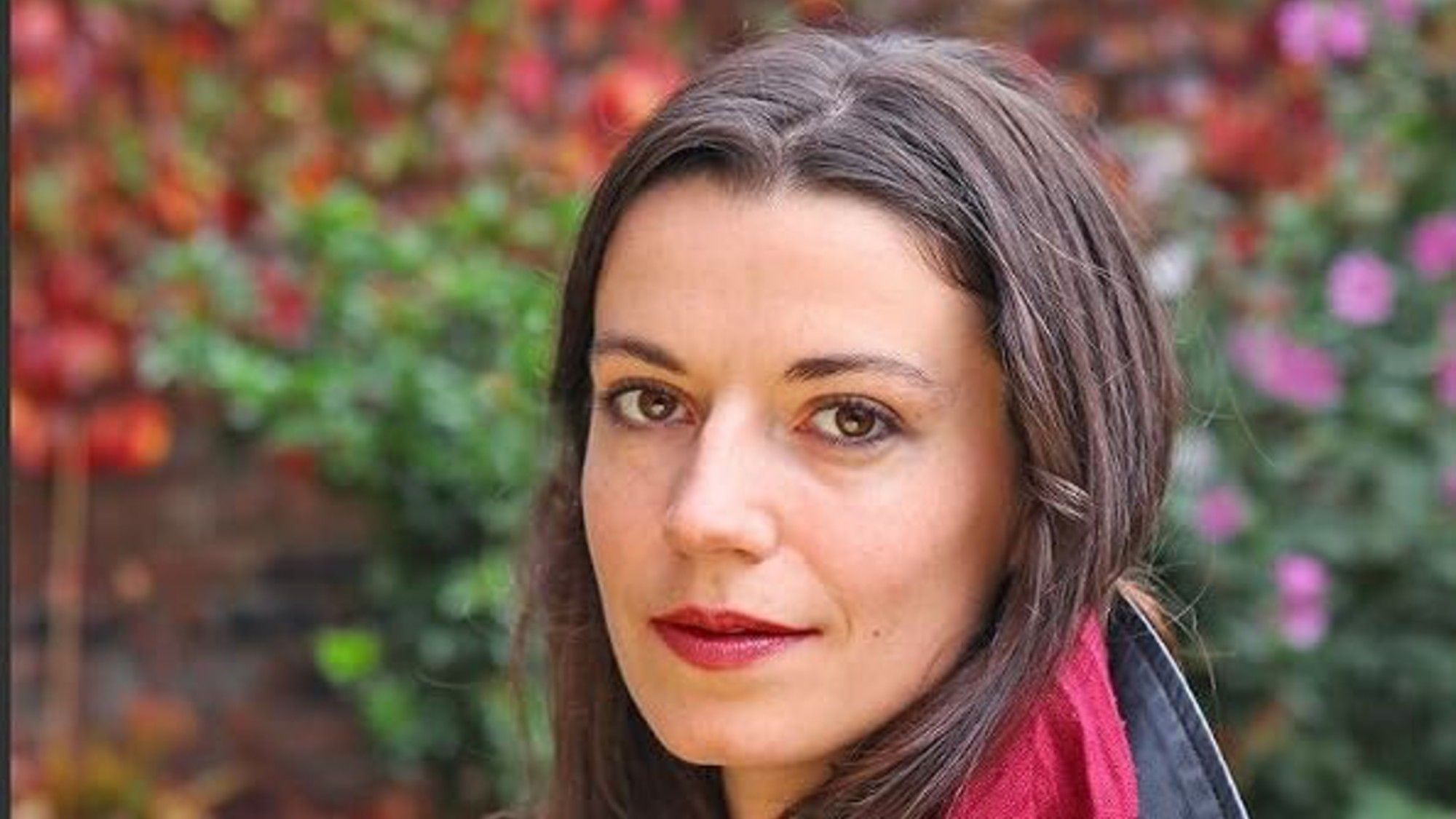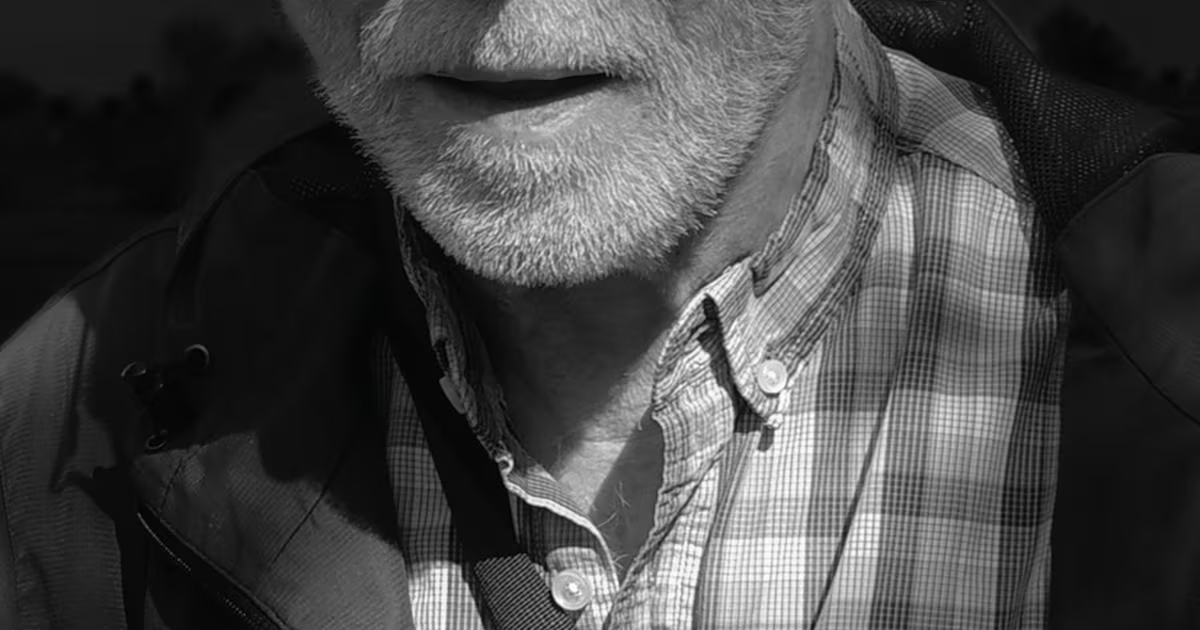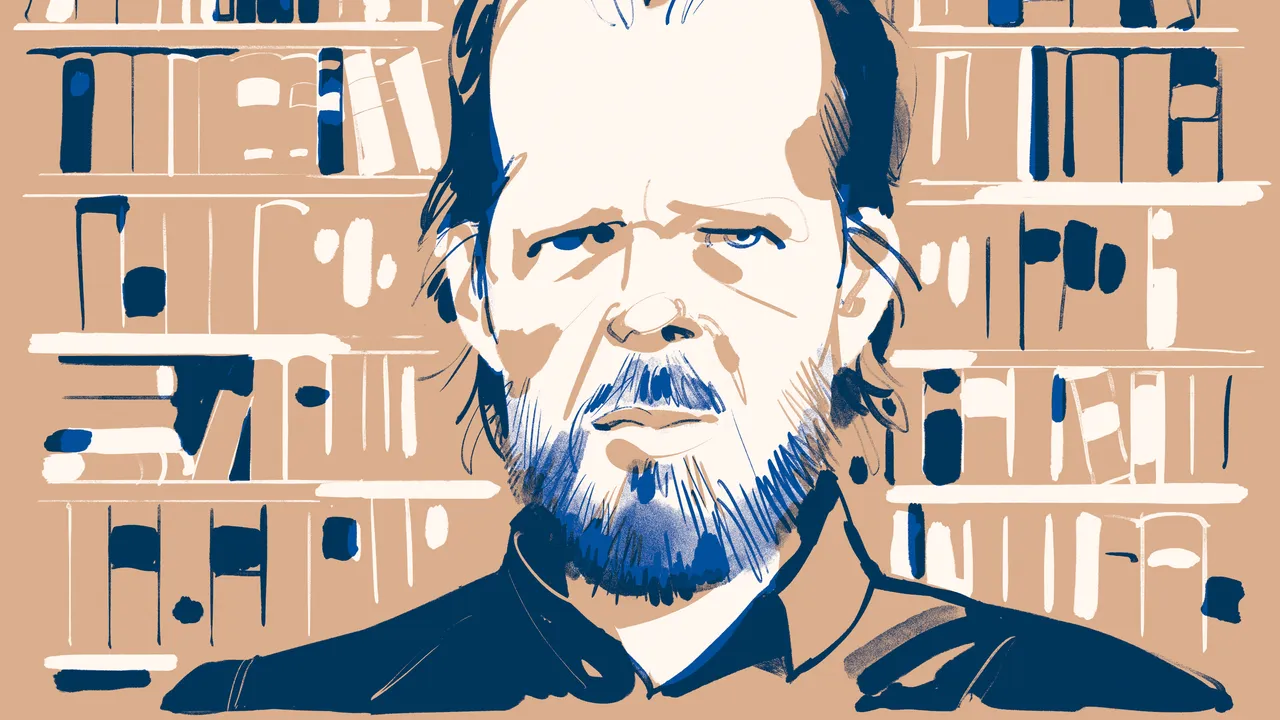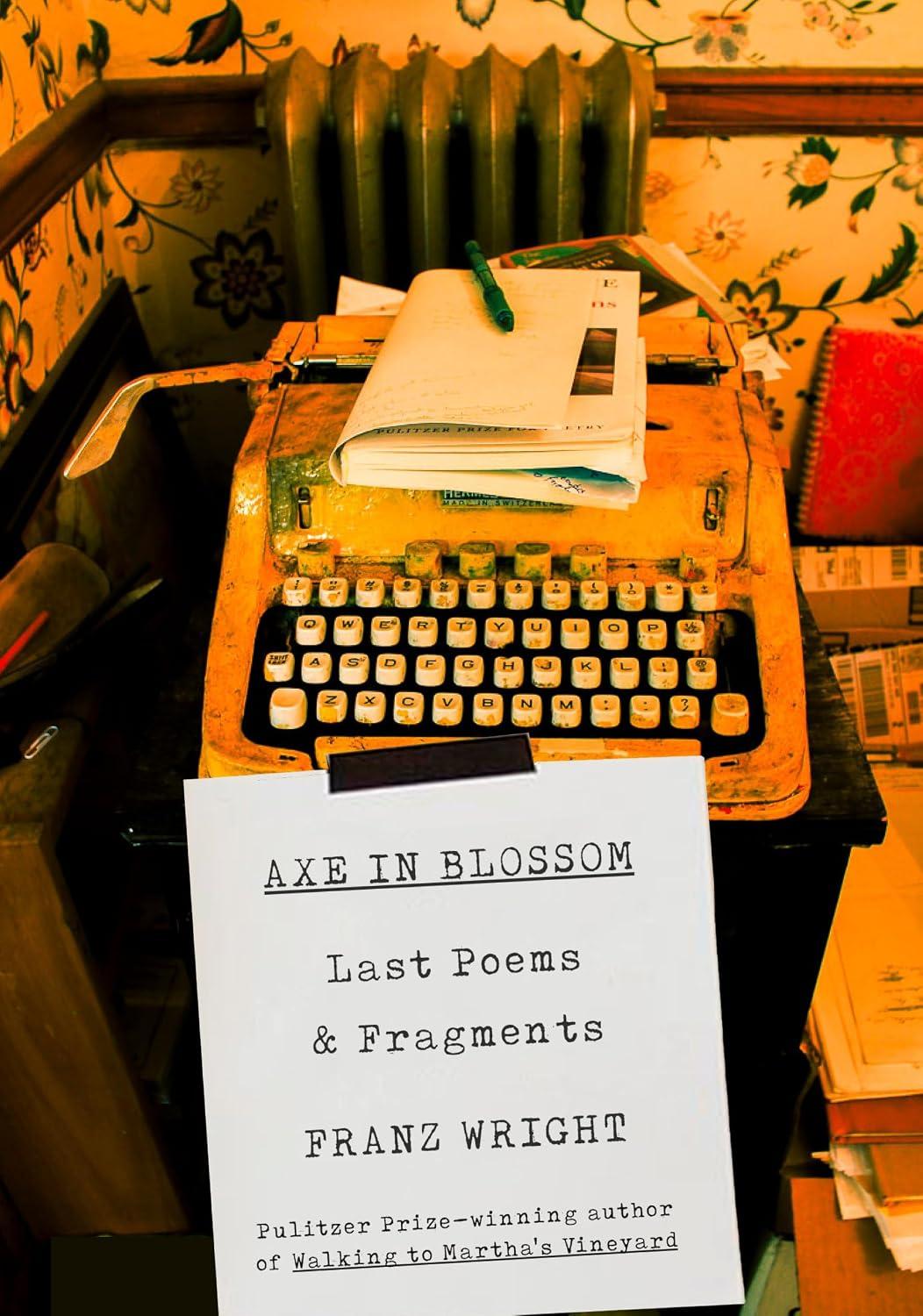
The final collection from one of contemporary poetry’s essential voices.Axe in Blossom: Last Poems & Fragments by Franz Wright. Knopf, 2026. 160 pages.Did you know LARB is a reader-supported nonprofit?LARB publishes daily without a paywall as part of our mission to make rigorous, incisive, and engaging writing on every aspect of literature, culture, and the arts freely accessible to the public. Help us continue this work with your tax-deductible donation today!A FRANZ WRIGHT POEM breaks into silence. Each poem in Axe in Blossom: Last Poems & Fragments (2026) brings with it a fragment of the unspeakable, a language for feelings so extreme they cannot be expressed. I think of Joan of Arc’s cryptic response to her inquisitors just before she was put to death: “The light comes in the name of the voice.” Written in the face of his own death, Wright’s posthumous collection beckons the divinely untranslatable: “I love to sleep when it is raining no meaning and the name of no meaning and the meaning of having no name.” In a recent conversation with Bianca Stone on the Ode & Psyche Podcast, Elizabeth Oehlkers Wright (editor of this collection, translator, and Wright’s wife) describes the poet’s phases of verbal floods so overwhelming that he prayed not to be able to speak. In turn, he was also prone to extensive phases of silence. Axe in Blossom is Wright’s final break into his final silence.Wright has always been a poet of extremes, of the tortured psyche. His poems urgently convert obsession into devotion. His speakers stand outside themselves (the etymology of ecstasy) and wrestle within themselves (the etymology of agony). Written from the realms of mental illness, addiction, religious conversion, and a weighty poetic lineage (his father is the poet James Wright), these poems confront life and death in the ordinary, gritty, and domestic. Feeling cold is anguishing. Turning off a lamp, sublime. Death dominates much of Franz Wright’s writing as both terror and temptation, but in these late poems, there is a graceful, and often playful, surrendering. Axe in Blossom haunts us with the almost-silence of a poet almost no longer haunted.In a postscript, Elizabeth Wright provides valuable insight into Franz Wright’s late process, noting that he spontaneously recorded and revised many of these poems on tape. Wright himself referred to his late poems as “Unfinishables,” which the editor describes as work both “once-abandoned” and “once-finished.” Many of them take up the work of earlier poets, such as René Char, Rainer Maria Rilke, Issa, and Bashō. More radically, Wright pillages his own work, reusing lines in new contexts. The phrase “axe in blossom” is one of these, variously repeated throughout the collection. The purpose of such repetition is not to expand meaning but to escalate intimacy—a mouth-to-mouth resuscitation, a love affair. In her conversation with Bianca Stone, Elizabeth Wright describes her husband’s practice as “translating his own work into the present […] to hear the heartbeat.”The second section in the collection comprises a “real” translation of an unfinished poem by Rilke—but how does a poet translate himself? Several poem titles appear twice in the collection (“The Writing,” “The Kiss,” “In One Face”), one in prose, the other lineated verse. Sometimes the doubles show up beside each other, but often not. Rather than “avoiding repetition across the two versions,” Elizabeth Wright notes that the poet was more interested in moving back and forth between “each form’s inherent tendencies.” Even within a single poem, one senses Franz Wright translating conflicted internal voices, bringing them as close as they will go, into one singular voice.From his debut full-length collection in 1980 (The Earth Without You) to the 2013 publication of his last book (F), Wright’s voice stands out as one of the most consistent and recognizable in contemporary poetry. His jagged forms pace shamelessly across the page. Langdon Hammer refers to his characteristic lineation as Wright’s “calculated unsteadiness.” This crafted rawness complements a conversational existentialism, daring us to step into uncharted, sometimes dangerous, patterns of thoughts. At the crossroads of plainness and strangeness, Wright moves between polarities: earnestness and irony, forgiveness and self-loathing. What allows us to keep up with such leaps is the pressure Wright applies to each word, torquing the simplest diction into a deep image, uncaging a cliché with unpredictable syntax. Starlight becomes a “masterful massé of starlight.” The commandment “Love thy neighbor” becomes “Love your neighbor. Love your stranger. Stranger, love your life.” This is not just linguistic prowess. It is also intimacy strangled into estrangement. To borrow a title from another poem, Wright’s poetry operates via the “systematic derangement of the senses.”The book’s final section, “Appendix: Burial Herbs,” is an amalgam of such derangements, bringing one-line aphorisms (“my whole allegiance is to the unwritten poem”) together with multipart drafts. In one longer poem, “At His Desk in the Past,” Wright repeats “it’s raining in a dead language,” a line originally written by Karl Krolow (which Wright envied since he was a student at Oberlin). With each repetition, Wright takes the line apart, then forces it back into blossom. We may read the repeated title phrase “axe in blossom” as an apt metaphor for the wielding of the poetic line, his own or another’s.The title Axe in Blossom also echoes a famous poem by Wright’s father: “[I]f I stepped out of my body I would break / Into blossom.” More than an homage, this, too, reads as a kind of translation. It is commonly noted that Franz and James Wright are the only parent-child pair to win the Pulitzer Prize for Poetry. The younger Wright won for his 2003 collection, Walking to Martha’s Vineyard, which is many a poet’s slimmest bible, myself included. He often recounted knowing he was a poet through his distant father’s recognition: “I’ll be damned. You’re a poet. Welcome to hell.” Figures of absent fathers and abandoned children haunt Wright’s oeuvre. The poems speak as much to a human father as to God, as much to his lonely childhood as to us strangers.The poem “Finisterre,” the title of which translates to “the end of the earth,” asks: “Was I ever a child? / I can’t remember a thing!” The speaker goes on to recall his only memory: “accidentally cutting my finger / and watching / the impressive gash healing / before my eyes.” On the edge of death, Wright’s original wound comes into view. If most of his poems open the wound unabashedly, here he witnesses its mysterious healing. Reaching toward the afterlife makes a visitation to childhood possible. In “Jamais Vu” (a play on déjà vu), the speaker considers returning as a ghost: “I think for a while I’ll return / as a guest / to a childhood room.” In the italicized proem or prologue poem, a strained paternal figure is our first figure of speech: “The unanswering / cold, / like a stepfather / to a silent / child.” The poem commands in fragments: “Wait. // The steplight.” The not-quite-real father becomes a portmanteau for “what passes for light.” Like the silent child, the poet must wait for the late light and its inevitable (fatherly?) abandonment:The light that’s alwaysleaving—instantaneousvoyager as it arrivesIn a Wright poem, the metaphysical usually comes with a wicked dose of self-deprecation. In “Omitted,” the first poem of section one, Wright proposes a metaphor for the future: “three lbs / of haunted / meat.” The precise, mundane weight of meat is made metaphysical by one mere adjective, “haunted,” just before it becomes too physical. Elsewhere, Wright treats death as nonchalantly as a painkiller: “My death is in the second drawer. // While you’re standing there would you mind getting me one?” He invites us to smirk at dying. A later domestic gesture in the poem “Heaven” (“I’ve packed / and have nothing to do / but switch off the lamp”) swerves into a blizzard of the living, before closing the frame with a temporal paradox:I’m packed and have nothing to dobut lie down and look at the snow.Which is somethingI am good at,something I enjoy.Probably, I’ll die like thisa long time ago.While death must be expected, describing the experience of death remains impossible. Sometimes words themselves must carry their own failings: Wright often doubles or triples up on negations or invents back-bending neologisms such as “undisobeyable.” These maneuvers from the mind’s haunted playground are a nod to apophatic language, the religious practice of “unsaying.” What word is right enough for God? And yet we pray.The poet famously sent a scrap of paper to Alice Quinn, the former poetry editor of The New Yorker: “Pray for me,” it read. Wright’s tongue-in-the-dark irony is always touched through with earnest humility, as in “Dark Matter”: “[B]ehold, between one haircut and the next, I am become one of those I myself have shoved past a thousand times.” Merciless yet in search of mercy, Wright deflates the terror of mortality in a shocking knot of hypocrisy: “It’s nothing, nothing but the force you exert all your life to exclude it from your thoughts that confronts you, when it does arrive, as the horror of being excluded.” Many lines in Axe in Blossom reflect on his poetics with the gravity and grace of last words, the “sudden overshadowing // sense of the mystery in the presence / of the most commonplace / things and events in the world, world and word // one at last.” The taken-for-granted thing becomes a catalyst for awe. A passport without name, gender, or birth date records “only a plausible death day in green, beautiful wind-riffled grass-green.” The only known identification for travel is the unknowable. Green is not just the color of the ink but also a sign of ongoing life, not just the color of grass but also the way grass moves. In another poem, Wright plays with the “quatrain” of a name and address on a letter. Both a place in the city and a speech act, the address leads him to the resurrection: “And by the time I get there, I have risen from the dead.”Wright’s metaphors are best experienced as hallucinations. Writing the unspeakable requires showing us what’s not there: “[I]f only I could break these restraints which after all aren’t really there.” The syntax gives us the restraints before it takes them away. The verb break insists they are physical even once they are gone. In “Involuntary Detox: Smoking Porch,” the line “Consider yourself completely alone” is followed by a final monostich: “Green vesperal rain at the screen.” It is at the moment the poem empties that we receive the grace of an image: the “vesperal” rain turns the screened porch of a rehab facility into the boundary between self and world.Taken as a whole, the voices of Axe in Blossom have the quality of the nearly posthumous. The dead revisit the dying. A speaker furtively enters a room furnished for sickness, “the narrow bed, the sheets / the color of old aspirin.” In one of the strongest love poems in Axe in Blossom, “Everything Else Will Change,” the poet imagines the many ways the world will become unrecognizable in his absence. In lieu of condolence, he professes eternal commitment: “But look, we are still an us. / And I will never leave you.”Axe in Blossom confirms Wright’s unimpeachable place in contemporary poetry, a rare combination of insider reputation and outsider stance. Detoxing toward divinity, converting word into world on the page and in the back pew of a church, his poems don’t heal us, and perhaps this is why his readers are so devout. A Wright poem makes us feel desperately needed (“pray for me”) while sharing both blessing and curse: “You’re a poet. Welcome to hell.” Doubling agony over ecstasy and ecstasy over agony, Wright brings contemporary poetry to its knees.For every swerve in meaning made by a line break, for every image made exponentially other, the poet’s ultimate quest is for clarity. Both poems titled “The Writing” express a kind of deathbed dream: “He wished he could have been more clear, / it was all so clear to him. / So he was twice alone. / But he was also living twice.” Each poem in Wright’s oeuvre is a private act of survival we have accidentally walked in on—and these late poems, written in the face of death, pass down the axe.While a Franz Wright poem temporarily splits the mind, formally and existentially, it maintains what Helen Vendler once praised as his “stoic self-possession within the agonies and penalties of existence.” As much mystic as poet, Wright voices a radical fantasy of self-erasure: “I won’t have written this. / I won’t have written any of it. / I will have back the rights / of anonymity.” The poems in Axe in Blossom are written not to immortalize, but to release him from the authorial coil. Finally free not to speak, Wright has left us a flood of language—and it will never leave us.LARB ContributorElizabeth Metzger is the author of The Going Is Forever (2026) and Lying In (2023), as well as The Spirit Papers (2017), winner of the Juniper Prize for Poetry. She is a poetry editor at the Los Angeles Review of Books and teaches poetry at 92NY and Columbia University.ShareLARB Staff RecommendationsTwo Ships in TouchMaya C. Popa discusses distance, wonder, and the 19th-century love letters explored in her newest collection.Elizabeth MetzgerJul 14A Glutton for DurationDevon Walker-Figueroa discusses eros, eternity, and her new collection ‘Lazarus Species’ with LARB’s poetry editor Elizabeth Metzger. Elizabeth MetzgerFeb 10
Stranger, Love Your Life | Los Angeles Review of Books
The final collection from one of contemporary poetry’s essential voices.
2,245 words~10 min read