Cross-border electricity links increasingly add security and resilience value to their existing roles in markets, adequacy and renewable integration.
Support CleanTechnica's work through a Substack subscription, on Patreon, or on Stripe. Help us produce all of the high-quality, original content we publish week after week despite the challenges of content-scraping AI, antisocial media, inflation, and other hurdles.
Energy independence was an understandable slogan in Europe after Russia’s invasion of Ukraine sent gas and electricity prices through the roof. But it was also the wrong lesson. European countries had not erred by depending on one another. They had allowed too much of a critical energy supply to depend on one increasingly unreliable counterparty. The better objective is strategic energy interdependence: more trusted partners, more routes, more generation diversity and enough redundancy that losing one supplier or corridor is disruptive rather than destabilizing.
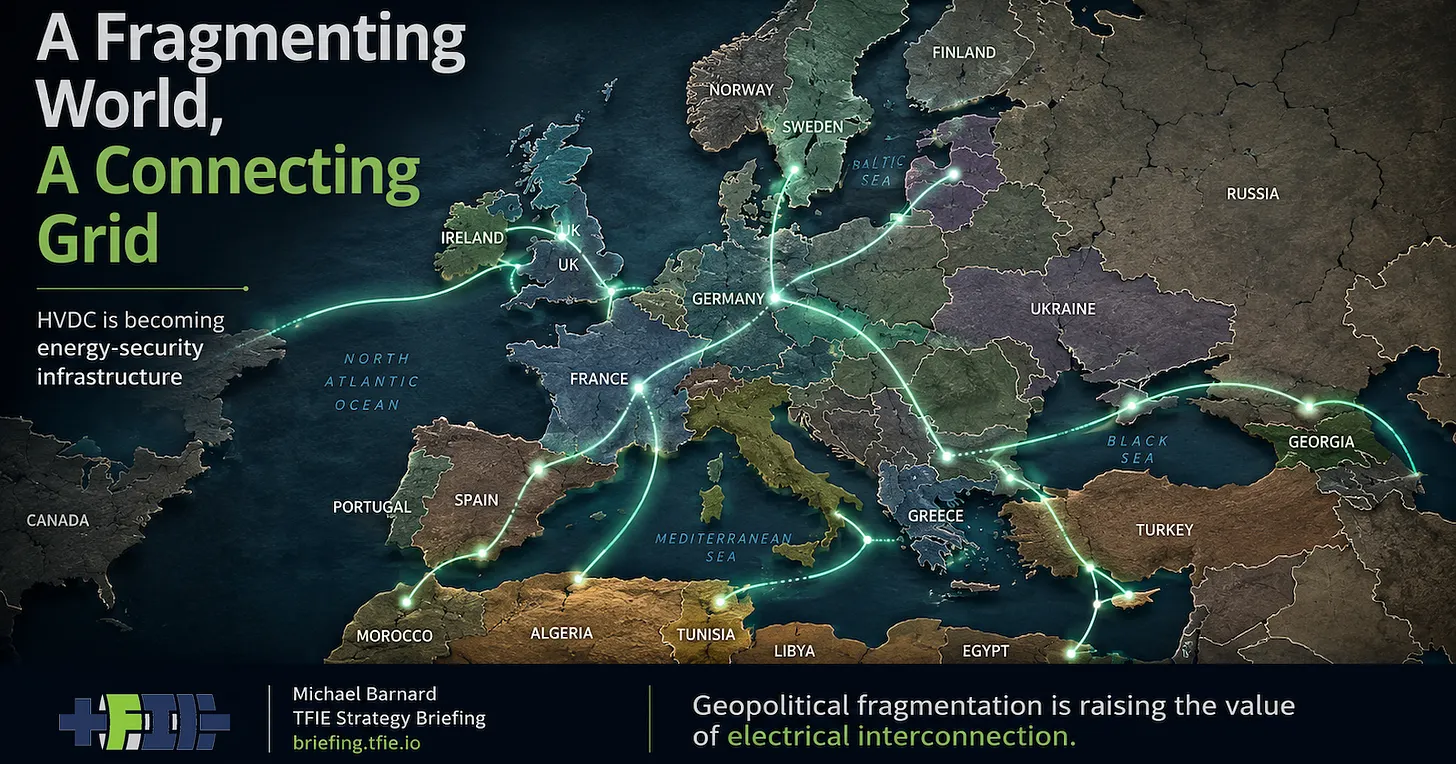
Four years later, the international HVDC pipeline provides a useful test. RTE International’s July 2026 inventory contains a substantial population of future voltage-source-converter projects, and filtering it for cross-national schemes produces about 60 prospective international links. Europe and its immediate neighbourhood dominate. If worsening geopolitics were pushing countries toward electrical autarky, cross-border transmission should be retreating. Instead, it remains a significant infrastructure category in the region where energy security has become most politically salient.