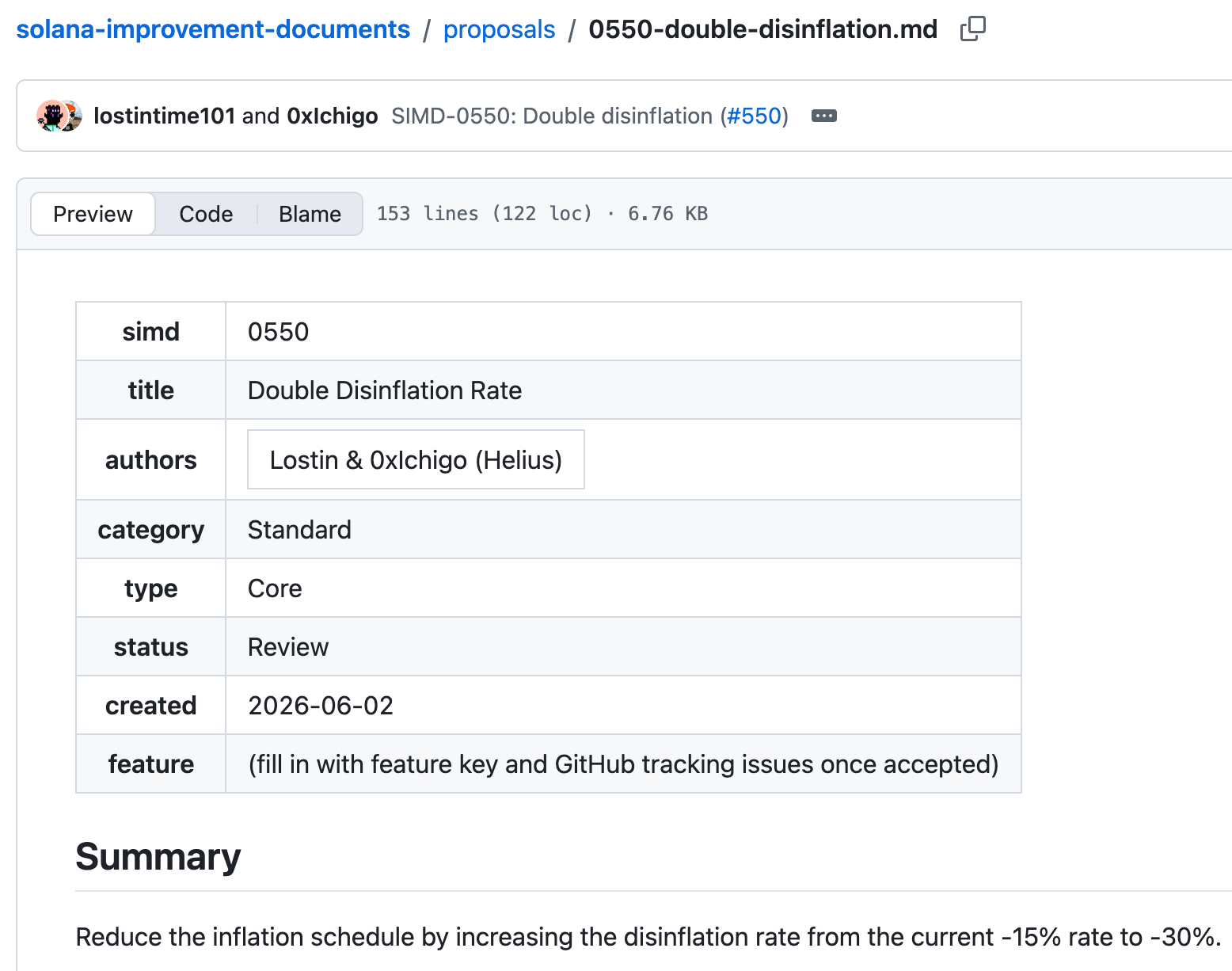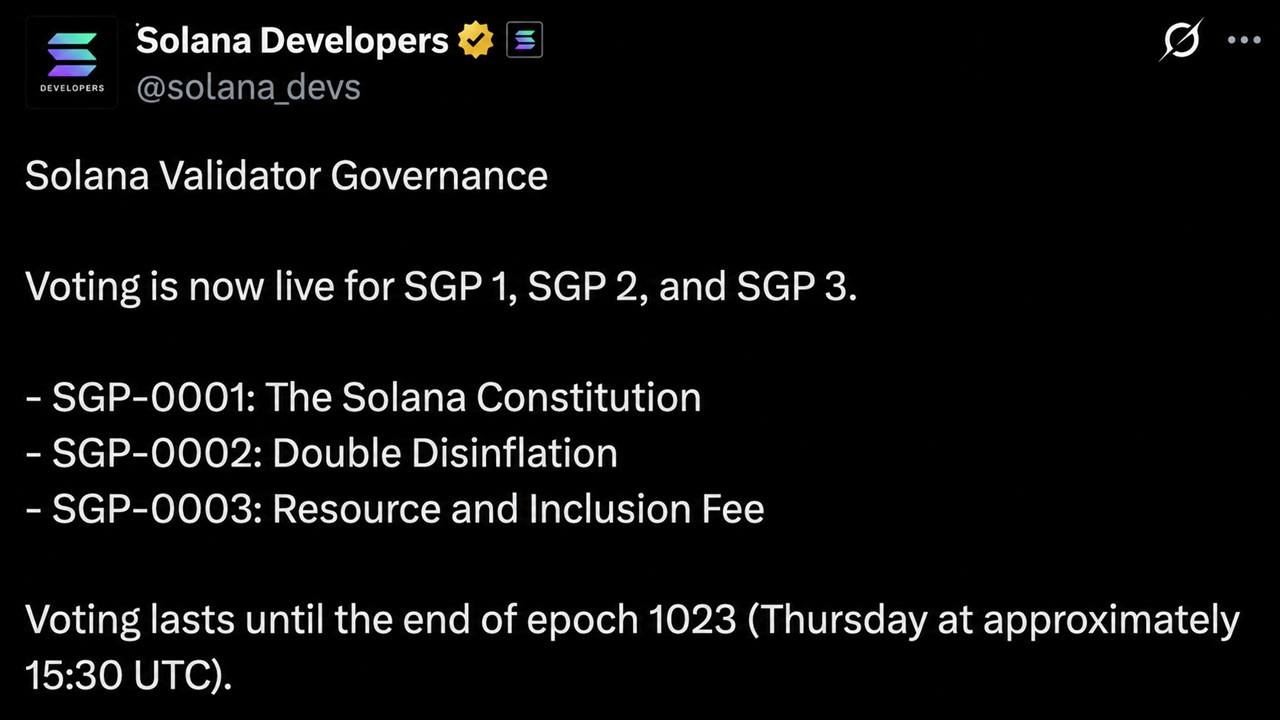
Updated nowPublished 38 min ago3 min readSolana’s faster supply cuts lead vote while $800,000 daily burn plan trails. (CoinDesk)SummarySolana operators are voting on the network’s first onchain governance proposals, including two measures intended to slow growth in the supply of SOL.A proposal to accelerate reductions in new SOL issuance has 68.77 percent support, narrowly above the two-thirds threshold, while a plan to increase transaction-fee burns has 62.72 percent support and is falling short.Even if approved, the proposals would serve only as mandates, with separate technical work required before any changes could take effect.The operators who help run Solana are voting on two ways to reduce the future supply of SOL, its native token. A plan to create fewer new tokens is narrowly passing, while another that would destroy more SOL from transaction fees is falling short.Solana creates new SOL every day to reward the operators securing the network, so both proposals would slow the growth of the total supply — something that matters to holders because fewer new tokens mean less dilution of the ones they already own.These votes are part of Solana’s first-ever onchain governance, a system that gives the people running and staking on the network a formal vote on major changes to how Solana works.One of the proposals would charge transactions based on the computing work they require and eliminate that portion of the fee, lifting daily burns from roughly 650 SOL to between 7,500 and 9,000 SOL.At prices this week, the upper end is worth about $800,000 a day. CoinDesk previously reported that even 9,000 SOL destroyed each day would remain well below the roughly 60,000 new SOL the network currently creates daily.Each proposal requires one-third of the network stake to participate and two-thirds of the participating stake to vote in favor. Abstentions count toward participation, meaning they help meet quorum but do not help a proposal reach the two-thirds approval threshold. All three votes have cleared the quorum as of Friday, according to data from the governance page.(Solana Validator Governance)What the proposals areThe so-called constitution is passing easily. Solana Governance Proposal (SGP)-0001 sets the rules for how major network decisions are put to a vote, including who can participate, how votes are weighted and what support is needed to pass. It has 95.35% support with just 0.22% opposed.SGP-0002 is over the line, though not by much. It would reduce the rate at which new SOL is created by 30% each year, down from 15%. The proposal has 68.77% support with 47.72% participation.That would bring the rate of new token creation down to its minimum of 1.5% a year around 2029 instead of 2032, resulting in roughly 18.9 million fewer SOL being created over six years.Read more: New Solana vote could ramp daily SOL burns to $800,000 and slow new token creationSGP-0003, which would change transaction fees and destroy far more SOL, has 62.72% support, with 16.52% opposed and 20.75% abstaining. Participation stands at 42.51%, leaving it below the two-thirds support needed to pass.Its abstention share is considerably higher than on the other two votes. And because abstentions still count as participating stake, they make it harder for the proposal to reach the approval threshold.As such, opposition to both supply proposals has been public. Solana Company, the Nasdaq-listed SOL treasury firm trading as HSDT, said on Aug. 21 it backed the constitution but opposed the other two, arguing that institutions need predictable economic rules for multi-year planning.Voting had earlier been expected to finish around Thursday afternoon UTC but remained open Friday as the final epoch continued. Solana votes run for three epochs, or block-based periods whose exact length varies with network production rather than the clock.None of the three votes changes the network by itself. An approved SGP is a mandate to proceed, while the detailed technical changes must still be written and implemented separately.12345678910Anvil: The Missing Collateral LayerAnvil: The Missing Collateral LayerAnvil is a shared on-chain collateral layer built on a programmable letter of credit: reserve assets as a guarantee -no loan, no interest, keep custody & yield.Jul 29, 2026Anvil is a shared on-chain collateral layer built on a programmable letter of credit: reserve assets as a guarantee -no loan, no interest, keep custody & yield.Why it matters:Anvil is a shared on-chain collateral layer built on a programmable letter of credit: reserve assets as a guarantee -no loan, no interest, keep custody & yield.View Full Report
SOL news: Solana’s faster supply cuts lead vote while $800,000 daily burn plan trails
All three proposals have cleared quorum, but a plan to slow new SOL creation is only narrowly passing while a separate vote to sharply increase token burns remains below the two-thirds support needed.
731 words~3 min read