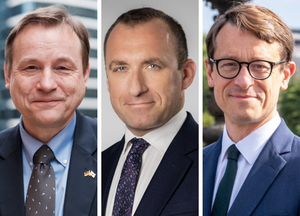
From left: German Ambassador to Korea Georg Schmidt, French Ambassador to Korea Philippe Bertoux and Polish Ambassador to Korea Bartosz Wisniewski From former enemies to partnersThirty-five years ago, Germany, France and Poland made a choice that changed Europe. Today, as Europe faces war and Asia confronts growing strategic uncertainty, the experience of the Weimar Triangle has a message for Korea and the Indo-Pacific: Peace is built through cooperation, trust and shared responsibility.In August 1991, Europe stood at a historic crossroads. The Berlin Wall had fallen. The Soviet Union was about to dissolve. Democracy was sweeping through Central and Eastern Europe. Across a continent divided for decades by the Cold War, a new question emerged: What should Europe look like after decades of division?In the German city of Weimar, the foreign ministers of Germany, France and Poland — Hans-Dietrich Genscher, Roland Dumas and Krzysztof Skubiszewski — came together to address precisely that question.Lead by the conviction that a goal of a united, safer, resilient and more prosperous Europe can only be achieved through cooperation, these statesmen created what became known as the Weimar Triangle.Their 1991 declaration included 10 points which spoke of democracy, prosperity and security, of overcoming borders and divisions, and of building Europe’s future together.Over the past 35 years, the Weimar Triangle has become a lot more than a loose diplomatic format. It deeply connects all three countries in various fields as security cooperation, economy, education, science and political exchange. It has brought its people closer together, whether it is through civil society organizations or school exchanges. And it continues to adapt to a changing international reality, serving as a vehicle to address emerging challenges to our societies, such as disinformation. The Weimar Triangle stands as a unique symbol for Europe’s unity and how it can be achieved on different levels.The story of the Weimar Triangle cannot be separated from the history of reconciliation in Europe. In fact, it is its embodiment. The relationship of Germany to France and Poland was marked by conflicts, culminating in the worst and most painful period of the Second World War, marked by German occupation, heinous destruction and immense suffering. Yet these countries that had once been enemies became partners — and ultimately allies within a European Union and NATO.This is perhaps the most important lesson of the Weimar experience: Reconciliation does not mean forgetting history. It means transforming history into a reason to cooperate.Why does this matter in Seoul?At first sight, the story of Weimar may seem distinctly European. The history in East Asia is different, and Europe should not pretend otherwise.Yet from Seoul, the experience of European reconciliation offers an important perspective.The Korean Peninsula remains divided and many different wounds of the past in the region remain. The security environment surrounding Korea is undergoing profound change. At the same time, the war in Ukraine has demonstrated that events in one region can have consequences far beyond its borders.The Weimar Triangle was born at the end of the Cold War, when Europeans hoped that the continent’s future could be built around cooperation rather than confrontation.Russia’s war against Ukraine has challenged that vision.Ukraine therefore belongs at the centre of conversations about European peace and stability in the future. The principles at stake — sovereignty, territorial integrity, the prohibition of the use of force and respect for international law — are not exclusively European principles. They are the foundations of a stable international system.For Korea, these principles have a direct relevance.The experience of the Weimar Triangle demonstrates that security cannot be reduced to military strength alone. It also depends on political trust, resilient institutions, economic cooperation and connections between societies.The link between Europe and the Indo-Pacific is no longer theoretical.Russia’s war of aggression against Ukraine has reshaped Europe’s security environment. North Korea’s ever-growing military cooperation with Russia has, in turn, highlighted the connections between European and Indo-Pacific security.For Korea, therefore, what happens in Europe cannot simply be regarded as a distant European affair. And for Europe, developments on the Korean Peninsula cannot be viewed as a purely regional matter. Our interconnected world requires us to strengthen our partnership and to deepen our exchange on matters of common interest — reflected in European-Korean cooperation.This is why the 35th anniversary of the Weimar Triangle is an opportunity not only to look back, but also to look outward — to preserve stability, prosperity and peace.From Weimar to SeoulThis is where Europe and Korea can learn from each other.Europe can share an experience born from its own history: Reconciliation between former enemies is possible, but it requires political courage, patience and institutions that make cooperation stronger than confrontation.Korea, meanwhile, brings its own extraordinary experience of transformation — from war and poverty to democracy, technological leadership and global influence.Neither side has a ready-made blueprint for the other’s challenges. But both Europe and Korea have learned that peace and prosperity require sustained effort.The next 35 yearsThe founders of the Weimar Triangle could not have known what Europe would look like 35 years later. They could not have predicted the European Union of today, the enlargement that would bring Poland into its heart, or the geopolitical challenges Europe now faces.But they understood something fundamental: The future would have to be built together.The answer to today’s uncertainty cannot be to retreat behind borders — geographical or political. It must be to build bridges despite historical differences, deepen cooperation with likeminded partners and defend the principles that allow countries to live together peacefully.Thirty-five years ago, Germany, France and Poland chose cooperation over division.Today, in Seoul, Europe and Korea have an opportunity to take that lesson one step further.The question is no longer only how Europe overcame its divisions. It is how Europe and Asia can work together to ensure that the divisions of the past do not become the conflicts of the future.That is the spirit of Weimar.The article was collectively contributed by German Ambassador to Korea Georg Schmidt, French Ambassador to Korea Philippe Bertoux and Polish Ambassador to Korea Bartosz Wisniewski. The views expressed in the article are their own. — Ed.
35 years of the Weimar Triangle — Which lessons can we share with Korea and the Indo-Pacific?
From former enemies to partners Thirty-five years ago, Germany, France and Poland made a choice that changed Europe. Today, as Europe faces war and Asia confron
1,011 words~5 min read