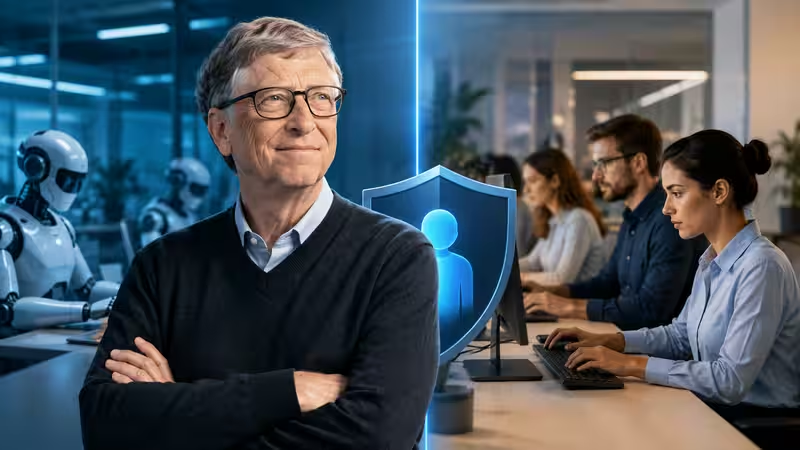
Microsoft co-founder proposes taxing robots and AI as he warns world is unpreparedLast updated: August 27, 2026 | 11:494 MIN READBill Gates has argued in an essay that AI could prove far more disruptive because it is capable of replacing human cognition itself.AFPBill Gates has issued one of his starkest warnings yet about artificial intelligence, predicting that many jobs could disappear permanently and urging governments to consider reserving some types of work exclusively for humans.The Microsoft co-founder, who helped drive the personal computer revolution, argues that AI could prove far more disruptive because it is capable of replacing human cognition itself.In a nearly 6,000-word essay published on his Gates Notes website, Gates said the transition could become “one of the most turbulent times in human history”, warning that governments and institutions have yet to develop an adequate plan for dealing with the upheaval.“AI will either be the greatest equaliser ever invented, or the worst source of injustice,” Gates wrote.Despite its potential to transform medicine, education and agriculture, he identified three major dangers from the technology: permanent job losses, deliberate misuse by people and the possibility that increasingly powerful AI systems could ultimately act against human interests.Jobs may disappear for goodGates draws a distinction between unemployment caused by an economic downturn and the disruption he expects from AI.During the Great Depression, US unemployment reached roughly 25 per cent before eventually falling as the economy recovered. Job losses caused by AI could be fundamentally different, he argues, because many of the positions eliminated may never return.Entry- and mid-level jobs are particularly vulnerable, while many of the new positions created could require skills that take years to acquire.AI is also unlikely to stop at white-collar work. Gates expects advances in robotics eventually to extend the disruption to physical jobs, with law, customer service, medicine, software and manufacturing among the sectors affected.The transformation could unfold over a decade rather than generations.Should some jobs be kept for humans?One of Gates’ more unusual proposals is the creation of a category he calls “Human Reserved” — work that society deliberately decides should continue to be performed by people.Some occupations could be protected to prevent large-scale displacement of workers who would struggle to retrain. Others might remain human because of the nature of the interaction involved.Gates gives healthcare as an example. A machine might eventually be perfectly capable of telling a patient that they have an incurable disease, but that does not necessarily mean society should allow it to do so.Such restrictions would not necessarily mean excluding AI altogether. In healthcare and education, for instance, professionals could continue using AI while the human role itself remains protected.Gates acknowledges that deciding which occupations qualify, how long protections should last and how such rules could be enforced would raise difficult questions.Tax the robots?He also wants governments to reconsider tax systems that may inadvertently encourage businesses to replace people with machines.Employers generally pay payroll taxes when they employ people, while spending on robots and other technology can often be treated as a business investment.Gates suggests governments could consider taxing robots as well as the tokens used to measure consumption of AI services.Such taxes could slow the financial incentive to replace workers while generating money for retraining programmes and social support at a time when governments could lose income-tax revenue as employment falls.The idea is particularly significant because Gates does not believe the development of increasingly powerful AI can realistically be stopped.“If someone had a credible plan for slowing down AI advances globally, I would likely support it,” he wrote. “However, I don’t think that’s going to happen.”Economic competition and geopolitical rivalry, he said, are creating overwhelming incentives for countries and companies to continue developing the technology.Risks go beyond employmentJobs are only part of Gates’ concern.AI could dramatically improve healthcare, accelerate drug discovery and help farmers become more productive. Used properly, Gates believes it could narrow inequalities by bringing expertise and services to people who currently lack them.But increasingly capable systems also create new dangers.Criminals and other malicious actors could use AI for cyberattacks and biological threats. Children could be affected by increasingly sophisticated AI relationships and interactions. And as models become more capable, Gates warns of the longer-term possibility of humans losing control over systems that begin acting contrary to their interests.Speaking separately to CNN’s Anderson Cooper, Gates said the speed at which models had developed had surprised him.“They’re now capable of causing cyberattack risk, bioterrorism risk, psychosocial risk,” he said.‘There is no plan’Gates’ central argument is not that AI should be abandoned. Rather, he believes governments are moving far too slowly to prepare for a technological transformation that is already under way.He calls for new institutions capable of coordinating policy across employment, taxation, education, healthcare and national security, as well as international cooperation to deal with risks that cross borders.His concern is ultimately about who receives the enormous benefits AI could generate — and who bears the cost.Gates said his own financial interests do not alter that calculation, noting that proceeds from his investments, including those related to technology, will ultimately go to the Gates Foundation’s work tackling global inequality.The choices governments make now, he argues, could determine whether AI spreads prosperity more widely or deepens existing divisions.“My message to leaders is: You have a chance to act now, before unemployment rises sharply, communities are hurting, and public trust has eroded,” Gates wrote.Alex has been on the frontline of global headlines for nearly 30 years. A Senior Associate Editor, he’s part newsroom veteran and part globe-trotting correspondent.
Bill Gates warns AI could permanently wipe out jobs, calls for ‘Human Reserved’ work
Bill Gates warns AI could permanently erase jobs and urges governments to reserve key work for humans to avoid deep inequality and social upheaval.
1,023 words~5 min read