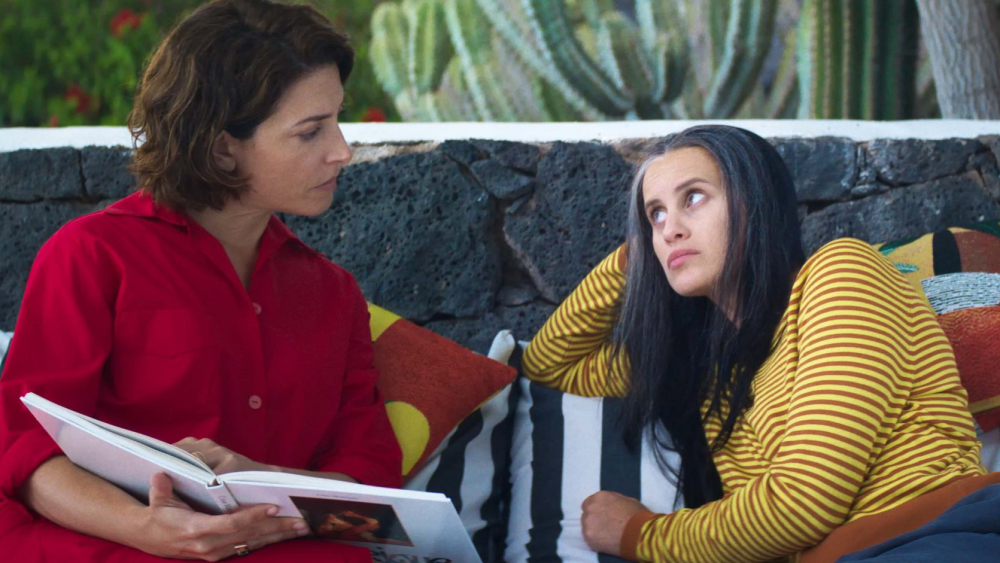
Bitter Christmas Director: Pedro AlmodóvarCert: 15AStarring: Bárbara Lennie, Leonardo Sbaraglia, Aitana Sánchez-Gijón, Patrick Criado, Quim Gutiérrez, Milena Smit, Rossy de PalmaRunning Time: 1 hr 51 minsNo, don’t worry. Christmas does not now start in the last week of August. The title refers to a film within the film – or a screenplay within the screenplay, anyway – that grants the latest Pedro Almodóvar release more than usually complex metatextuality. The most Christmassy thing about the film is the director’s stubborn propensity for rich greens and richer reds.Graham Greene once wrote that any decent writer requires a “splinter of ice” in the heart. Bitter Christmas, particularly towards the close, has much to do with this need to plunder from the lives of loved ones. It is tricky that way. Large sections only make sense when it is later qualified that we were watching the film’s fiction rather than its supposed reality. All very clever. All very calculated. Often a bit dry.We begin, in 2004, with Elsa (Bárbara Lennie), a director of advertisements and sometimes movies, being hospitalised with a crippling migraine. We learn that she has a boyfriend straight from fantasy casting: this Bonifacio (Patrick Criado) alternates between fighting fires and revealing his pectorals as a stripper. He not only looks the part but also seems to be the most understanding of individuals. You might argue that the couple belong in an early draft for a Pedro Almodóvar screenplay that later added more nuance and irony.That turns out to be close to the truth. We eventually realise we are watching characters in a script by a middle-aged, urbane Spanish film-maker who has a great many nicely coloured things in his house. Can you tell who it is yet? Raúl (Leonardo Sbaraglia), who seems to have been struggling creatively, is now reprocessing strands from the life of his dogged assistant Monica (Aitana Sánchez-Gijón) and his boyfriend (Quim Gutiérrez). The story is coming along all right. But emotional complications threaten. It is satisfying when the structure becomes clear, but that revelation makes a cool construct of the opening yarn. This is the sort of puzzle that Charlie Kaufman would enjoy pulling inside out and stretching into absurd secondary shapes.Almodóvar is not at home to that sort of high-end postmodernism. His late works have been thoughtful, melancholy and steeped in regret. Not everyone loved The Room Next Door, his Golden Lion-winning English-language picture with Tilda Swinton and Jullianne Moore, but nobody would accuse that film of lacking emotional weight. In contrast, Bitter Christmas too often feels like an exercise: a challenge the director has set for himself.For all that, Almodóvar cannot fail but deliver an attractive package. Among contemporary film-makers, perhaps only Wes Anderson has as recognisable a fingerprint. As ever the shots flow with poetic discipline. Locations are chosen as backdrop and visual subtext. Elena’s story eventually takes her to Lanzarote with her bereaved friend Natalia (Milena Smit). The bleakly beautiful maritime landscapes chime with the film’s creative starkness. Here the bold colours of nature seem daubed by an Almodóvarian god.[ Cannes First Look review: Bitter Christmas - You’ll wonder if Almodóvar is phoning it inOpens in new window ]It hardly needs to be said that the performances are up to scratch. Nobody here gets to exhibit the sort of curtain-chewing emotion the director called up for his more flamboyant pictures, but the female actors in particular work quiet magic with the less heated interactions. Alberto Iglesias is back with a clever churn of a score.Has Almodóvar ever made a bad film? Maybe I’m So Excited, from 2011, but that broad comedy was so out of character it hardly registers in the canon. Bitter Christmas confirms that, even when coasting, he cannot help but charm and entertain. The key elements are all in place even if the project lacks a certain magic. Don’t bet against the next one being a masterpiece.In cinemas from Friday, August 28th
Bitter Christmas review: even when Almodóvar is coasting, he cannot help but charm
Charlie Kaufman would enjoy the sort of puzzle Pedro Almodóvar has created here but too often it feels like a challenge the Spanish director has set for himself
658 words~3 min read