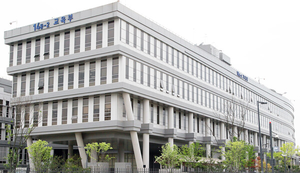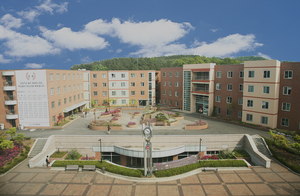
Cases expose gaps in protections for international students, with authorities lacking direct means to secure refunds, rescue students Woongji Accounting and Tax College's Korean Language Education Center in Paju, Gyeonggi Province (Woongji Accounting Tax College) The Education Ministry is discussing with the Justice Ministry whether visa restrictions should be imposed on Woongji Tax and Accounting College, as the school continues recruiting international students despite failing to refund those whose enrollments fell through.“We believe visa issuance needs to be restricted,” an Education Ministry official told The Korea Herald. “We are currently discussing that with the Justice Ministry.”Such restrictions could effectively prevent the college from bringing in new international students for a designated period, although no specific action has been finalized.Woongji came under fire in June after it was revealed that the college had failed to return roughly 1 billion won ($720,000) in tuition paid by international students who had been scheduled to enroll in March but were denied visas.The college acknowledged at the time that it had used around half of the money for operating expenses amid financial difficulties.A senior Woongji official previously told The Korea Herald that the college had planned to sell university-owned property in Mapo-gu, western Seoul, to complete the refunds by August.But three Indian students told The Korea Herald that they had still not received their money as of press time.Woongji has meanwhile continued recruiting international students for Korean-language courses. About 20 Sri Lankan students who had been scheduled to enroll in a June program also told The Korea Herald that they had yet to receive refunds after their enrollment fell through.The case has exposed a regulatory gap as Korean universities increasingly turn to international students to bolster enrollment and revenue amid a shrinking college-age population.Limited legal toolsEducation authorities currently have limited means to intervene when universities fail to refund foreign students after visa denials or canceled enrollment.“This really is an unacceptable situation,” the ministry official said. “But there is currently no legal basis for us to impose sanctions over this.”The ministry has instead relied largely on the International Education Quality Assurance System and related visa measures when universities face serious problems involving foreign students.Under IEQAS, however, failing the government’s internationalization certification does not automatically bar a university from recruiting foreign students. Depending on its classification, a noncertified university may face ordinary or heightened visa screening, while only institutions in the most restrictive category are effectively blocked from obtaining student visas.The Higher Education Act provides no direct basis for administrative sanctions solely over poor management of international students, according to the ministry.The ministry is now examining whether stronger measures are needed when universities continue recruiting despite unresolved refund disputes.“We believe there needs to be some kind of brake on this,” the official said.Students in limboPossible visa restrictions could prevent additional students from facing similar problems, but they would do little to immediately recover money for those already waiting for refunds.The students said they had paid 6.6 million won in tuition.“I quit my job and paid all that money to earn an opportunity to study in Korea,” said Ruth, 38, a former accountant who had planned to study at Woongji. “Now, I have no source of income and I really need the money.”Woongji told The Korea Herald that it was still awaiting Education Ministry approval to sell its Mapo property and had already secured a prospective buyer.The college enrolled 122 students in Korean-language courses in the previous semester and has received roughly 400 applications for the September semester, according to a senior college official.“We are really invested in our international program and we are doing our best to resolve this problem as soon as possible,” the official said.The college said it was trying to sell the property quickly but could not provide a new timeline for completing the refunds because the sale depends on ministry approval.The ministry said it has continued to request additional explanations from the college, while issues including questions over ownership of the building remain unresolved.Education authorities acknowledged that there is little they can do for students who have already been affected.“We are also looking at what can be done for students who have already suffered harm,” the Education Ministry official said. “But realistically, we are prioritizing preventing further harm as quickly as possible.”The ministry plans to announce broader measures in September aimed at shifting Korea’s international student policy from quantitative expansion toward improving the quality of recruitment and management, as the number of foreign students in the country has surpassed 300,000.
[Exclusive] Ministries weigh visa curbs on Woongji College over unpaid refunds
The Education Ministry is discussing with the Justice Ministry whether visa restrictions should be imposed on Woongji Tax and Accounting College, as the school
748 words~3 min read