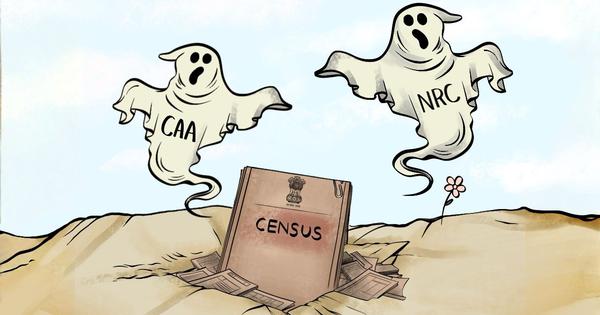
The list of questions for the 2027 census has stoked fears that census data might be used to prepare a National Register of Citizens.The questionnaire for the 2027 census includes 12 questions that were not asked in the previous census. Ten of these were part of the contentious National Population Register that the Modi government had attempted to conduct in 2020.With these inclusions, the census has subsumed the National Population Register, which is the first step towards drawing up a National Register of Citizens.Scroll spoke to lawyers, activists and politicians to understand what the collapse of the distinction between the census and the National Population Register means. Most were of the view that this move could trigger anxieties about citizenship similar to those that had sparked the nationwide protests against the Citizenship Amendment Act of 2019.The main purpose of the census is to collect statistical data about India’s population and their housing and social conditions. But the 2027 census will go beyond questions that allow administrators to construct a statistical picture of how Indians live.It will, for instance, ask respondents where and when their parents were born and which religion they practiced. Activists worry that this could set off a cycle of investigations and inquiries into the citizenship of those who have been living in India for generations, especially if they are Muslims.File photo from a 2020 protest against the National Population Register in Mumbai, Maharashtra. Credit: Punit Paranjpe/AFPSubsuming the NPRThe population enumeration phase of the census, during which enumerators go door-to-door with a questionnaire, will begin in snowbound parts of North India in September. At least 12 of the 40 questions to be asked as part of this process have never been asked in a census before. These include details about a respondent’s spouse, parentage, nationality and identification documents, such as passport, Aadhaar and voter card number.This information was meant to be collected in 2020 as part of the National Population Register but the exercise had to be shelved back then on account of the Covid-19 pandemic. However, even before the pandemic, the National Population Register had been met with fierce opposition from civil society groups because of its design.Specifically, questions about where and when a respondent’s parents were born caused concern as these could, in theory, help determine whether they were Indian citizens. A 2003 amendment to the Citizenship Act made the citizenship of those born in India after June 30, 1987, contingent on the citizenship of their parents.Those controversial questions have now been included in the census as “father’s particulars” and “mother’s particulars”. Scroll accessed the training manual meant for government officials involved in conducting the exercise to find out what these “particulars” entail. They include name, date of birth, place of birth and religion.
Is Census 2027 the first step to a National Register of Citizens?
With 12 new questions that have never been asked in the census before, the exercise has fully subsumed the controversial National Population Register.
1,697 words~8 min read