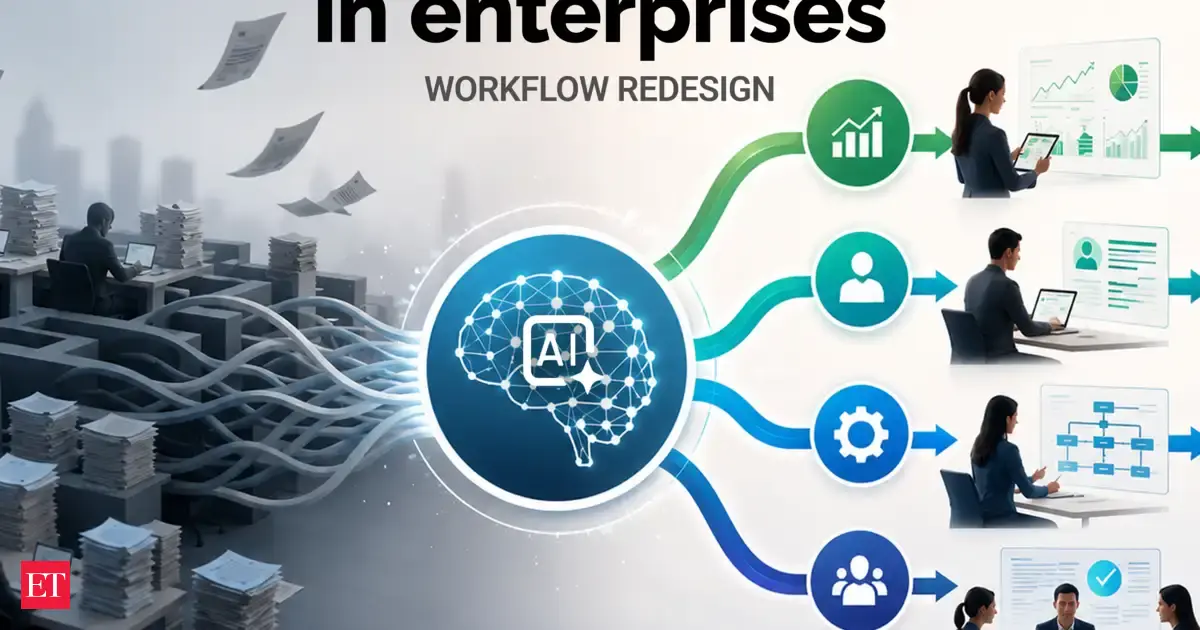
Mohan Subrahmanya, Country Leader & Executive Director, India at Insight Enterprises.gettyAI is fast transitioning from a supplementary productivity tool to the core infrastructure driving modern enterprises. By integrating AI into the heart of their operations, organizations are moving beyond experimentation to achieve faster execution, greater scalability and sharper data-driven decision-making.As dependence on AI-led insights deepens, enterprises are investing in stronger AI foundations to ensure sustainable and long-term impact. The focus is shifting decisively toward measurable returns, signaling a move from exploratory adoption to building AI-first business models. This momentum is reflected in market projections, with Gartner estimating global AI spending to reach $2.52 trillion by 2026, a 44% year-on-year increase, driven significantly by investments in AI infrastructure. A New Era Of AI-Led ProductivityAI is rapidly moving beyond simple task automation to power sophisticated, multistep workflows that can reshape entire business processes. By combining AI’s speed and analytical depth with human creativity, judgment and ethical oversight, organizations are unlocking a new model of work.What’s changing is not just individual tasks, but how entire workflows operate. At Insight, a generative AI voice assistant helped a telecom company serving nearly 2,000 locations cut live-agent call routing from 90% to 40%, freeing thousands of hours each year. Across industries, AI improves efficiency, decisions, compliance and service.We are seeing this pattern across sectors. Quality inspection, anomaly detection, maintenance and worker safety in manufacturing. In healthcare, AI supports patient flow, diagnostic reporting and better use of clinical time. In financial services, it helps with data analysis, compliance and better customer engagement.Agentic AI Takes Center StageAgentic AI is rapidly emerging as a powerful force in enterprise transformation, with organizations deploying task-specific agents to plan workflows, execute actions and coordinate across departments.Organizations that combine agentic AI with strong governance, trusted data, human oversight and clear business outcomes are the ones that will separate successful agentic AI deployments from failed ones.Leaders should define the work they are meant to do and the decisions they must not make. Organizations often underestimate the effort required to clean data, integrate systems, train employees and monitor outcomes. Starting with focused use cases and clear accountability helps avoid mistakes.AI Upskilling: The New Must-Have Workforce AdvantageI have seen companies overinvest in AI tools while underestimating people. The real gap isn’t technical skill, it’s judgement, curiosity and the confidence to experiment.Workforce readiness now means rewiring mindsets:• Start with a real business problem: Do not ask, “Where can we use AI?” Instead ask, “Which business problem is slowing us down, increasing cost or affecting customer experience?”• Build the foundations before scaling: Assess data quality, legacy systems, cloud infrastructure, cybersecurity and governance before expanding pilots. • Equip employees with hands-on AI literacy and the skills required to effectively collaborate with intelligent systems in real-world scenarios. Ethics, Governance And Cybersecurity ImperativeAs systems become autonomous, risk rises when human oversight is weak, especially in cybersecurity, compliance and customer-facing decisions. The biggest mistake is adopting AI before deciding who is accountable for its decisions.• Start with a clear AI strategy anchored in business outcomes. A responsible AI operating model should begin with a clear answer to where AI will create measurable value. Organizations should identify the business processes where AI can improve overall customer experience.• Put governance at the center, not the edge. If AI is to scale responsibly, governance needs to be designed into the operating model from the outset, with policies for data use, model validation, human oversight, security, compliance and auditability.• Build on a secure, modern data and platform foundation. Scalable AI depends on well-structured data, secure infrastructure, and an architecture that can support multiple models and use cases without creating lock-in or control issues.• Create a human-centered talent and adoption model. Organizations need to upskill employees and ensure that teams understand how to use AI responsibly in day-to-day tasks. Continuous learning is essential.• Measure, learn and scale through a repeatable factory model.Organizations should create a model that standardizes how use cases are evaluated, piloted and scaled, with clear metrics at every stage.ConclusionAI will define future competitiveness not through adoption alone, but through how deeply and responsibly it is operationalized. The shift toward collaborative intelligence, where humans and AI work as integrated teams, demands strong governance, ethical frameworks and workforce readiness. Organizations that strike this balance will unlock sustainable growth and long-term leadership in an AI-driven world.Forbes Technology Council is an invitation-only community for world-class CIOs, CTOs and technology executives. Do I qualify?
How AI Will Rewrite Enterprise Strategy In The Coming Years
AI will define future competitiveness not through adoption alone, but through how deeply and responsibly it is operationalized.
735 words~3 min read