Article
Open access
Nature
(2026) Cite this article
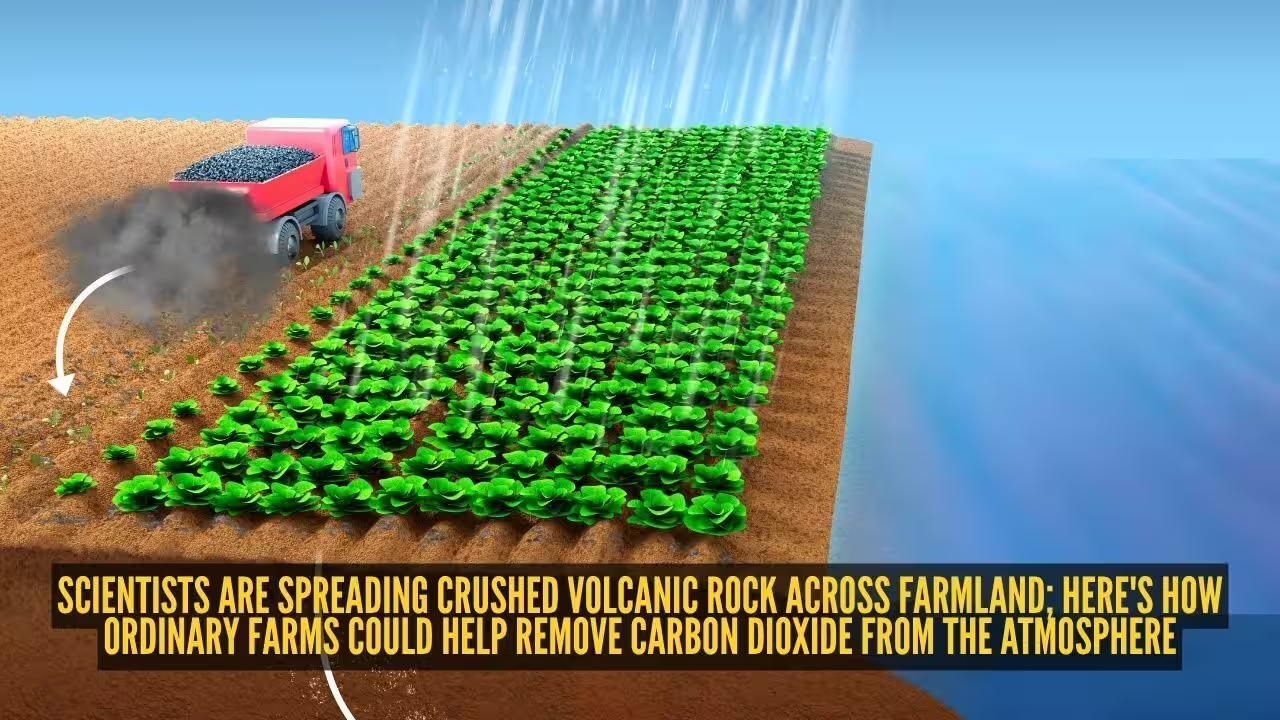
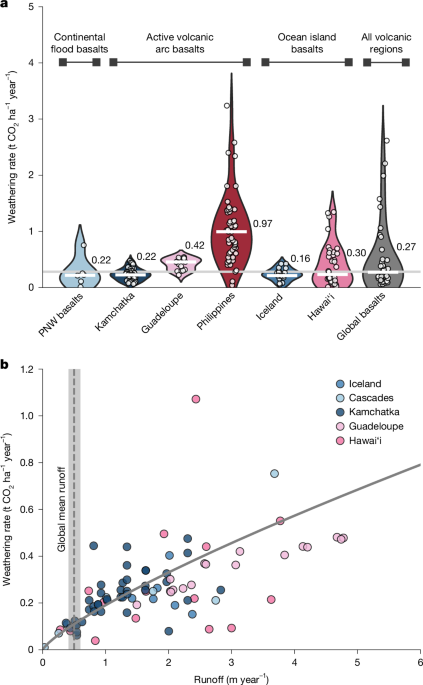
AbstractEnhanced weathering (EW) of rocks is a proposed strategy for carbon dioxide removal (CDR) that relies on the dissolution of silicate minerals, typically basalt, applied to soils1. Globally, large-scale CDR by means of EW requires the generation of alkalinity during mineral dissolution in soils and preservation and transport of that alkalinity through groundwater and rivers to reach the ocean2,3. Although field trials and models have focused on near-surface alkalinity generation after addition of crushed rock4,5, the transmission of this alkalinity is modulated by hydrological and geochemical processes that unfold across watersheds6,7,8. Here we synthesize observations from natural volcanic watersheds to evaluate alkalinity export along the complete reactive pathways from soil to river. Data from basaltic catchments demonstrate attenuation of alkalinity fluxes, leading to reductions in exported alkalinity. This attenuation is probably the result of precipitation of secondary clay and carbonate minerals along subsurface flow paths and during river transport. Although natural weathering systems differ from engineered EW deployments, these observations provide an empirical baseline on watershed-scale alkalinity export. Our results indicate that critical zone processes influence the efficiency with which weathering-derived alkalinity is exported, implying the need to incorporate watershed processes into future assessments of EW CDR.