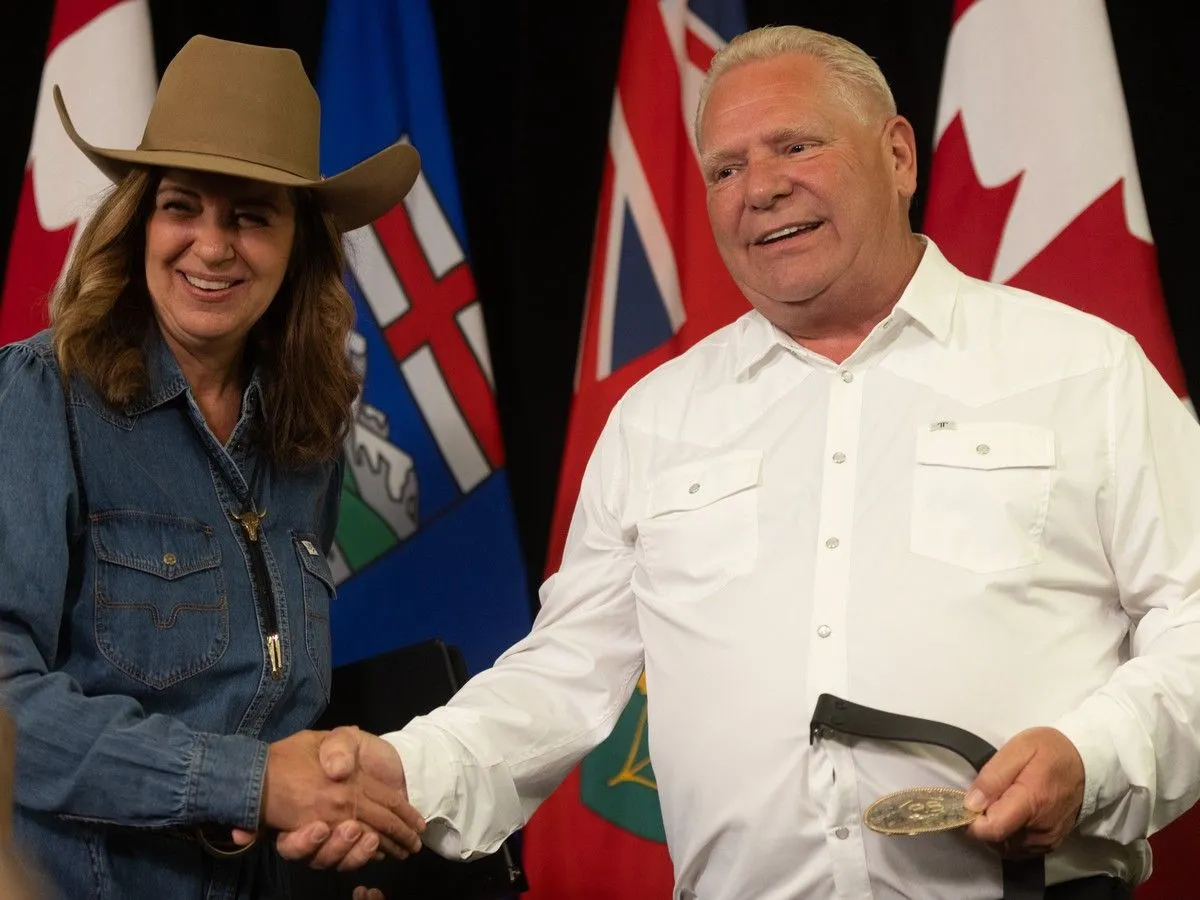
Skip to Content News Archives Economy Energy Oil & Gas Renewables Electric Vehicles Mining Commodities Agriculture Real Estate Mortgages Mortgage Rates Finance Banking Insurance Fintech Cryptocurrency Work Wealth Smart Money Wealth Management Investor Personal Finance Family Finance Retirement Taxes High Net Worth FP Comment Executive Women Puzzmo Newsletters Financial Times Business Essentials More Innovation Information Technology FP500 Podcasts Small Business Lives Told Tails Told Shopping Financial Post Store Obituaries Place a Notice Advertising Advertising With Us Advertising Solutions Postmedia Ad Manager Sponsorship Requests Classifieds Place a Classifieds ad Working Profile Settings My Subscriptions My Offers Newsletters Customer Service FAQ News Economy Energy Mining Real Estate Finance Work Wealth Investor FP Comment Executive Women Puzzmo Newsletters Financial Times Business Essentials HomeEnergyVarcoe: Using energy as weapon in trade war should be a 'non-starter,' Alberta premier saysSmith says the Americans have a bigger stick when it comes to placing tariffs or cutting off energy exportsLast updated 2 hours ago Alberta Premier Danielle Smith and Ontario Premier Doug Ford at a press conference in Calgary on July 6, 2026. Smith said she had a lengthy phone call with Ford Monday to discuss how to respond to American tariffs. Brent Calver/PostmediaIt’s a non-starter and would hurt Canadians, says Premier Danielle Smith.Subscribe now to read the latest news in your city and across Canada.Exclusive articles from Barbara Shecter, Joe O'Connor, Gabriel Friedman, and others.Daily content from Financial Times, the world's leading global business publication.Unlimited online access to read articles from Financial Post, National Post and 15 news sites across Canada with one account.National Post ePaper, an electronic replica of the print edition to view on any device, share and comment on.Daily puzzles, including the New York Times Crossword.Subscribe now to read the latest news in your city and across Canada.Exclusive articles from Barbara Shecter, Joe O'Connor, Gabriel Friedman and others.Daily content from Financial Times, the world's leading global business publication.Unlimited online access to read articles from Financial Post, National Post and 15 news sites across Canada with one account.National Post ePaper, an electronic replica of the print edition to view on any device, share and comment on.Daily puzzles, including the New York Times Crossword.Create an account or sign in to continue with your reading experience.Access articles from across Canada with one account.Share your thoughts and join the conversation in the comments.Enjoy additional articles per month.Get email updates from your favourite authors.Create an account or sign in to continue with your reading experience.Access articles from across Canada with one accountShare your thoughts and join the conversation in the commentsEnjoy additional articles per monthGet email updates from your favourite authorsSign In or Create an AccountorAs a trade battle between Canada and the United States enters a new phase, Smith spoke for about a half-hour with Ontario’s Doug Ford on Monday to discuss ways to work together.But the “non-starter” for Alberta’s premier is using energy as a weapon in the clash, such as threatening to reduce supplies or place export levies on oil and natural gas headed to the U.S.In an interview on Tuesday, Smith noted large volumes of Canadian crude move into Ontario via pipeline through Michigan and Wisconsin, making it vulnerable to American trade action. Ontario also consumes natural gas imported from the U.S.Get the latest headlines, breaking news and columns.By signing up you consent to receive the above newsletter from Postmedia Network Inc.A welcome email is on its way. If you don't see it, please check your junk folder.The next issue of Top Stories will soon be in your inbox.We encountered an issue signing you up. Please try again“If you start talking about cutting that off or tariffing it, well, the Americans actually have a greater stick,” Smith said.“You can just imagine if we put 50 per cent tariffs on oil and gas leaving Canada, they would put 50 per cent tariffs or more on oil and gas leaving the United States into Canada. And so that would be a wipeout of the Ontario and Quebec economies,” she added.“I don’t want to do anything that is going to result in a retaliation that would be crippling to Eastern Canada, and crippling to consumers in the middle of an affordability crisis. That would just be dumb, and I don’t want Canada to do anything that’s dumb.”On Tuesday, the federal government unveiled its list of counter-tariffs that will be placed on American products imported into the country, along with a $7.5-billion assistance package for Canadian businesses and workers affected by the trade dispute.The federal government said higher tariffs will be imposed on U.S. goods from sectors including steel, agriculture, electronics, appliances, and pulp and paper, beginning Sept. 8. It did not include levies or restrictions involving oil, Canada’s largest export to the U.S.The Trump administration placed 50 per cent tariffs on an array of almost $28 billion of Canadian imports, starting Saturday, following the termination of negotiations on a trade agreement.On Tuesday, Federal Finance Minister François-Philippe Champagne told reporters that most of the imported goods being hit with counter-tariffs can be substituted with Canadian products. Minister of Finance and National Revenue François-Philippe Champagne speaks during a press conference in Ottawa on Tuesday, Aug. 25, 2026. Canada announced countermeasures and support for workers and businesses in response to United State’s tariffs. Hyungcheol Park/PostmediaOntario’s premier wants to see oil, gas and potash used as potential leverage in the conflict. His province’s auto and manufacturing sectors are being pounded by U.S. trade action.He said Monday that Canada should throw “everything in the kitchen sink at them” to inflict pain on the U.S.“I just let him know it was a non-starter,” said Smith.The Alberta Federation of Labour’s president sent a letter to the prime minister on Tuesday, calling on Mark Carney to impose an export tax on Canadian oil headed to the U.S. Midwest, and criticizing Smith for her stance.Refineries in the region rely on Canadian heavy crude, and any disruptions or higher feedstock costs would push up gasoline prices in the region.The real goal should be to put pressure on American voters, “to ensure that Trump and the Republican party lose control of Congress in this fall’s mid-term elections,” AFL president Gil McGowan wrote.The total value of energy trade between both countries topped US$137 billion last year, and Canada is the largest foreign supplier of oil and natural gas to the United States.Oil shipped to Ontario from Western Canada on Enbridge’s Line 5 heads through Wisconsin and Michigan before reaching Sarnia, making it vulnerable to U.S. trade action or restrictions. Alberta’s premier said Ford told her “we have different contexts, and I told him I appreciate that Ontario has greater exposure to all of these tariffs than Alberta does, but we’re here and we want to help.”For example, steel production in Ontario could be used for pipelines required in the oil and gas sector. More Canadian-made cars could be sold in Alberta.“We should be trying to find ways to support each other so that we end up limiting the impact on the economy,” Smith added. Alberta NDP leader Naheed Nenshi spoke to media in Calgary on Tuesday, August 25, 2026 criticizing Danielle Smith’s position toward the ongoing trade talks with the U.S. Brent Calver/Postmedia“You shouldn’t do something if the consequence of doing that is going to hurt you even harder. It’s just basic math.”Speaking at a news conference on Tuesday, Alberta NDP Leader Naheed Nenshi lambasted Smith for “kowtowing to Trump” by meeting him at Mar-a-Lago in 2025, and said it’s a mistake for Smith to simply rule out using its energy leverage in the middle of a trade war.“I’m not sure (export duties on oil and gas are) the right tool, but to take it off the table, as Danielle Smith has done, just plays into Trump’s hands,” Nenshi said.The North American energy system has been deeply integrated for decades, with oil and gas flowing in both directions. That’s a key reason energy has not been hit by tariffs by either side, said Ben Cahill, an energy analyst at the University of Texas at Austin.“It‘s been seen as too important to both countries to upset the apple cart,” Cahill said from Washington, D.C. “Bilateral energy trade is too big to fail.”Smith said she understands why the federal government “had to walk away” from the trade negotiations last week, and reiterated she hopes a deal can be reached.As for the counter-tariffs, Smith said the province is trying to determine how they will affect Alberta businesses that buy products from the United States, or rely on exports heading south.“Then we’ll do our work to either provide some interim funding to assist them through this challenging time and finding new markets, or try to get some tariff relief,” she added.Chris Varcoe is a Calgary Herald columnist. Join the Conversation This website uses cookies to personalize your content (including ads), and allows us to analyze our traffic. Read more about cookies here. By continuing to use our site, you agree to our Terms of Use and Privacy Policy.
Varcoe: Using energy as weapon in trade war should be a 'non-starter,' Alberta premier says
Alberta’s premier said threatening to cut off supplies or place export levies on oil and natural gas to the U.S. will backfire.
1,494 words~7 min read