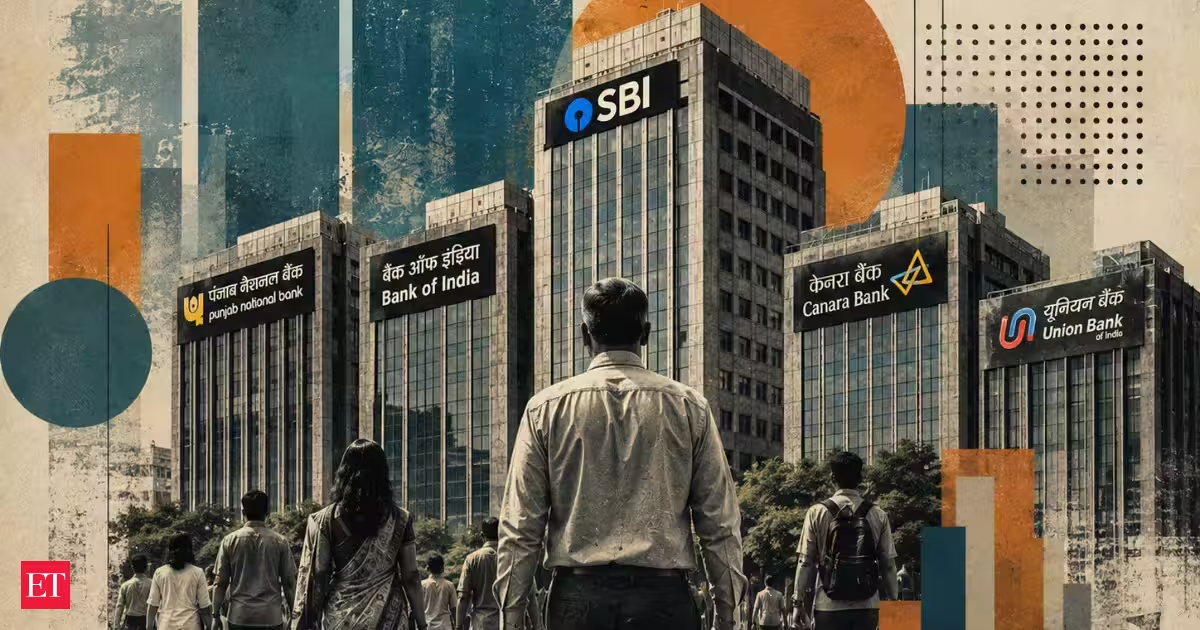
The case for bigger public sector banks has returned to the policy debate just as the banks themselves are in much better shape than they were a decade ago.A new Economic Advisory Council to the Prime Minister (EAC-PM) paper says India should consolidate banks into a few large institutions of broadly comparable size to meet rising credit requirements and the ambitions of Viksit Bharat 2047.Also Read: EAC moots consolidation to create a few large banksTo be sure, this is not a government decision. As recently as May, Finance Minister of State Pankaj Chaudhary told the Lok Sabha that no proposal to merge or consolidate PSBs was under consideration. But the recommendation is significant because it comes after a decade in which public banks have cleaned up their balance sheets, regained profitability and begun competing more effectively with private lenders. The question now is whether healthier PSBs should be combined to create institutions with the scale to finance India's next phase of growth.From repairing banks to building scaleThe EAC-PM paper, 'Reforms, Efficiency, and Productivity of the Indian Banking Sector in the Last Decade: A DEA Approach', is primarily about the dramatic improvement in banking efficiency. It says the sector has moved from a period of under-recognised corporate stress, weak PSB capitalisation and constrained credit creation to one marked by low NPAs, stronger capital buffers, sustained profitability and faster credit growth.The numbers show the extent of the turnaround. The mean technical efficiency of scheduled commercial banks fell from 91.3% in FY15 to 78% in FY20 as bad loans were recognised and Covid disrupted the economy. It recovered to 88.3% in FY26. PSBs led that recovery, with their average technical efficiency rising from 72.5% in FY20 to 93.1% in FY26.Also Read: Banking sector in strongest position to undertake reformsThe improvement is equally visible in balance sheets. The 12 PSBs recorded combined profits of Rs 1.98 lakh crore in FY26, while their gross NPA ratio fell to 1.93% and net NPAs to 0.39%. Their advances rose 15.7% to Rs 127 lakh crore and deposits grew 10.6% to Rs 156.3 lakh crore.The recovery changes the rationale for consolidation. The mergers that reduced the number of PSBs from 27 to 12 between 2017 and 2020 were largely about creating stronger institutions by combining weaker banks with larger ones. A future round would have a different purpose of building banks capable of financing a much larger Indian economy.India's largest lender, State Bank of India, illustrates the scale gap. ET reported last year that SBI had assets of about $846 billion and ranked 43rd among the world's largest banks. In comparison, The bank ranked tenth globally had assets exceeding $2.6 trillion. Even the combined assets of India's 12 PSBs would not put the system among the very largest individual global banking institutions.Global rankings themselves are not the objective. But the size gap matters because balance-sheet capacity determines how much risk a bank can take on, how large a project it can finance and how easily it can participate in international lending. India's infrastructure, manufacturing, renewable energy and technology investments are likely to involve increasingly large projects. A few institutions with very large balance sheets would be better placed to underwrite or lead such transactions than a collection of mid-sized banks.Also Read: Indian banks are in their best shape in a decade: Motilal OswalWhy scale matters for India's next investment cycleThe strongest argument for larger PSBs is not that Indian banks are currently incapable of lending to big companies but that the financing requirements of the economy are becoming larger and more complex.Scheduled commercial bank credit grew 19.3% year-on-year at the end of July, against 9% in FY15, while deposit growth reached 15.4% compared with 10.7% a decade earlier. The EAC-PM paper says banks will need to mobilise stable deposits to support this expansion and channel more credit towards MSMEs, infrastructure and green investment while avoiding excessive concentration in unsecured retail lending.PSBs are particularly relevant because of their deposit franchise and reach. Their combined business stood at Rs 283.3 lakh crore in FY26. ET has also reported that PSBs regained loan-market share, accounting for 54.4% of bank credit in December 2025 compared with 53.1% a year earlier. Several large PSBs were growing advances at rates of 18-28%, ahead of many private-sector peers.That recovery provides a stronger foundation for consolidation. Larger PSBs could finance bigger infrastructure and industrial projects while also having greater capacity to participate in syndicated loans and global transactions. A bank with a very large balance sheet can spread the risks of a major project across a broader asset base and invest more heavily in specialist capabilities.The international dimension is becoming important too. Indian companies expanding overseas increasingly need banks capable of providing trade finance, foreign-currency funding, guarantees, acquisition finance and cross-border cash management. Reuters reported this week that Union Bank of India returned to the US dollar debt market after a 12-year gap, raising $600 million. SBI and Bank of Baroda have also raised dollars through public bond issues.Bigger Indian banks would have a better chance of building the international networks and capital-market capabilities needed to support Indian companies abroad. They could also raise funds more efficiently in international markets, reducing dependence on domestic deposits as their balance sheets expand.Technology provides another argument for scale. The EAC-PM paper expects banks to rely increasingly on AI, data-driven customer services and stronger cybersecurity. Such investments are expensive and can be spread more efficiently across a very large customer base. Consolidation could reduce duplication in technology infrastructure, procurement and specialised teams, although the benefits would depend heavily on successful integration.Consolidation is not enoughThe case for bigger PSBs should not be confused with a case for indiscriminate mergers. The previous consolidation exercise demonstrated that combining banks can produce much larger institutions. Bank of Baroda's total business rose from Rs 16.1 lakh crore in March 2019 to Rs 27 lakh crore in March 2025. PNB's business increased from Rs 18.3 lakh crore in March 2020 to Rs 26.8 lakh crore over the same period. Canara Bank's rose from Rs 15.7 lakh crore to Rs 25.3 lakh crore while Union Bank's increased from Rs 15.3 lakh crore to Rs 22.9 lakh crore.But scale does not automatically produce efficiency. The EAC-PM study found that only seven banks were fully scale-efficient in FY26. This suggests that the government should pursue an optimal number and size of institutions rather than simply maximising balance sheets.There are other risks. Mergers involve difficult integration of technology, employee structures, risk systems and corporate cultures. Smaller PSBs can also possess valuable regional knowledge and relationships that could be weakened when they are absorbed into national institutions. The banking system also needs competition. The EAC-PM recommendation itself recognises this, calling for a few large banks of comparable size without compromising competition.The bigger issue is governance. A larger bank with weak management would simply become a larger source of risk. Analysts have therefore argued that consolidation must be accompanied by reforms in governance, human resources and technology. Large banks need to attract specialist talent, strengthen risk management and operate with greater managerial autonomy. Without these changes, the benefits of scale could be consumed by bureaucracy rather than converted into higher productivity.Capital is another part of the equation. If PSBs are expected to grow substantially, the government cannot remain the automatic source of capital. The proposal discussed last year to raise the foreign investment ceiling in state-owned banks from 20% to 49% was partly aimed at widening access to private and international capital. Such a change, if adopted, would become more meaningful if PSBs were simultaneously being built into larger and more competitive institutions.A recommendation, not a merger planThe latest EAC-PM recommendation should therefore be read as a strategic argument rather than an announcement of imminent mergers.The government's formal position remains that no PSB consolidation proposal is under consideration. But the idea of creating larger banks has been discussed repeatedly. ET reported last year that the government was examining another round of consolidation, while Reuters reported in November that Finance Minister Nirmala Sitharaman had spoken of creating larger, world-class banks and indicated that consolidation could be part of the discussion.The timing of the EAC-PM recommendation is nevertheless important. The first phase of reform was about making PSBs safe enough to lend again. The banks have now largely achieved that. Gross NPAs have fallen from the crisis-era levels, profitability has reached records and PSB credit growth has recovered strongly. The next question is whether India wants to stop there.For an economy seeking to become a developed country by 2047, having a handful of banks capable of financing very large infrastructure and industrial projects, raising capital globally and supporting Indian companies overseas could become strategically useful. The answer does not have to be another sweeping merger exercise. Some banks may be large enough already, while others may have regional or specialised strengths that are worth preserving.But the scale gap is real. India's banking system has become much healthier without becoming proportionately larger on the global stage. The EAC-PM recommendation is essentially an argument that the next phase of banking reform should address that gap.If the government eventually chooses to act, the test should not be whether India ends up with fewer PSBs. It should be whether the resulting institutions have enough scale, capital and managerial capability to finance a much larger economy without sacrificing competition or financial stability. That would make consolidation a means to a larger objective rather than an objective in itself.
India has fixed its PSU banks. Now comes the more ambitious part
The EAC-PM has proposed consolidating Indias public sector banks into a few large, comparable institutions to meet rising credit demand and finance the countrys growth towards Viksit Bharat 2047. The recommendation comes after a major PSB turnaround, with stronger profits, lower NPAs and faster credit growth. Larger banks could better fund infrastructure, manufacturing, technology and overseas expansion.
1,579 words~7 min read