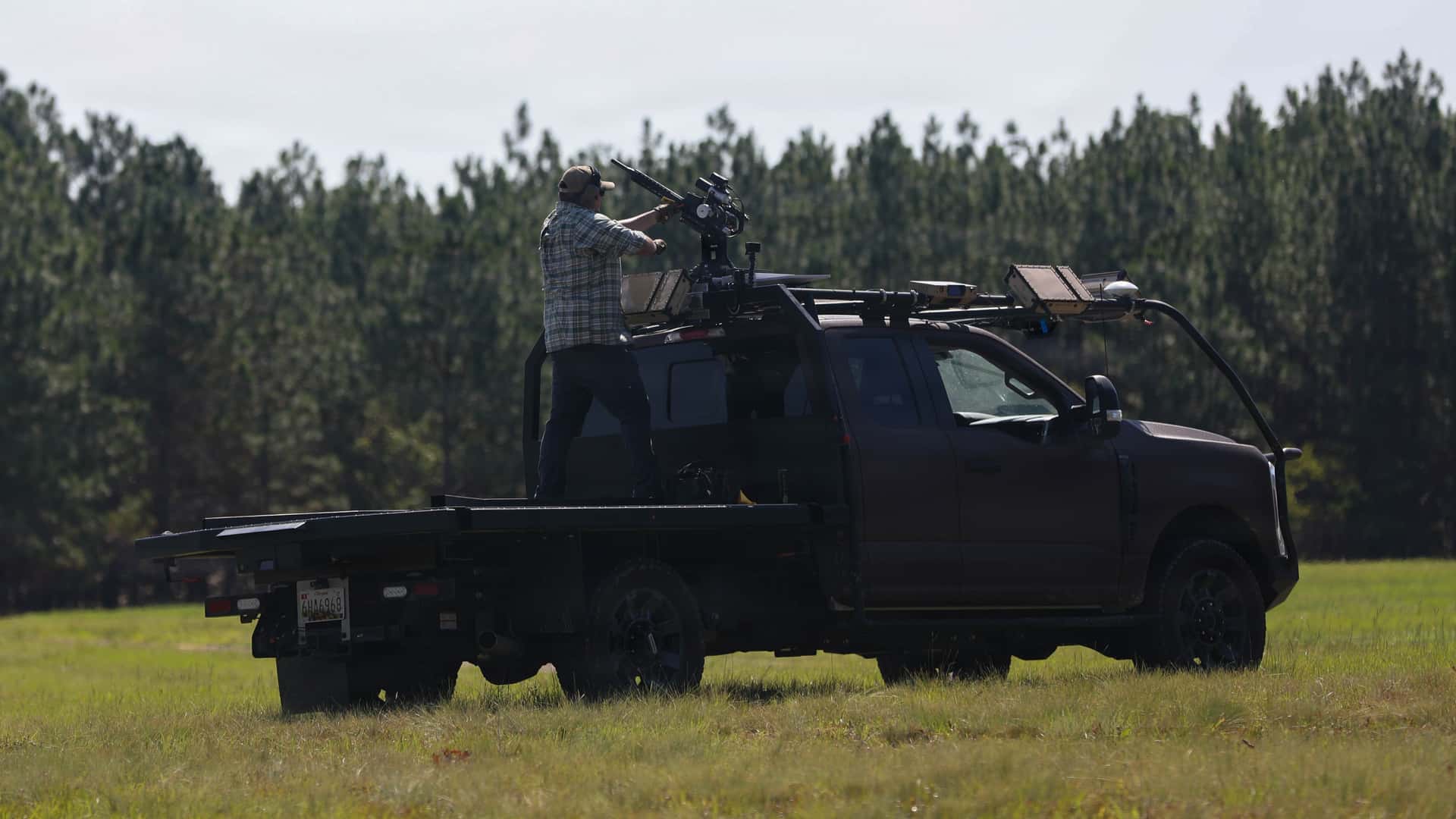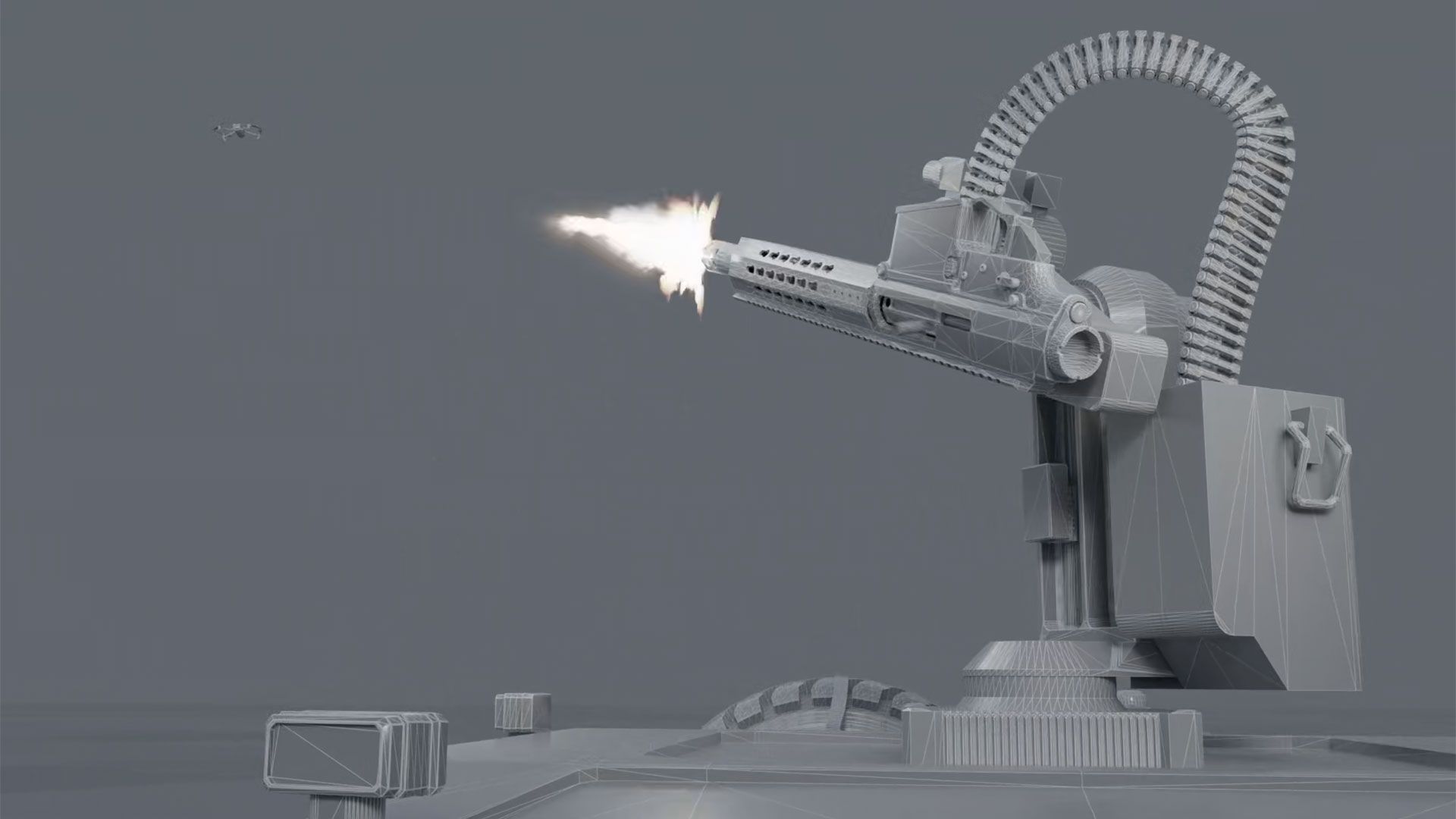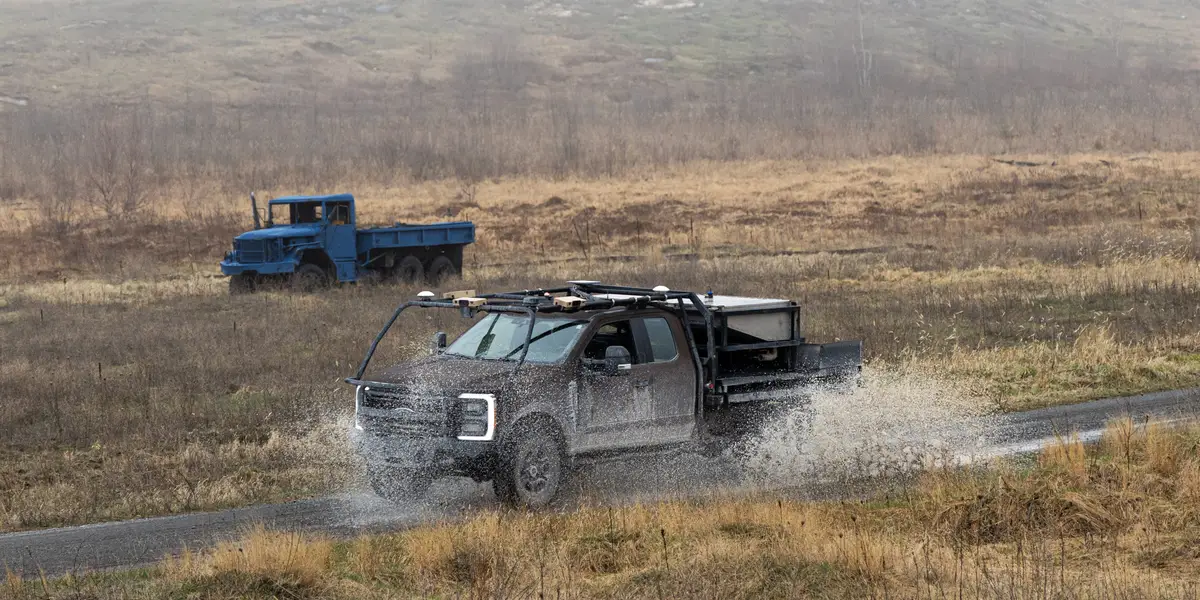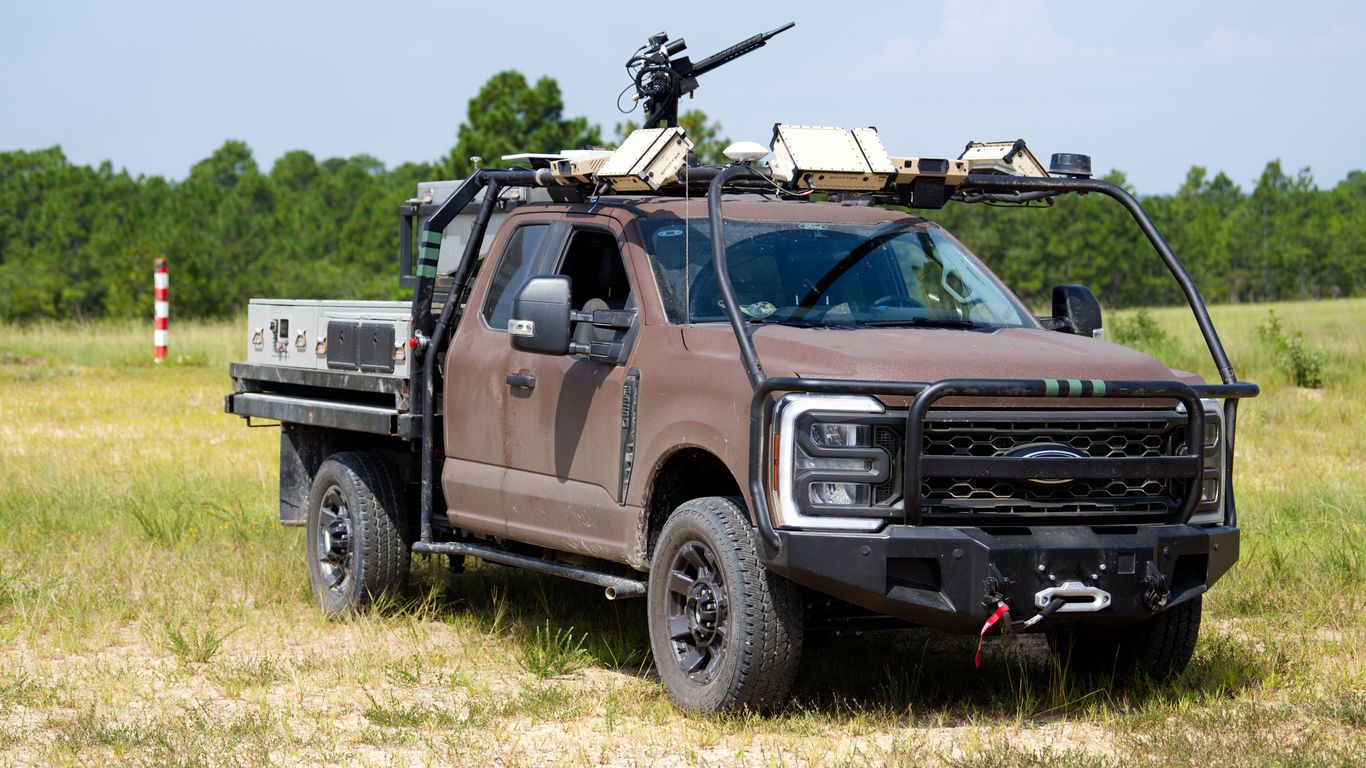
A Ford F-250, made smart and outfitted with counter-drone and counter-mine gear. Photo: Colin Demarest/AxiosFORT BRAGG, North Carolina — The scrubby, scorching-hot hills of Range 63 bustled last week with soldiers and contractors. Some nursed cans of Monster. Some rocked sunglasses and sun shirts. Some handled shotgun magazines.A futuristic Ford F-250 was posted at one end of the range. Atop sat a 12-gauge turret, dubbed Edda, that shredded two targets as they flew overhead. A small shipping container labeled "Bee Hive" was parked at the other end. It brimmed with Bumblebee V2 drones, which zipped toward the horizon one after the other.In the middle, a crew with Safe Pro AI pored over aerial imagery and algorithms to identify hidden mines. And somewhere farther off, another F-250 finessed a slurry line charge into place. Its detonation, seen and felt, hurled into the air smoke and dust.The big picture: This hourslong jam session was part of Sandhills 2.0, an ongoing experiment meant to remove U.S. troops from some of the bloodiest battlefield tasks, like breaching.More broadly, the tinkering shows just how deeply lessons from the Russia-Ukraine war have penetrated parts of the Army.Detonation aftermath, as seen from a berm at Range 63. Photo: Colin Demarest/AxiosWhat they're saying: "It's a new era of warfare," Col. Jeff Burges, commander of the 20th Engineer Brigade, told reporters at the range.The brigade manages Sandhills and is assigned to the XVIII Airborne Corps."Gone are the days of a soldier running with a grapnel hook," Burges said. "As we think through the next evolution, it's attacking the enemy with that attritable, autonomous mass."Zoom in: Texas-based 9 Mothers furnished the drone countermeasure, which used a Genesis Arms shotgun. (9 Mothers is working on a belt-fed system, designed in-house, according to CEO Russell Smith.) California-based Perennial Autonomy provided the drones, dozens of which can be stacked inside the hive. Maryland-based Forterra ruggedized the F-250s and made them smart, capable of self-driving, sensing and communicating."The Army is super self-aware that it needs to stop delivering yesterday's technology tomorrow," Col. Tom Monaghan, the director of the Joint Innovation Outpost, told reporters."That's why they're doing these types of on-site experiments with soldiers, with vendors, with acquisition professionals," he said."Something that's good enough 100% tomorrow isn't good if we're leaving today."Drones stacked inside the "Bee Hive." The container can be quickly hauled away. Photo: Colin Demarest/AxiosZoom out: Battlefields are increasingly mechanized. In Eastern Europe, autonomous and uncrewed tech is being used to assault trenches, evacuate the wounded, shuttle supplies and spy on positions far afield.Militaries and weapons makers are scrambling to keep up. Commercially available products with widely available, cheap parts are having a moment."I think there's a strong argument to be made that in order to really proliferate these UGVs at scale ... biasing toward a vehicle that looks like this and has a supply chain like this and has a maintenance tail like this is a good thing to do," Forterra's Phil Cotter told reporters while standing beside an F-250.What we're watching: Where and how the Army strikes a balance between tradition, like a multimillion-dollar assault breacher vehicle, and novelty, like an armed, self-navigating pickup truck.Go deeper: Army weapons shake-up backed by Hegseth and other Trump picks
At Fort Bragg, a jam session for a "new era of warfare"
"The Army is super self-aware that it needs to stop delivering yesterday's technology tomorrow."
535 words~2 min read