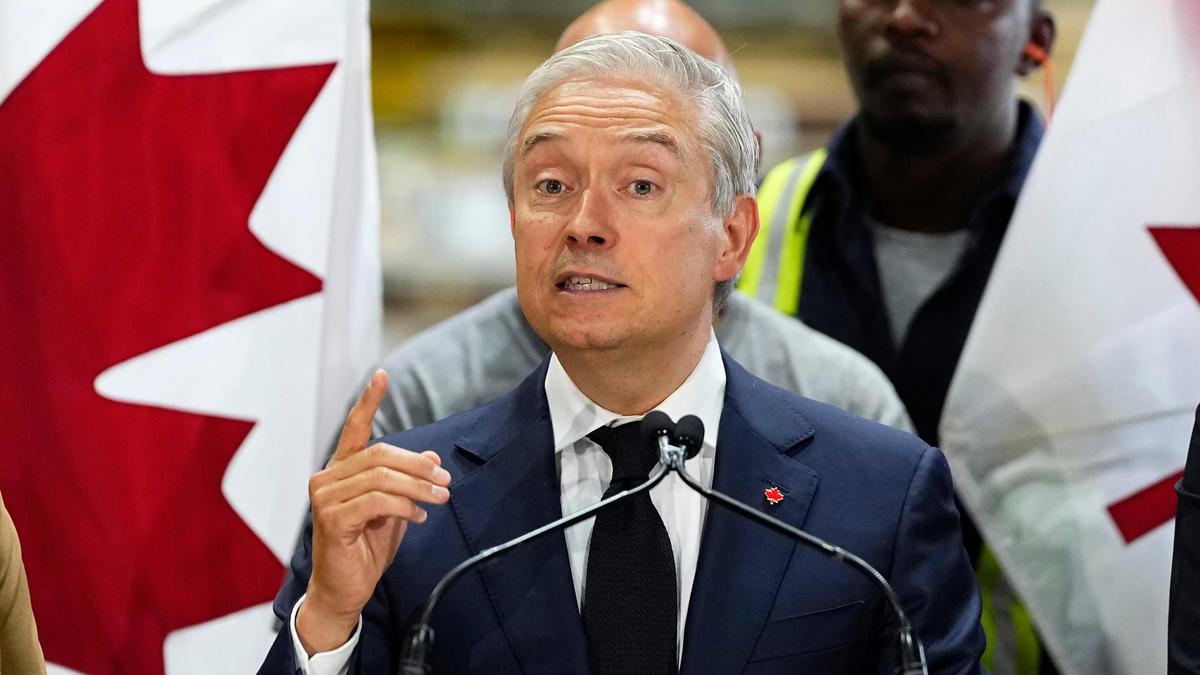
BusinessCanada is set to impose retaliatory tariffs on $27.6 billion worth of U.S. goods starting Sept. 8. For some Canadian businesses, these counter-tariffs stand to drive up the costs of the things they make, which could be another difficult blow for companies at a time when many are already impacted by the ongoing trade war with the United States.Move could drive up costs for business owners, and experts worry government supports won't provide enough helpAbby Hughes · CBC News · Posted: Aug 26, 2026 4:00 AM EDT | Last Updated: 1 hour agoListen to this articleEstimated 5 minutesThe audio version of this article is generated by AI-based technology. Mispronunciations can occur. We are working with our partners to continually review and improve the results.PhiBer Manufacturing owner Derek Friesen says Canada's retaliatory tariffs could increase costs for his Manitoba business, which he says could result in certain trailers that his company makes becoming too expensive to buy or sell. (Jaison Empson/CBC)Derek Friesen says the Canada-U.S. trade war had mostly bypassed his agricultural equipment manufacturing business, save for some of his products that were hit by an earlier round of 10 per cent duties.That is, until retaliatory Canadian tariffs on $27.6 billion worth of U.S. goods were announced today.His Manitoba company, PhiBer Manufacturing Inc. makes agriculture equipment, including dash trailers that are used by large-scale farmers to tend to crops. They've long imported the frames for these machines from Iowa, but starting Sept. 8, those frames will be subject to new retaliatory tariffs.Ottawa's counter-tariffs find broad support in Canada as businesses brace for trade war impactFriesen says taxing an important and expensive part like that will inevitably drive the sticker price way up."Farms can't absorb another big increase like that," Friesen said.PhiBer Manufacturing Inc.'s Dash trailers, used by large-scale farmers to tend to crops are made with frames imported from Iowa. Starting on Sept. 8, those frames will be subject to new retaliatory tariffs. (Jaison Empson/CBC)He expects these trailers, which make up about 70 per cent of his sales, might no longer be economically feasible to buy or sell in a few weeks time.For some business owners, retaliatory tariffs will bring higher costs, making it harder for some to weather the worsening trade war — even if others are hopeful these new countermeasures could boost their sales within Canada.Targeted list of newly tariffed itemsCanada will impose tariffs of 15, 25 or 50 per cent on a number of products from the U.S. starting on Sept. 8.The new levies will impact a variety of goods including seafood, certain paper products, furniture, apparel, tools and motorcycles. Some of the categories facing the largest tariffs are products made of iron or steel or the raw metals, paper products and machinery and parts.Bradley Saunders, an economist with Capital Economics, says that based on the list, it seems like the federal government took a targeted approach when deciding what to tariff."The majority of these goods have been picked as they have readily available domestic alternatives, in an effort to hurt American businesses while minimising the hit to Canadian consumers and industry," Saunders wrote in a note on Tuesday.He said the countermeasures would be relatively insignificant in the big picture, only giving a slight boost to inflation, while government support measures for businesses could offset about half of the possible drag on business growth.California governor 'absolutely' believes Trump will restart trade talks with Canada in 'a matter of days'Canada's big banks are shrugging off Trump's trade warAccording to another read of the numbers by University of Calgary economist Trevor Tombe, nearly three quarters of the counter-tariffed items are industrial supplies or things used to manufacture other goods — costs that would be felt more by businesses rather than consumers.But for some businesses like Danby Appliances based in Guelph, Ont., the new tariffs could even help a little.Danby owner Jim Estill says some of the parts his company uses will now face higher prices because of the retaliatory tariffs — for example, some of the cables used in their snowplows will now be subject to a 15 per cent tax under the new rules.Jim Estill, the owner of Guelph, Ont.,-based Danby Appliances, says retaliatory tariffs won't increase costs at his business by much, and could help keep U.S. competitors out of the Canadian market for some products like refrigerators. (Zachary Proulx/CBC)Estill says those added costs are manageable for him. And retaliatory 25 per cent tariffs on things like refrigerators could actually make his Canadian-made products a more competitive option for consumers in this country compared to those brought in from the U.S."So we may gain a little bit of market share," he said. "It's a double-edged sword."But the counter-tariffs will still likely hurt more than they help, Estill says — especially if the trade war causes customers to hold off on making big purchases, like a new fridge.Supports for businesses still not enough: CFIBSimon Gaudreault, chief economist at the Canadian Federation of Independent Business (CFIB), agrees that the retaliatory tariffs are mostly bad news for Canadian business owners. CFIB data shows that there are about two businesses that import components from the U.S. for every one that exports finished products south of the border, which means retaliatory tariffs can pose a larger threat to Canadian businesses.Q&ACanada 'can't afford' to wait for Trump to be reasonable, says jobs ministerTrump threatens to rename Lake Ontario 'Lake America' as trade feud heats up"Our economy is based on two-way trade. So now, on top of those export tariffs that the U.S. is putting on our shoulders, we are also putting counter-tariffs on our own shoulders," Gaudreault said.While many of those measures were later suspended, Gaudreault worries fresh ones will have a similar effect and says he's concerned that business owners won't have the capacity to withstand another shock like this.WATCH | Feds announce 'dollar-for-dollar' counter-tariffs on billions in U.S. imports:Feds announce 'dollar-for-dollar' counter-tariffs on billions in U.S. importsAugust 25|Duration 1:15Finance Minister François-Philippe Champagne says Canada will match the latest round of U.S. tariffs in a 'proportionate, targeted and strategic' way. Champagne says the tariffs, which will impact more than $27 billion in U.S. goods, are 'all about fairness.'He's also not optimistic that new support measures will do much to help. Along with announcing the retaliatory tariffs, the federal government said it would create a $7.5-billion support package for businesses and workers affected by the trade war. Some of that will go toward enhanced employment insurance measures, while $1.5 billion will be set aside for medium-sized businesses to access through regional development agencies, and millions more will go toward grants and interest-free loan programs. Federal ministers announce support for Canadians, counter-tariffs against U.S.Tens of thousands of jobs, half a point off GDP: Canada-U.S. trade war by the numbersGaudreault says those programs are "unfortunately similar" to past programs the government has used to try to stimulate businesses earlier in the trade dispute. He says only one per cent of the CFIB's membership used them, largely because they had certain requirements — like requiring $2 million in revenue in order to access supports — that prevented small business owners from applying.And while that particular threshold was lowered to $1 million in Tuesday's announcement for a certain program, Gaudreault still worries the measures will miss lots of businesses.Friesen says the only thing that will really help is an end to the trade war."We just need this to be resolved," he said.ABOUT THE AUTHORAbby Hughes is a writer with CBC News based in Toronto. Originally from Orillia, Ont., she studied journalism at Toronto Metropolitan University. She covers news from the worlds of business, entertainment, health, science and education, and her favourite stories focus on the real people in those areas — the customers, fans, patients, citizens and students. You can reach her with story ideas at abby.hughes@cbc.ca.With files from Cameron MacIntosh and Laura MacNaughton
Retaliatory tariffs could raise costs for Canadian businesses already weathering the trade war | CBC News
Canada is set to impose retaliatory tariffs on $27.6 billion worth of U.S. goods starting Sept. 8. For some Canadian businesses, these counter-tariffs stand to drive up the costs of the things they make, which could be another difficult blow for companies at a time when many are already impacted by the ongoing trade war with the United States.
1,306 words~6 min read