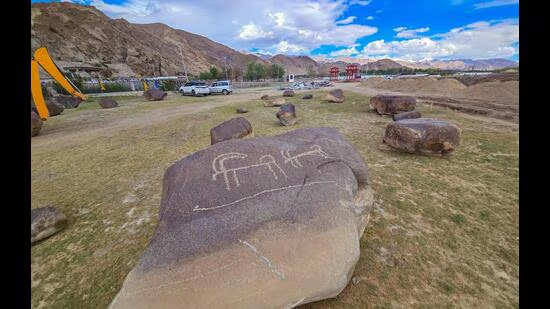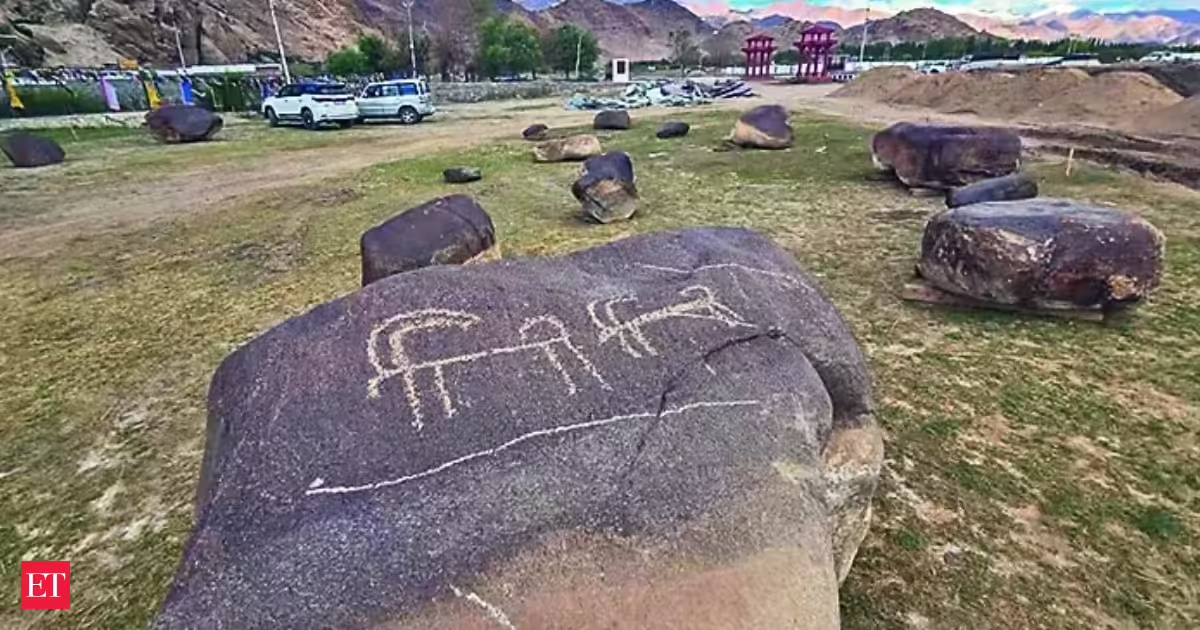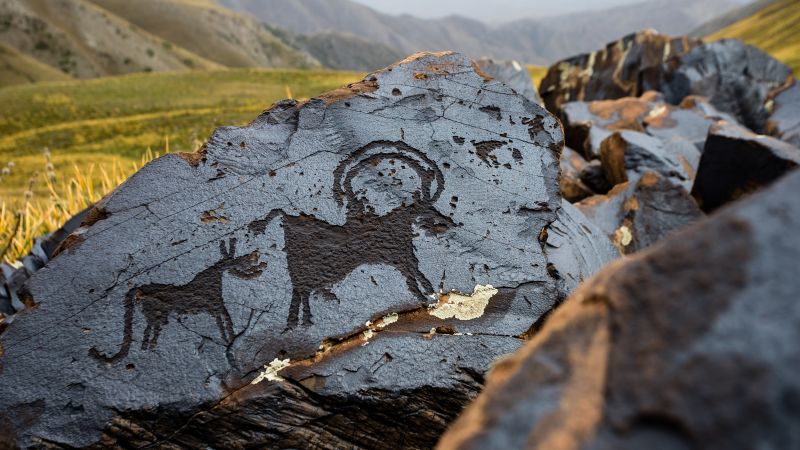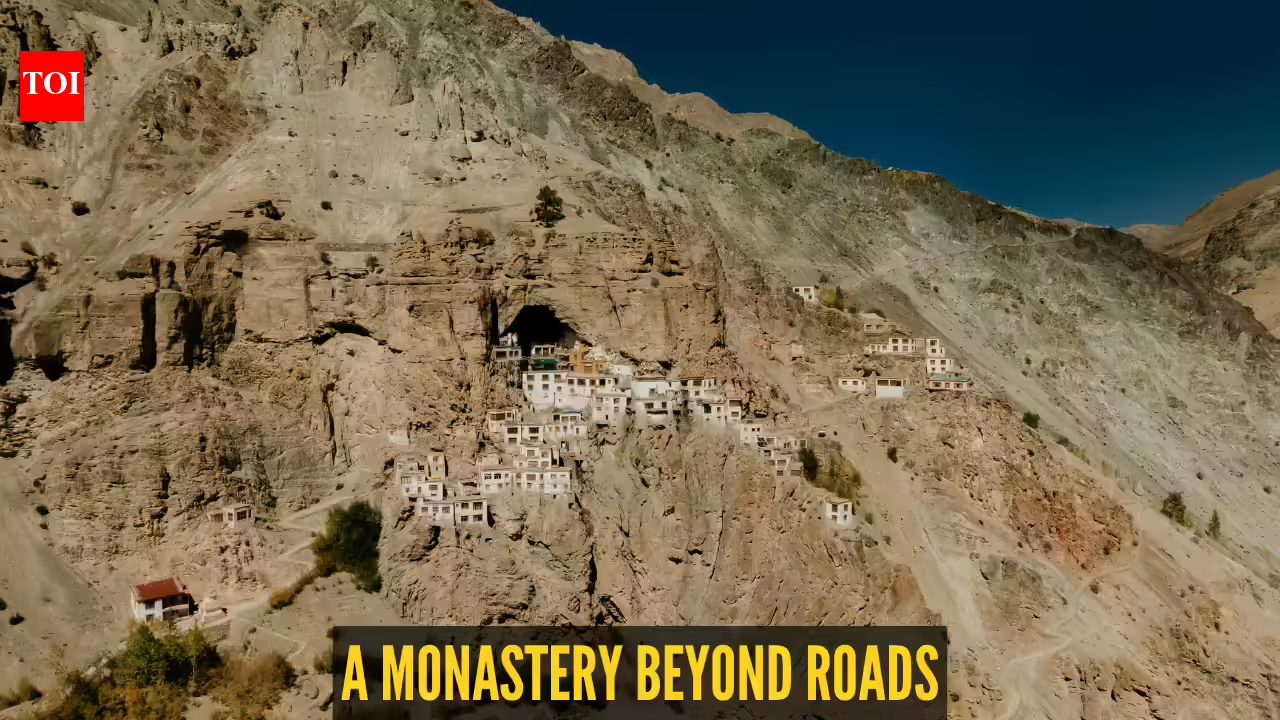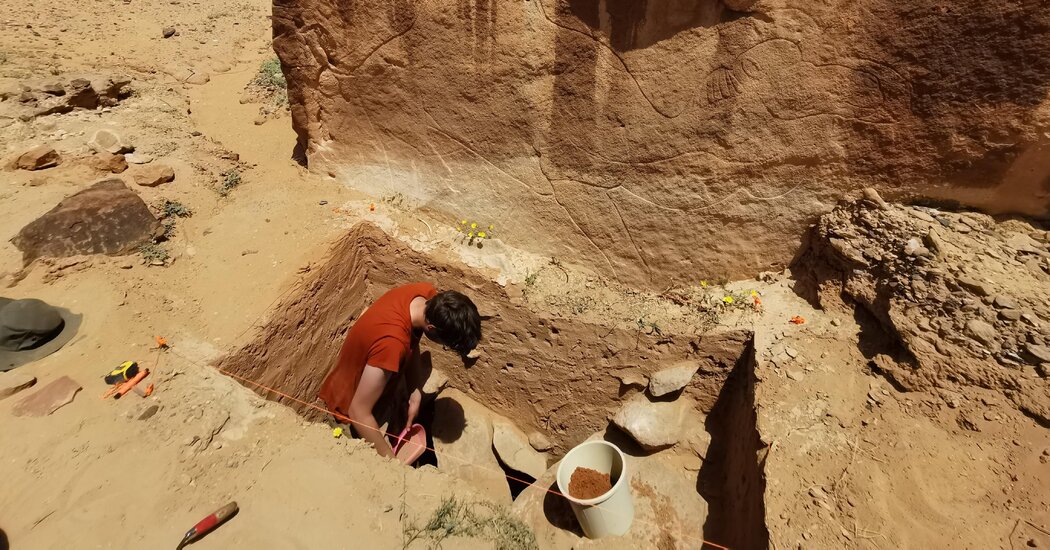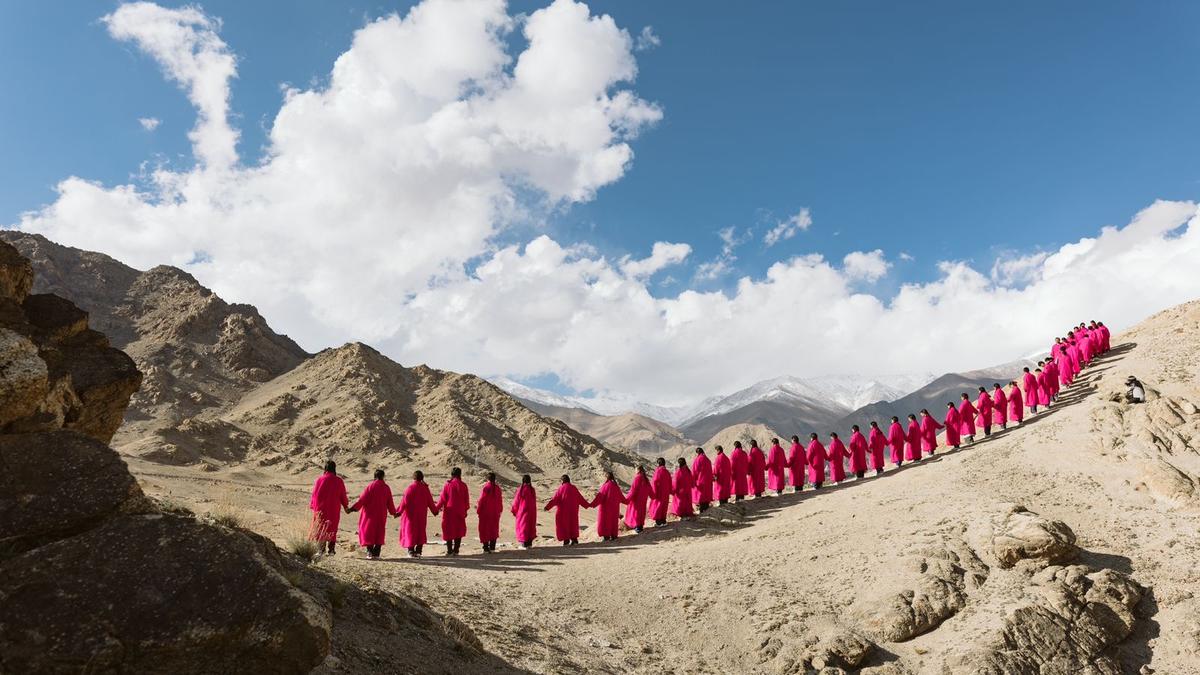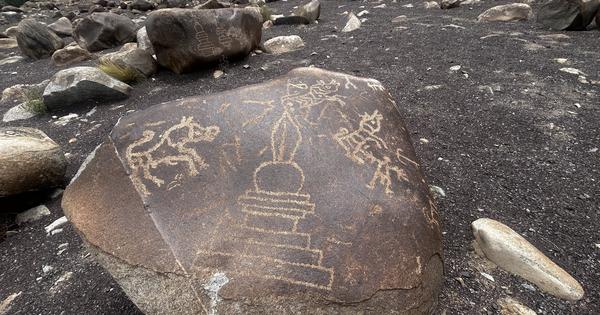
The phrase “open-air art exhibition” usually brings to mind a curated arrangement of contemporary artworks in elegant, manicured surroundings. But consider a different kind of public art display – scattered across rugged landscapes, exposed to the elements and unmoved for thousands of years.In Ladakh, it is not unusual to stumble upon such a gallery in the wild, in the form of its vast and diverse heritage of ancient petroglyphs, or rock carvings. One such site lies at Alchi, 65 km west of Leh, within walking distance of its fabled medieval monastery. Access to the gated petroglyph field is easy by road and the site is officially open to visitors, though getting inside may require a little gymnastics to surmount the enclosure wall.The exercise is worth it.Atop a shelf overlooking the majestic downstream flow of the Indus lie about 250 large, smooth boulders bearing a gallery of primeval images. Strolling through the field, one spots animals, architectural forms, abstractions and inscriptions incised into the stone, their outlines stark against the dark obsidian lustre of the rocks. A weathered metal signboard installed by the tourism department dates the oldest pictures to the Bronze Age (3300-1200 BCE), while the presence of Tibetan inscriptions suggests that the site continued to receive interventions well into the middle centuries of the second millennium CE.Carved historiesBefore examining Alchi more closely, it helps to survey the broader canvas of petroglyphs across the region, numbering in the thousands. In an article for Sahapedia, zoologist Tashi Ldawa Tshangspa, who has studied Ladakh’s petroglyphs for three decades as part of a small group of independent researchers, notes their documentation of hundreds of sites throughout the territory of Ladakh: along the upper and lower banks of the Indus, in valleys such as Domkhar and Nubra, on the high plateau of Changthang, and in lower-altitude settlements such as Chilling and Alchi.Situating these carvings, “pecked and chiselled into rock surfaces”, within a historical geography stretching from Baltistan to Tibet, Tshangspa traces the earliest examples to the Neolithic Age, “with the bulk…attributed to the Bronze Age or Iron Age”.Credit: Viraf Mehta.In another essay, Ancient Petroglyphs of Ladakh: New Discoveries and Documentation, Tshangspa provides an overview of the form and historiography of Ladakh’s oldest art. Sorting through the most common iconographic types – some highly localised, others distributed across vast distances – he offers a taxonomy of imagery: masks and giants; human figures “involved in activities such as hunting, dancing, fighting and conducting rituals”; zoomorphic representations, most commonly native “ungulates such as Siberian ibexes, blue sheep, urials, antelope and yaks”, birds, and domesticated beasts like horses, dogs and camels; runic symbols, and inscriptions in various ancient languages.Tshangspa points out how relatively recent the systematic study of petroglyphs in Ladakh and its neighbouring regions is. These prehistoric carvings first began to be documented in the late 19th and early 20th centuries by European missionaries, travellers and academics. Following Ladakh’s reopening to tourism in 1974 after 25 years of isolation, researchers picked up the thread again. Among them were David Snellgrove and Tadeusz Skorupski, who published photographs of Alchi’s petroglyphs, along with translations of its inscriptions by Philip Denwood, in the second volume of The Cultural Heritage of Ladakh.Snellgrove and Skorupski’s visual record from half a century ago appears remarkably consistent with the rocks scattered across the site today. Identifying the roughly two-metre-wide boulders as either igneous or metamorphic, they describe their surfaces as having been rounded, smoothed and darkened by water and weather. The sharply delineated drawings and inscriptions, they suggest, were “made by scratching or bruising away the very thin surface layer to reveal the body of the rock, much lighter in colour”.Credit: Kamayani Sharma.In later, medieval Buddhist images and inscriptions, the effect was sometimes reversed: the area surrounding a form was scratched or bruised away, leaving the figure itself in the rock’s dark surface coloration. While Snellgrove and Skorupski were particularly interested in Alchi’s epigraphs in the late 1970s, archaeologist and historian John Vincent Bellezza’s 2023 article Early Himalayan Rock Art reflects a contemporary shift toward analysing the images themselves. Bellezza suggests that carvers may have deliberately favored Alchi’s boulders specifically for their “dark purplish patina”.That patina is more than an aesthetic feature. According to Tshangspa, it may eventually prove useful in attempts to develop a chronometric method for dating the petroglyphs. Rock varnish – the thin coating of mineral particles deposited on exposed rock surfaces in desert environments such as Ladakh’s cold, high-altitude landscape – contains manganese and iron, which cause the surface to darken and redden. When a petroglyph is created through abrasion, the lighter inner layer of rock is exposed. Over time, the varnish grows back across the exposed surface, a process known as repatination. Studying this regrowth could potentially provide clues to the relative age of a carving, although techniques for refining the method are still being developed.Prehistoric echoesCiting archaeologist Laurianne Bruneau’s dissertation as the source for her inventory of the Alchi carvings – “24 anthropomorphic figures, 91 zoomorphic figures, and 328 stepped structures, as well as 131 rock inscriptions” – Bellezza catalogues the site’s imagery: ibexes and felines resembling snow leopards, hunting and combat scenes, swastikas, and outlines of stepped architectural structures, including stupas.Ibexes and felines are ubiquitous in Ladakh’s lithic bestiary. Bellezza describes one particularly striking image at Alchi: a leaping feline, probably a snow leopard, “one of these tigrine animals covered in chevronlike stripes…with its pointed ears, gaping jaws, large round eye, flexed legs, and tail curling over the back”.Credit: Kamayani Sharma.In their essay Petroglyphes archaïques du Ladakh et du Zanskar, archaeologists Henri-Paul Francfort, Daniel Klodzinski and George Mascle note similarities between these Alchi felines and related figures found from Tibet to Mongolia and China. In particular, they argue that the leaping posture, volute tail, striped coat and curved claws evoke the imagery of Chinese ritual bronzes of the Zhou period, dating from between the 6th and 5th centuries BCE.Given Ladakh’s location at an ancient crossroads between South, Central and East Asia, such resemblances are perhaps unsurprising. Tshangspa reports Bronze Age motifs such as masks and giants extending from Nubra through present-day Pakistan to Siberia. An essay by Bruneau and fellow archaeologist Martin Vernier, Animal style of the steppes in Ladakh: A presentation of newly discovered petroglyphs, discusses the influence of artists associated with the Eurasian Saka peoples on zoomorphic petroglyphs in what is now Ladakh during the first millennium BCE.Analysing and classifying drawings from a number of sites, Bruneau and Vernier identify specific iconographic elements they designate as “steppic” design: tip-toe hooves, folded forelegs and patterned bodies. They raise the question of whether these protohistoric artefacts signal dissemination through migration from Central Asia to the Western Himalayas, or an independent line of development shaped by the movement of images and ideas.The relationship between Ladakh’s petroglyphs and farther-flung artistic traditions is also suggested by their locations. Tshangspa writes in Ancient Petroglyphs of Ladakh that they are frequently found “on or near the main transport routes…bridges or river crossings”, along the historic and prehistoric trade routes of the region.Credit: Federico Carpani.Alchi’s location at a crossing of the Indus would therefore have made it a natural site for artistic interventions during the Stone and Metal ages. Its later integration into the Silk Route towards the beginning of the Common Era, and the establishment of a major Buddhist monastery in the late 10th century CE, would have brought further travellers and potential carvers to the area. The preponderance of ziggurat-like forms denoting Tibetan stupas (chörtens) and inscriptions probably belongs to the medieval centuries, when Buddhism was spreading across the trans-Himalayas under Tibetan influence.In their essay Evidence of Human Presence in the Himalayan Mountains: New Insights from Petroglyphs, Vernier and Bruneau point to a carving of a triple stūpa, below which two birds face each other on either side of a lotus petal. The composition has given these otherwise prehistoric-looking figures a Buddhist connotation.Snellgrove and Skorupski, meanwhile, suggest that the existence of pre-Buddhist animal and bird drawings may have prompted early Buddhist artists to add images of chörtens, which they posit are modelled on the set of eight stupas associated in Tibetan Buddhism with events in the life of Buddha. “Probably,” they write, “we shall not be far wrong in dating the older types around the time of the founding of the Alchi temples.”Their particular interest in the Tibetan inscriptions led them to suggest that these were carved by Tibetan-speaking military personnel who camped at the Alchi petroglyph field. The location would have been strategically useful: close to water and offering an elevated vantage point along what they describe as a “major invasion route”.Credit: Kamayani Sharma.Rock recordsThe Rock Art Resource Centre in Leh offers another layer to this history. Its members are a group of dedicated researchers – Tshangspa, Viraf Mehta, Sonam Wangchuk, Sonam Choldan Gasha and Quentin Devers. Over the phone, Mehta contextualises the continuity of human activity at Alchi over millennia by citing the discovery of Paleolithic tools and remnants of Kushan-era gold mining near the petroglyph field. “About a thousand years ago...armies belonging to Tibetan forces, Ladakhi generals and clans were camped at Alchi on their expeditions to invade Baltistan,” he added.At the Centre’s office in downtown Leh, Wangchuk says the group has documented 800 sites so far. Among the rarer images are exotic animals such as a giraffe and incongruous ones such as a pig, neither native to Ladakh, as well as singular compositions such as a woman giving birth.Yet this vast archive of rock art is increasingly vulnerable to infrastructural and environmental interference. Along with their colleagues, Wangchuk and Tshangspa have been campaigning for the preservation of petroglyphs for many years, finally approaching the Union Territory administration “for a small piece of land where we can preserve all these vulnerable rocks”.This April, their efforts bore fruit when Ladakh’s government announced a petroglyph conservation park in collaboration with the Department of Archives, Archaeology and Museums and the Archaeological Survey of India. The land allotted is at Sindhu Ghat, near enough to transport rocks from in and around Leh, particularly “the most vulnerable ones”, including those from locations where villagers “distribute lands among themselves”.Credit: Kamayani Sharma.Wangchuk says the group has identified 200 rocks within a 100-km radius between Leh and Shara, nearly 50 of which have already been transported. The logistics of moving such ancient and precious cargo might seem daunting. Wangchuk, however, appears confident as he describes the process of using a crane to place the rocks into a truck: “the small ones are easy to move without a scratch, and for the big ones, we pack them up in thermocol”.It’s not only contemporary climate change that is relevant to a discussion of petroglyphs. Their millennia-long durability and immobility have also made them a potential source of supplementary information about palaeoclimatology.A recent study by scientists at the Birbal Sahni Institute of Palaeosciences turned to the depictions of animals in rock art to corroborate data from extant faecal remains. The hunting scenes point to the consumption of meat by humans, and the confirmation of dietary practices, in turn, provides clues about animal habitats and ecology, potentially helping researchers track climatic variation during earlier phases of the Holocene.Mehta says that rock carvings in Ladakh started being made in the Stone Age after “we moved away from icy, glacial periods to much warmer periods, so people were carving art by then and aware of these changes”. He cautions against treating petroglyphs as straightforward natural-history records: they “were not supposed to be a glossary of flora and fauna over here”. Scientific studies may reasonably use the carved images to corroborate other evidence, but, as Mehta reminds us, “They’re depicted for symbolic reasons…they are not necessarily supposed to be taken literally in all cases.”Credit: Kamayani Sharma.One of the early images at Alchi that Bellezza draws attention to is an Iron Age hunting scene, dated to 700-100 BCE. Four ibexes, their distinctive horns curling backwards, gather around a hunter holding a raised bow and arrow aimed at one of them. Though the prevalence of hunting meant that its depiction was a recurring composition across the region, Bellezza argues for its metaphorical rather than mimetic value based on the lack of linear perspective in prehistoric representation: “...the perspective used in the work stresses the prowess of the hunter as a provider of sustenance, while at the same time articulating various social and religious calculations that accompanied this most basic of human activities…the literal documentation of the hunt assuming second place to a set of grandstanding social considerations and ritualized demonstrations.”Before exiting the enclosure, one might pause to reflect on the enigmas encrypted in Alchi’s petroglyphs, brushing against the very reason our species makes pictures.The late-morning sun limns the ripples of the river gushing thousands of feet below and the folds of the gorge as they plunge into it. Mountain lizards scamper across the sleek black rocks, the carvings gleaming white against their sheen.Was the weather similar on that day 3,000 years ago when an artist chiselled the triangle of a human torso, the stripes of a big cat or the arc of an ibex’s horn? Were they drawing from the memory of a hunt, recording an animal in their world, or crafting an allegory about power?The gurgle of the Indus softens the remoteness, collapsing time with its constancy, uniting the artist’s labour and the viewer’s marvel across centuries.Kamayani Sharma is an independent writer, researcher and podcaster based in New Delhi. This project was made possible under the Scroll x MMF Arts Writer Grant.
In Ladakh, an ancient art gallery is hiding in plain sight
Scattered across rugged boulders and exposed to the elements for millennia, Ladakh’s prehistoric petroglyphs reveal a deep history of trade and ritual.
2,257 words~10 min read