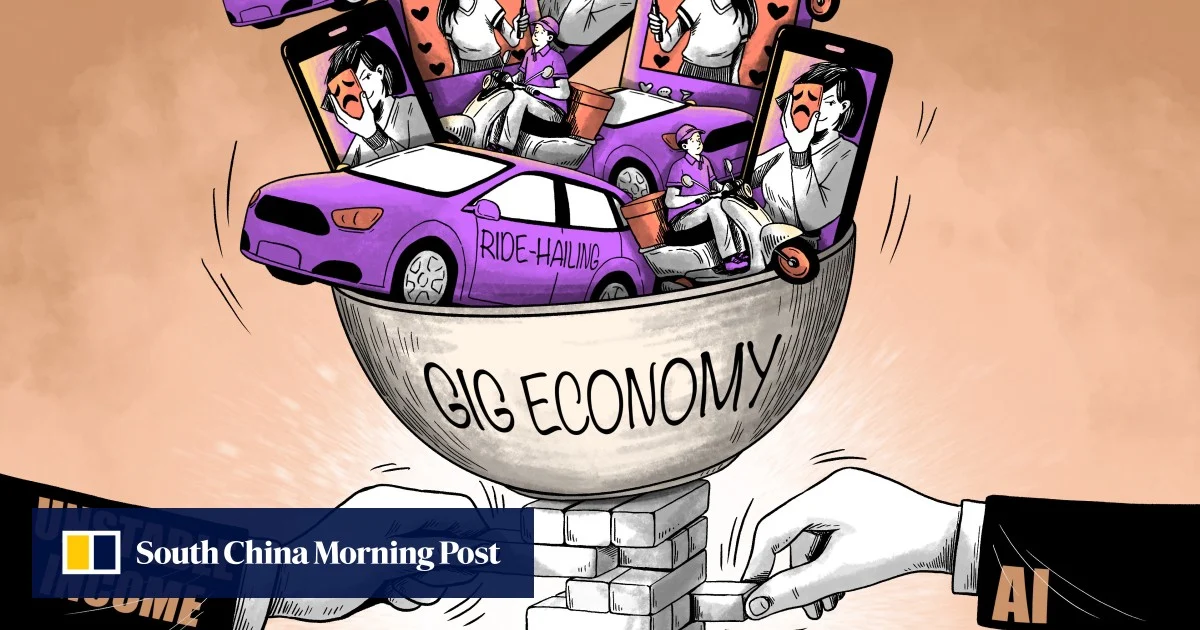
1. In December, Li Yun, a recent university graduate, spent her weekends working various short-term roles such as a dentist or flight attendant at a children’s career center, earning 100 yuan ($14.57) a day. Despite her double major in education and literature, Li finds herself emblematic of China’s growing population of “flexible workers” in a difficult job market marked by shrinking full-time opportunities. [para. 1][para. 2]2. In China, “flexible employment” covers anyone working over an hour per week for pay but without a full-time contract, including freelancers and gig workers. Official recognition of this trend is new—by late 2025, Vice Minister Wu Xiuzhang estimated over 200 million Chinese were in flexible work, representing 27% of the country’s total workforce and 43% of the urban labor force. [para. 3][para. 4][para. 5]3. Flexible workers lack the benefits and stability of traditional employment, such as steady income and a social safety net. Recent graduates like Li Yun, Luo Yi, and Wen Yu find themselves performing extreme tasks for inconsistent pay, from brewing 100 cups of coffee in two hours to photographing 1,500 images in three hours, earning anywhere from 20 to 1,000 yuan per gig. [para. 6][para. 7]4. Scholars warn the trend could push flexible workers toward 60% of China’s total workforce, exposing serious gaps in social protection. Many workers, facing costly insurance premiums and unstable jobs, have adjusted by discarding old career ambitions and focusing on self-reliance as they navigate this challenging new market. [para. 7]5. The scope of gig work in China is massive and growing. State media reported roughly 240 million gig workers by the end of 2024. A study found that 36.4% of job seekers on a major portal sought flexible work, and over 16% of university graduates from 2020-2021 entered the gig economy due to a lack of steady jobs. [para. 9][para. 10]6. Li Yun’s search for stable work took her through multiple short-term gigs, from anime conventions to fast-food kitchens, where grueling, poorly-paid trials left her frustrated. She is among 12.22 million college graduates in 2025 contending with a tight labor market; that year, unemployment for ages 16-24 (excluding students) hit 18.9%. [para. 12][para. 13][para. 14]7. Not all choose gig work from necessity. Luo Yi, a 2024 graduate, rejected a prestigious gaming job, fearing the physical and mental toll of endless hours. Many young Chinese prioritize personal well-being and independence over traditional career success, while older workers often enter the gig economy after layoffs from more stable sectors. [para. 15][para. 16][para. 18]8. Survey data reveals widespread dissatisfaction among gig workers: over 54% report unstable income and 41% lack of basic guarantees. While some, like photographer Wen Yu, find significant income in peak seasons (up to 30,000 yuan a month), overall volatility and health risks remain high, with income extremely skewed—e.g., the top 0.25% of livestreamers take 90% of earnings while the vast majority earn little. [para. 22][para. 23][para. 25][para. 27]9. Employers are adopting flexible hiring to reduce costs and avoid traditional obligations. The standard employment system is shrinking fast; for example, a major restaurant chain shifted from all-standard contracts in 2021 to only 30% by 2024, and up to 70% of certain tech company divisions now rely on outsourced, younger staff. Over 61% of firms were using gig-based labor as of 2021, with nearly 29% relying on it for skilled roles. [para. 30][para. 31][para. 32][para. 33][para. 34][para. 35]10. China’s social safety net is failing to keep up. Social insurance premiums for freelancers can reach 35-40% of their revenue, unaffordable for most. Government pilot programs offer some protections, but many workers remain uncovered. Reform debates continue over whether to decouple social benefits from employment status or update labor laws for the new era. [para. 36][para. 37][para. 38][para. 39][para. 40][para. 41]11. Amidst this “wilderness,” young people are letting go of prestige-based employment expectations and seeking meaning in self-driven work. Some, like Li Yun, are reigniting old passions (studying for a teaching certificate) or starting entrepreneurial ventures, believing that “life is a wilderness, not a track.” [para. 43][para. 44][para. 45][para. 46]AI generated, for reference only
Cover Story: How China’s Growing Gig Economy Has Left a Generation Adrift
‘Flexible workers’ make up an estimated 27% of the country’s total employed population, creating a new class of employment defined by instability and anxiety that the government is just starting to address
675 words~3 min read