Editorial
President Prabowo Subianto was marketed as a bold foreign policy visionary, but his record reveals an administration driven by reactive damage control rather than strategic global leadership.
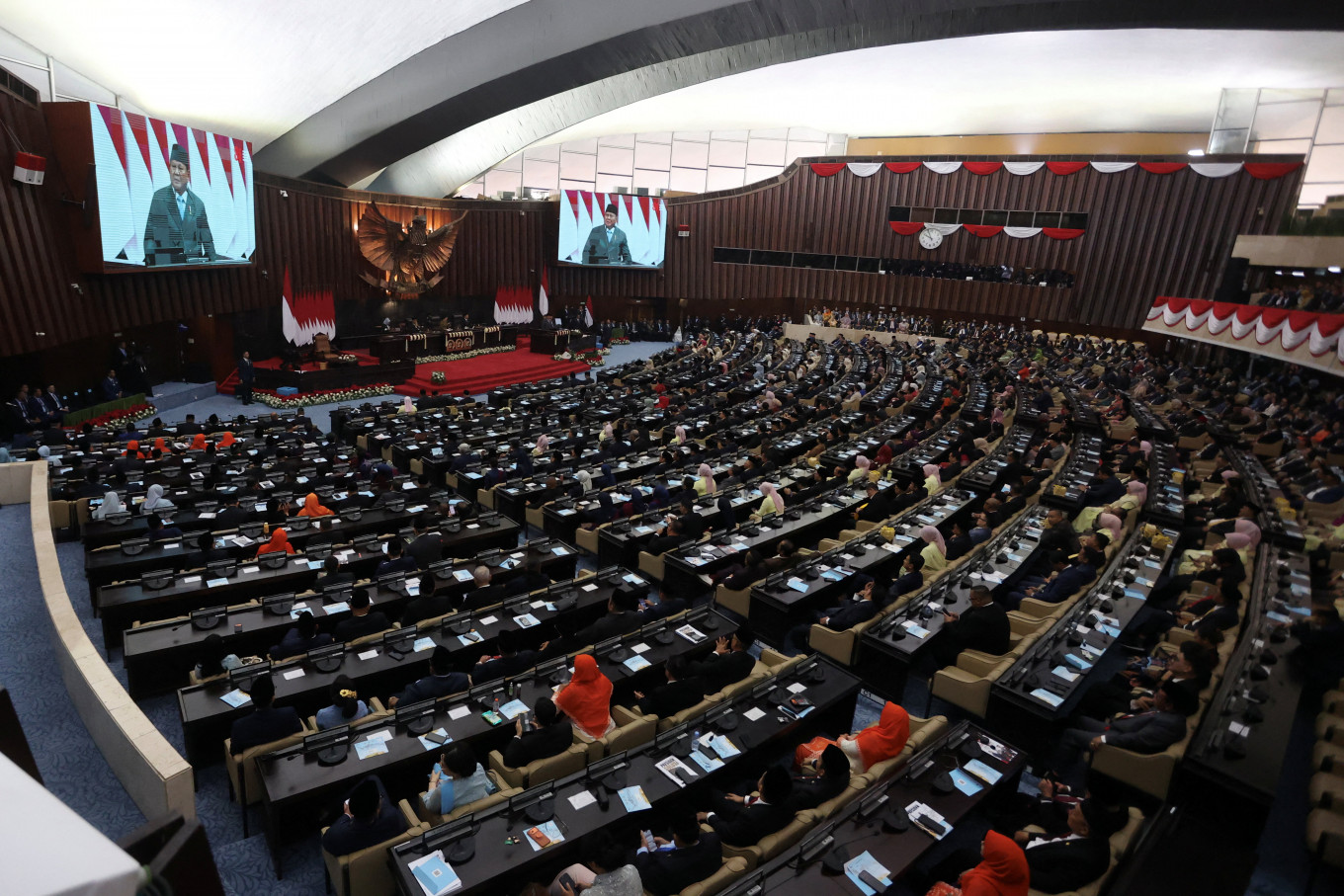
President Prabowo Subianto is displayed on screens as he delivers his annual state of nation address in front of legislator while Vice President Gibran Rakabuming Raka sits next to him, on Aug. 14 ahead of the country's 81st Independence Day anniversary, in Jakarta. (Reuters/Stringer)
When President Prabowo Subianto addressed the joint legislative session on Aug. 14, his commentary on global affairs was whittled down to three brief sentences: "We know the world is facing geopolitical conflict, trade wars, open wars in Europe, the Middle East and elsewhere," he said. "In this situation, Indonesia must increasingly be able to stand on its own two feet."No ASEAN agenda. No mention of Iran, the Strait of Hormuz or the Pertamina tankers stranded in a waterway that should have been open to all. No vision for Indonesia's role in the geopolitical disorder he had just described.
The entirety of his foreign policy statement was a domestic resilience argument dressed in geopolitical buzzwords.