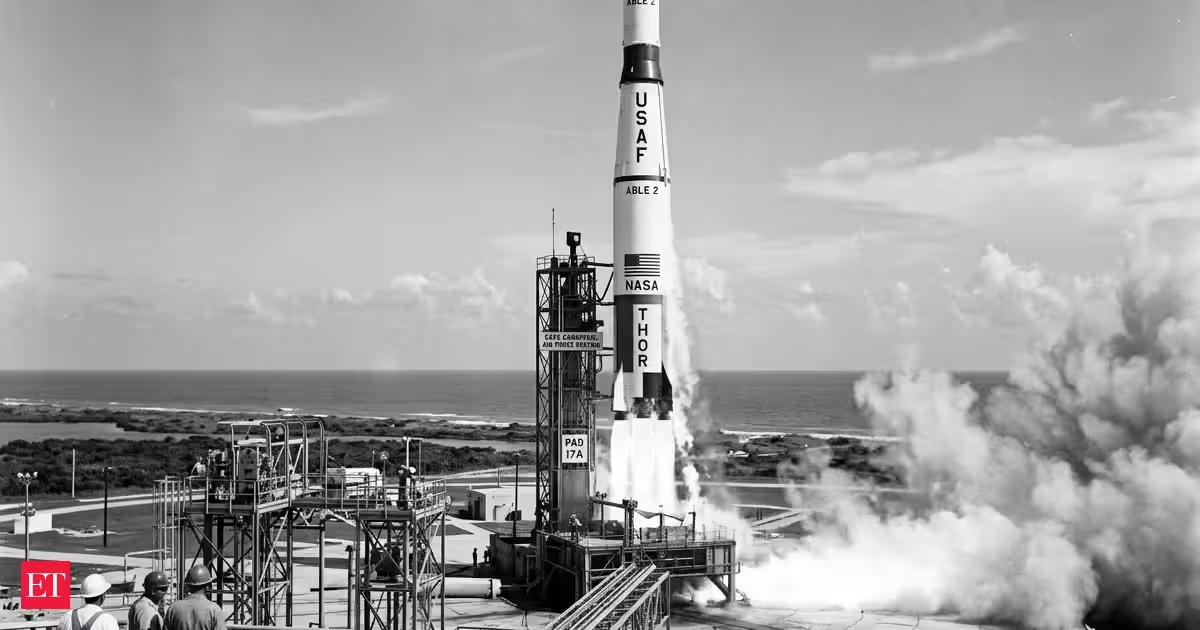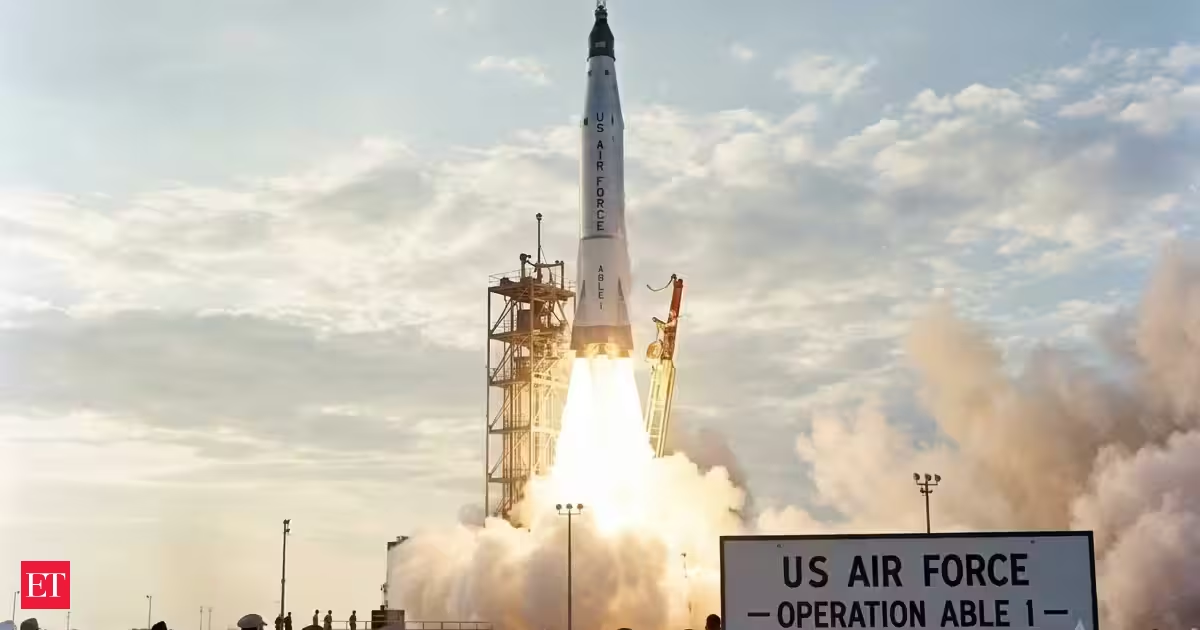
In 1958, US Air Force launched an Able 1 spacecraft to the Moon in humanity’s first attempt to send a spaceship anywhere beyond Earth orbit. The mission was planned as an attempt to place a spacecraft around the Moon. Able 1 was launched from Cape Canaveral Air Force Station in Florida on Aug. 17, 1958. The spacecraft carried instruments that were designed to study conditions during the journey and near the Moon. However, the mission ended shortly after launch. The Thor first stage exploded 73.6 seconds after liftoff. The spacecraft continued transmitting data for at least 123 seconds after the explosion. The mission later became known as Pioneer 0.Able 1 was the first attempt by any country to send a spacecraft into deep space. It was also the first attempt to send a spacecraft to the Moon. The spacecraft was built for a lunar orbit mission. It was launched on Aug. 17, 1958, at 12:18 UT from Launch Complex 17A at Cape Canaveral Air Force Station in Florida.The mission was carried out by the Advanced Research Projects Agency, or ARPA, and the U.S. Air Force Ballistic Missile Division. At the time, NASA did not yet exist. NASA was established a few months later.Able 1 weighed 84 pounds, or about 38 kilograms. Its target was Earth’s Moon, and its main objective was to enter lunar orbit. The mission was part of the early United States effort to explore space beyond Earth orbit. It came about six and a half months after Explorer 1, which was the first U.S. satellite.You Might Also Like:Why the Moon mission was planned?On March 27, 1958, the U.S. Department of Defense announced plans to launch four or five lunar probes later that year. The missions were placed under the supervision of the Advanced Research Projects Agency as part of scientific investigations during the International Geophysical Year.The original plan divided the missions between the U.S. Army and the U.S. Air Force. One or two missions were to be carried out by the Army’s Ballistic Missile Agency. The other three were assigned to the Air Force’s Ballistic Missile Division.Able 1 was the first of three planned Air Force attempts. It also became the first attempted deep-space launch by any country. The mission was therefore part of a larger effort to send spacecraft beyond Earth and study the Moon.The spacecraft and its instrumentsAble 1 was a squat, conical spacecraft made from fiberglass. Space Technology Laboratories, also known as STL, built the spacecraft. The spacecraft carried a group of instruments for scientific measurements.Its instruments included:A magnetometer to measure magnetic fields.A micrometeoroid detector to detect small particles in space.Two temperature sensors.A TV camera.A crude infrared TV scanner.The infrared device was designed to detect thermal radiation from the lunar surface. It used a small parabolic mirror to focus reflected light from the Moon onto a cell. The cell was designed to produce a voltage based on the amount of light it received. The information could then be transmitted back to Earth.Engineers also had to manage the spacecraft’s temperature. They painted dark and light stripes on its outside surface to help regulate its internal temperature. Before launch, the spacecraft was disinfected with ultraviolet light.How the launch vehicle was designed?The launch vehicle used for Able 1 was a three-stage version of the Thor intermediate-range ballistic missile, or IRBM. The rocket also used elements taken from the Vanguard rocket. These elements came from the second and third stages of the Vanguard launch vehicle.The project involved about 3,000 people. They came from 52 scientific and industrial firms. Almost all of those companies were based in Southern California. Only six of the firms involved were located elsewhere. This shows the number of organizations that were involved in the first U.S. attempt to send a spacecraft beyond Earth orbit.What Able 1 was supposed to do?The planned mission called for Able 1 to travel toward the Moon after launch. According to the planned mission profile, the spacecraft was expected to reach the Moon’s vicinity about 2.6 days after launch. After reaching the Moon’s vicinity, a TX-8-6 solid-propellant motor was supposed to fire.The motor would provide the thrust required to place the spacecraft into orbit around the Moon. The planned lunar orbit would have had an altitude of about 18,000 miles, or 29,000 kilometers. The spacecraft was expected to remain in that orbit for about two weeks under the planned conditions.The mission therefore required several stages to work correctly. The rocket first had to place Able 1 on its flight path. The spacecraft then had to travel toward the Moon. Finally, its motor had to fire at the correct time to establish lunar orbit. None of those later steps could take place because the launch vehicle failed shortly after liftoff.Why the Able 1 mission ended?The actual mission lasted only 73.6 seconds. The Thor first stage exploded at an altitude of about 9 miles, or 15 kilometers. The explosion prevented Able 1 from continuing its planned journey to the Moon.However, the spacecraft did not immediately stop transmitting information. Telemetry from the payload was received for at least 123 seconds after the explosion. Investigators believed the telemetry continued until the spacecraft probably struck the Atlantic Ocean.An investigation later concluded that the accident was caused by a turbopump gearbox failure. The failure occurred in the launch vehicle’s first stage. Since the rocket could no longer operate as planned, Able 1 could not continue toward the Moon.The mission was not originally called Pioneer 0The spacecraft was not officially given the name Pioneer 0 at the time of launch. The mission later became known as Pioneer 0. The name became part of the history of the Pioneer program. The program later included Pioneer 10 and Pioneer 11, which became missions associated with exploration beyond the inner solar system. Able 1 therefore became the starting point of a series that continued with later Pioneer spacecraft.What Able 1 achieved despite the failure?Able 1 did not reach the Moon and did not enter lunar orbit. Its mission ended on Aug. 17, 1958, the same day it was launched. Still, the mission represented a first in space exploration. It was the first attempt by any nation to launch a probe into deep space. It was also the first attempt by any nation to send a spacecraft to the Moon.The mission provided information about the launch vehicle and its failure. The telemetry received after the explosion also provided investigators with data about what happened during the accident. The mission took place before NASA was established. The United States was still developing the technology needed for missions beyond Earth orbit.Key dates and mission detailsMission: Able 1, later known as Pioneer 0Type: OrbiterNation: United States of AmericaTarget: Earth’s MoonObjective: Lunar orbitSpacecraft mass: 84 pounds, or 38 kilogramsLaunch date: Aug. 17, 1958Launch time: 12:18 UTLaunch site: Cape Canaveral Air Force Station, FloridaLaunch complex: Launch Complex 17AMission managers: Advanced Research Projects Agency and U.S. Air Force Ballistic Missile DivisionScientific instruments: Magnetometer, micrometeoroid detector, two temperature sensors and TV cameraPlanned travel time to the Moon’s vicinity: 2.6 daysPlanned lunar orbit altitude: 18,000 miles, or 29,000 kilometersActual mission duration: 73.6 secondsExplosion altitude: About 9 miles, or 15 kilometersTelemetry after explosion: At least 123 secondsCause of failure: Turbopump gearbox failureLaunch date and end of mission: Aug. 17, 1958Why the Able 1 mission remains important?The Able 1 mission is part of the early history of lunar exploration. It showed that sending a spacecraft beyond Earth orbit required launch systems, spacecraft systems and mission operations to work together. The mission failed before the spacecraft could travel to the Moon. However, it established two firsts in space exploration. It was the first attempt to send a probe into deep space and the first attempt to send a spacecraft to the Moon.The mission also preceded the creation of NASA by a few months. Later U.S. lunar missions would use technologies developed through years of testing and failed attempts. Able 1, later called Pioneer 0, was therefore an early step in that process. Its 73.6-second flight did not achieve its lunar orbit objective, but the mission became part of the development of U.S. deep-space exploration.
In 1958, US Air Force launched an Able 1 spacecraft to the Moon in humanity’s first attempt to send a spaceship anywhere beyond Earth orbit but the mission lasted only 73.6 seconds
In 1958, US Air Force launched an Able 1 spacecraft to the Moon in humanitys first attempt to send a spaceship anywhere beyond Earth orbit. The spacecraft was designed to enter lunar orbit, but its Thor rocket exploded 73.6 seconds after launch. The mission later became known as Pioneer 0 and became the start of the Pioneer mission series.
1,352 words~6 min read