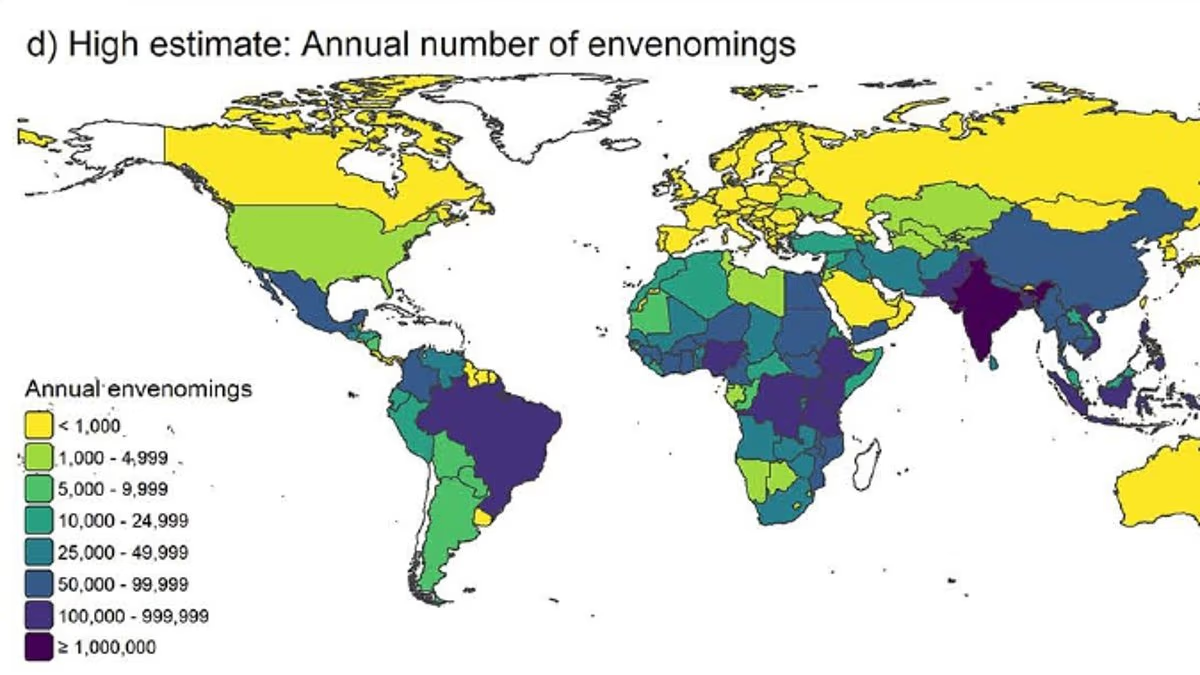
Australia is often regarded as the 'critter capital' of the world. But a surprising new study has revealed that when it comes to snake attacks, Australia pales in comparison to dozens of other countries. Scientists from the Liverpool School of Tropical Medicine have revealed the countries where the most incidents occur every year. Overall, they estimate that between 2.1 and 7 million people experience snake bites – also known as 'envenomings' – each year. Sadly, between 274,000 and 513,000 of these incidents prove deadly. India tops the list as the world's snake attack capital, with up to 1.3 million attacks every year, ahead of Nigeria (666,000), Indonesia (490,000), and the Democratic Republic of the Congo (467,000). 'Low–income countries exhibit the highest incidence and mortality rates, with sub–Saharan Africa accounting for 45% of global envenomings and deaths, nearly three times the incidence observed in South Asia,' the researchers explained. 'These estimates suggest that previous burden estimates could substantially underestimate the scale of the problem.' Scientists from the Liverpool School of Tropical medicine have revealed the countries where the most incidents occur every year While snakes are some of the most feared creatures around the world, the true extent of their attacks has remained unclear until now. In recent years, several terrifying snake attacks have hit the headlines.Last year, a grandmother was found swallowed whole inside a snake in South Sulawesi, Indonesia, with footage showing the python's stomach appearing to wiggle. And in 2025, unsettling scenes from Brazil showed a man writing in pain after a snake bit his penis. Writing in their study, published in PLOS Medicine, the researchers, led by Dr Dileepa Ediriweera, said: 'Snake envenoming (SE) remains an important public health problem.'Although previous attempts have been made to quantify the global burden of SE, accurate, up–to–date data remain scarce.'To get to the bottom of it, the researchers reviewed literature on snake bites occurring in 79 countries between January 2007 and March 2025. Their analysis suggests that between 2.1 and 7 million attacks happen each year – 75 per cent of which are in just 20 countires. In terms of deadly incidents, the study estimates there are between 274,000 and 513,000 every year The world's snake attack hotspots India NigeriaIndonesiaDemocratic Republic of CongoEthiopiaKenyaBangladeshUgandaPakistanBrazilUnited Republic of TanzaniaPhilippinesVietnamChinaIvory CoastBurkina FasoYemenSouth SudanMalawiSudan In India, between 409,000 and 1.3 million attacks take place every year, while Nigeria sees 198,000–666,000 incidents. Other countries in the top 20 include Brazil (48,000–162,000), Vietnam (33,500–113,000), and China (28,900–97,400 attacks).In terms of deadly incidents, the study estimates that there are between 274,000 and 513,000 every year. 'Based on our analysis, we estimate that at least 2.1 million snake envenomings occur annually, resulting in 274,000 deaths worldwide,' the researchers said.'However, these figures likely represent a conservative baseline.'The true burden may be substantially higher, potentially up to three times greater for envenomings and twice as high for mortality.'The Daily Mail has contacted the researchers for further information on the species of snakes involved in the attacks, and the number of incidents in the UK each year. The news comes shortly after the RSPCA revealed how incidents involving snakes spike during warm weather. In 2025, the animal welfare charity received 1,485 reports involving snakes – 905 of which were between May and September. 'We're seeing a significant increase in reports involving snakes, with the highest numbers consistently taking place during the warmer months,' said RSPCA Senior Scientific Officer Evie Button.'Snakes naturally become more active as temperatures increase and they are very skilled escape artists so we're urging owners to take a few extra moments to check enclosures are secure and suitable for their particular species. 'With such hot temperatures on the horizon, we're issuing this snake safety warning.'Many of the incidents we deal with involve snakes that are believed to have escaped from their owners.'
World's snake attack hotspots: Map shows countries with most bites
Scientists from the Liverpool School of Tropical medicine have revealed the countries where the most incidents occur every year.
633 words~3 min read