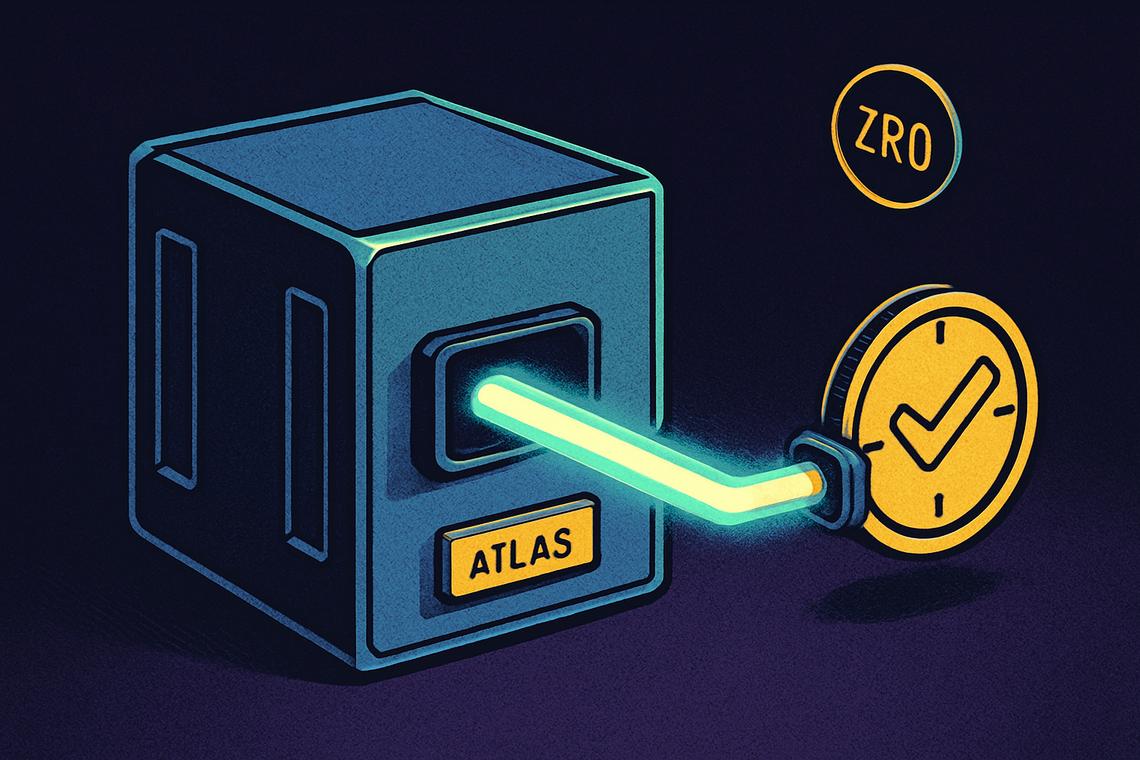
LayerZero introduced ATLAS on Tuesday, an exchange engine built on its Zero blockchain that provides matching, clearing, settlement and risk management to trading venues. The product has no frontend or consumer application of its own.
The design moves LayerZero from carrying assets between chains to running the machinery underneath the venues where they trade, and ties ZRO's fee capture to volume the protocol does not itself distribute. Every user reaches ATLAS through a third-party application, which keeps between 20% and 65% of the trading fee depending on how much ZRO it stakes and how much volume it routes.
ZRO traded at $1.29 at 16:01 UTC, up 12.5% on the day and 63% over the past week, according to CoinGecko. The token bottomed at $1.06 at 09:00 UTC, hours before the announcement, and has climbed since. Its market cap is $454 million on $170 million of 24-hour volume. The weekly gain follows an all-time low of $0.71 set on July 31; ZRO is down about 83% from its December 2024 peak of $7.47 and roughly 39% over the past year.
After the venue takes its rebate, 25% of what remains goes to whoever created the market being traded and 75% goes to buying and burning ZRO, according to the announcement. Rebate tiers require venues to stake ZRO, scaling to 1% of total supply at the top band. ATLAS charges one all-in trading fee that already embeds the venue's economics, which LayerZero said removes the incentive for sophisticated traders to bypass a venue and trade directly against the underlying exchange.