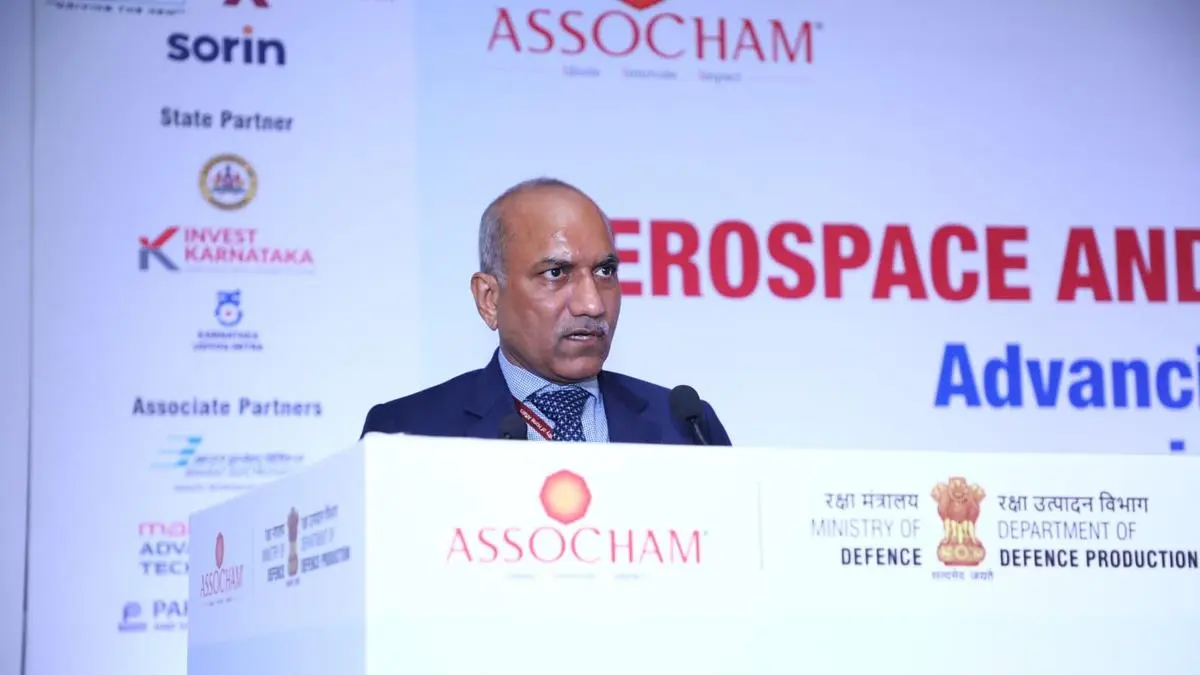
Sanjeev Kumar, Secretary, Department of Defence Production, addressed the event
| Photo Credit:
Assocham
The Ministry of Defence (MoD) has created a concept paper, awaiting nod from the Union Ministries of Commerce and Home, to reduce timeline of processing a defence manufacturing licence to less than three weeks with fewer compliance burden, and supported by a unified standard operating procedure (SOP) across states, Secretary, Department of Defence Production, Sanjeev Kumar said.Another policy tweak for faster and smoother output is taking place in the export licensing regime, Kumar said in his inaugural address at the National Conference on Aerospace & Defence Manufacturing, organised by the Associated Chambers of Commerce and Industry of India (ASSOCHAM) on Tuesday.Kumar expressed concerns over why only 240-250 of the 871 issued defence manufacturing licenses are currently operational but at the same time acknowledged that the statistics “don’t give a great picture of the policy.”Licensing ReformThe Secretary of the Department of Defence Production emphasised the government’s continuing push to improve the ease of doing business for the sector, and said the process for granting defence manufacturing licenses had been significantly simplified. A 19-member evaluation committee was disbanded since March 2025, and approvals are now cleared directly by a Joint Secretary in the Department for Promotion of Industry and Internal Trade (DPIIT), which comes under the Ministry of Commerce, in consultation with the Defence Research and Development Organisation (DRDO) and the Directorate General of Quality Assurance (DGQA), he stated.“It doesn’t require more than three weeks now, unless some information is awaited. We don’t stop here. We thought that it is our duty to talk to other arms of the government, to expedite manufacturing licences in defence,” Kumar told the gathering of representatives of industrialists, diplomats, academia and others.Concept paperTo push further reforms, he said, “We have created a concept paper where we have analysed, right from the application form to the number of papers we ask for, and also the conditions in the licence. We have sent it to the DPIIT and to the MHA (Ministry of Home Affairs) for their consideration. I’m sure they would consider it favourably, and we would be able to reduce the timeline further.”Similarly, the Secretary said the export licensing has been rationalised, with him delegating his powers to a Joint Secretary in his department and a one-time, multi-year export authorisation regime under consideration for long-term supply partners of global OEMs.“As of now, we are in the process of finalising the export promotion regime, where the export consultations process would be further reduced. Apart from that, we are bringing more items into the open general and export licence category. And we are also in the process of final approval of a one-time approval for many years for our industries who have become global supply chain partners,” he revealed.Another speaker, Amit Mahajan, Director (Technical and R&D) of Paras Defence & Space Technologies Ltd, spoke about the transformation in the defence sector in the last decade but emphasised the need to invest more in innovation. “Move ahead from this thinking: if someone has done it, let us do it. Now, it should be: if nobody has done it, why can’t we do it,” Mahajan remarked.He also stated that a decade back, the defence industry was import-centric. But initiatives like Make in India and Atmanirbhar Bharat compelled foreign OEMs to look at our country as a manufacturing hub, given the proliferation of indigenous weapon systems with increased private participation. Published on August 25, 2026