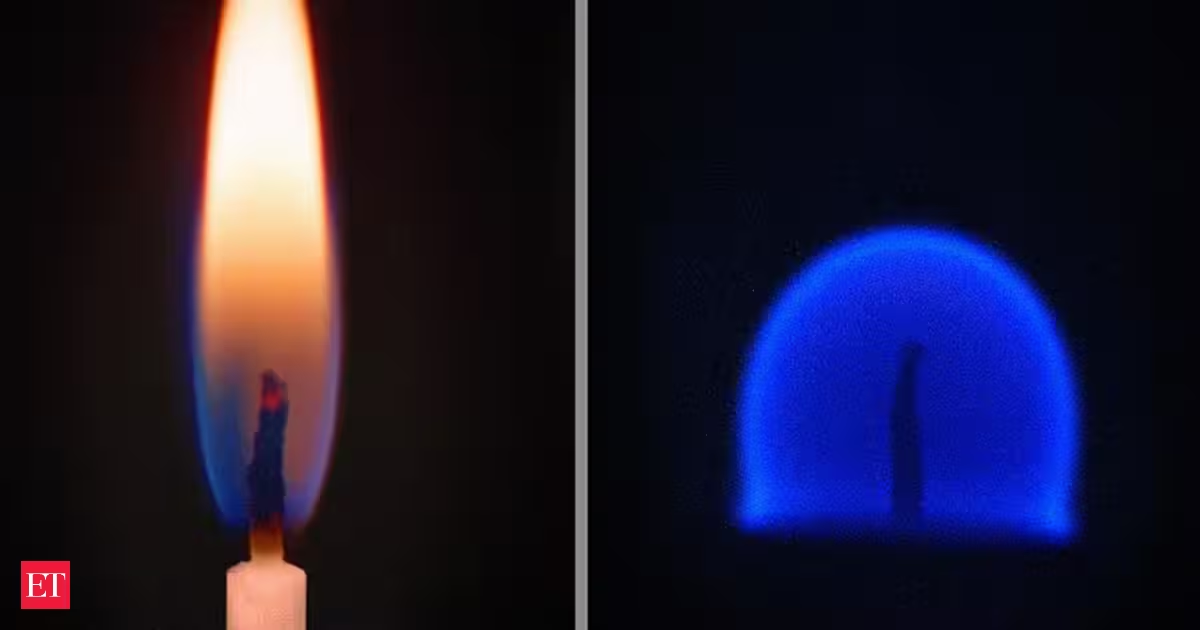
NASA ignited a fuel droplet aboard the International Space Station in 2012, and the flame did not extinguish as expected. Scientists working on the Flame Extinguishment Experiment, or FLEX, observed heptane droplets extinguish twice, with the findings later published in the journal Combustion and Flame. At first, the hot flame burned itself out, but after that the droplets shrank further, as if being consumed by something invisible. NASA called this phenomenon the cool flame, and its discovery led to a new research field: cool flame chemistry. Unlike the hot flame, which releases soot, carbon dioxide, and water, the cool flame emitted carbon monoxide and formaldehyde.Why the experiment did not go as plannedThe researchers aimed to understand how a flame burns in microgravity because that information is essential to ensuring astronauts' safety in the event of a fire aboard a spacecraft. Tiny fuel droplets, about three millimeters in diameter, were ignited in the Combustion Integrated Rack on board the space station and observed until they burned out. Nobody expected a droplet to go out but keep shrinking without showing any signs of a burning flame, either to the naked eye or on the space station's cameras.An exterior view of the International Space Station (ISS) with an arrow pointing to the Destiny U.S. Laboratory module. This specific module houses the Combustion Integrated Rack (CIR) where the groundbreaking 2012 cool flame experiment was performed. Image Credit: NASAA flame with no glow is still a flameOn Earth, such a flame will extinguish in less than a millisecond, making it nearly impossible to observe. Microgravity conditions sustain the process much longer because hot gases don't move upward and disrupt it. Cool flames burn at about 600°C, whereas regular candles burn at temperatures of around 1,400°C, according to NASA Glenn Research Center's account of the discovery. This explains why the flame is not visible. It is an actual combustion process, but at a temperature too low for the naked eye to detect as a fire. Forman Williams, the FLEX principal investigator, said the continued burning of heptane droplets without a visible flame was "entirely unexplained," underscoring how unusual the finding was.Why gravity was hiding this chemistryThis is where the discovery matters to chemists and engineers. On Earth, gravity carries hot combustion products away from the flame so quickly that the slower cooling reaction cannot continue. In microgravity, the reaction gets the time and space that it needs to continue without interruption. The researchers found that if the heptane droplets were less than 2.4 millimeters in diameter, then no two-stage burning would occur at all. This showed that droplet size affected whether the cool flame could persist.What burning invisibly actually producesIt is not just an academic point of chemistry, either. A normal flame produces heat and light through a very rapid, hot chemical reaction. In a cool flame, a slower, cooler chemical reaction does not generate enough energy to emit light, producing CO and formaldehyde instead of CO2 and water. Researchers had worked with theoretical models of such reactions for decades, but the brevity of the reaction on Earth had kept anyone from watching it unfold in full, until microgravity gave it room to breathe.A sequence of snapshots taken 3 seconds apart during NASA’s recent SoFIE (Solid Fuel Ignition and Extinction) experiment aboard the ISS. Following the 2012 liquid droplet discoveries, NASA continues to use microgravity to study how different fuel states burn in space. Image Credit: NASAWhy this discovery reaches beyond the space stationIt may have applications for engine design on Earth. As co-investigator Vedha Nayagam of the FLEX experiment pointed out, this type of partial oxidation combustion is similar to what occurs in HCCI engines, a process considered a way to achieve diesel-like efficiency while producing less particulate matter and nitrogen oxides. The results of this study also have practical applications for fire safety in space; a flame that seems out may still be burning, so fire suppression systems must be reconsidered in light of this information. The NASA Glenn Research Center, which conducted this investigation, has continued related cool flame research through follow-up studies.Why this discovery still matters todayMore than a decade on, the finding still highlights what microgravity experiments can reveal. Microgravity slowed the reaction enough for scientists to observe and analyze it. NASA has conducted other research on this chemistry to find useful applications here on Earth. A candle flame blown out on a birthday cake really does go out, but for a fraction of a millisecond before it does, it likely passes through this same invisible, cooler stage of chemistry, one so fleeting on Earth that no one would ever notice it happening.
In 2012, NASA observed a fuel droplet continue burning invisibly in space after the visible flame went out, producing carbon monoxide and formaldehyde
In a groundbreaking experiment, NASA discovered that fuel droplets in space can burn invisibly, producing harmful emissions like carbon monoxide and formaldehyde. This finding has implications for fire safety in space and could change engine design on Earth.
772 words~4 min read