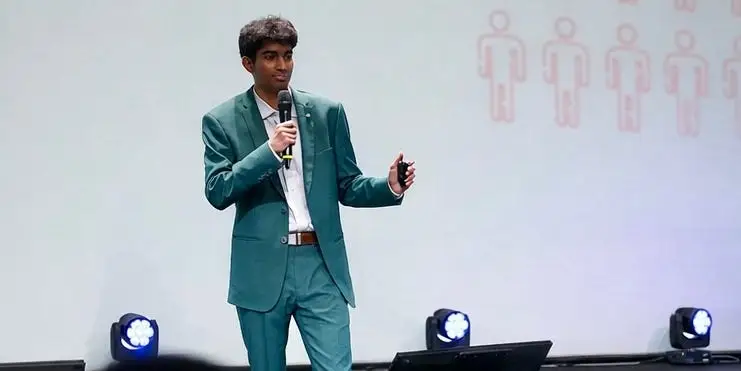
Srikar Srinivasan.
Courtesy of Srikar Srinivasan
This as-told-to essay is based on a conversation with Srikar Srinivasan, a 21-year-old Babson College student and cofounder of Arcangel, an AI-driven intellectual-property platform. He's currently living in Chattanooga, Tennessee. The following has been edited for length and clarity.I've wanted to be an entrepreneur since I was in the fourth grade. During my summers in elementary and middle school, I attended coding camps, hackathons, and innovation programs throughout New Jersey.When I was 14, I got my first business idea after being in charge of walking my dogs and cleaning their paws. It was an automatic pet paw washer, and I filed for a patent for it. That same year, I sold the company, Comzys, for a six-figure sum to ARCOMM Tech Solutions.When I was 16, I used some of that capital to start a STEM learning company called Stricx. When my friends and I left for college, we passed the company down to our younger siblings and friends. Today, it continues to generate five-figure quarterly revenue.Now, at 21, I'm building a third company in the intellectual property space while attending Babson College. Here's my top advice for young entrepreneurs who don't know how to get started.Talk to 100 potential customers before you build your businessWhen I started my third company, Arcangel, one of my mentors was a fellow college student. During one of our first meetings, she told me that before I ask her for advice, I need to talk to 100 potential customers. She advised me to ask them if they needed the solution I was building, how much they'd pay, and how much time my product would save them.When you're first building a business, you might think the problem you're solving is obvious, but it's very important to find out if customers actually need your solution. If not, you need to pivot.Pivoting your company doesn't mean it's a failureWhen I first started building companies, I thought the initial backbone of the idea would never change, but that's not always true. When you start building something, even with potential customer interest, you might see gaps along the way. It's important not to ignore those moments.My company has gone through seven pivots. We started as a fintech company, but ran into compliance and regulatory issues. We've pivoted and had money and customers coming in, but realized it just wasn't the right business. We ultimately landed on an AI platform designed to help founders and companies protect intellectual property.