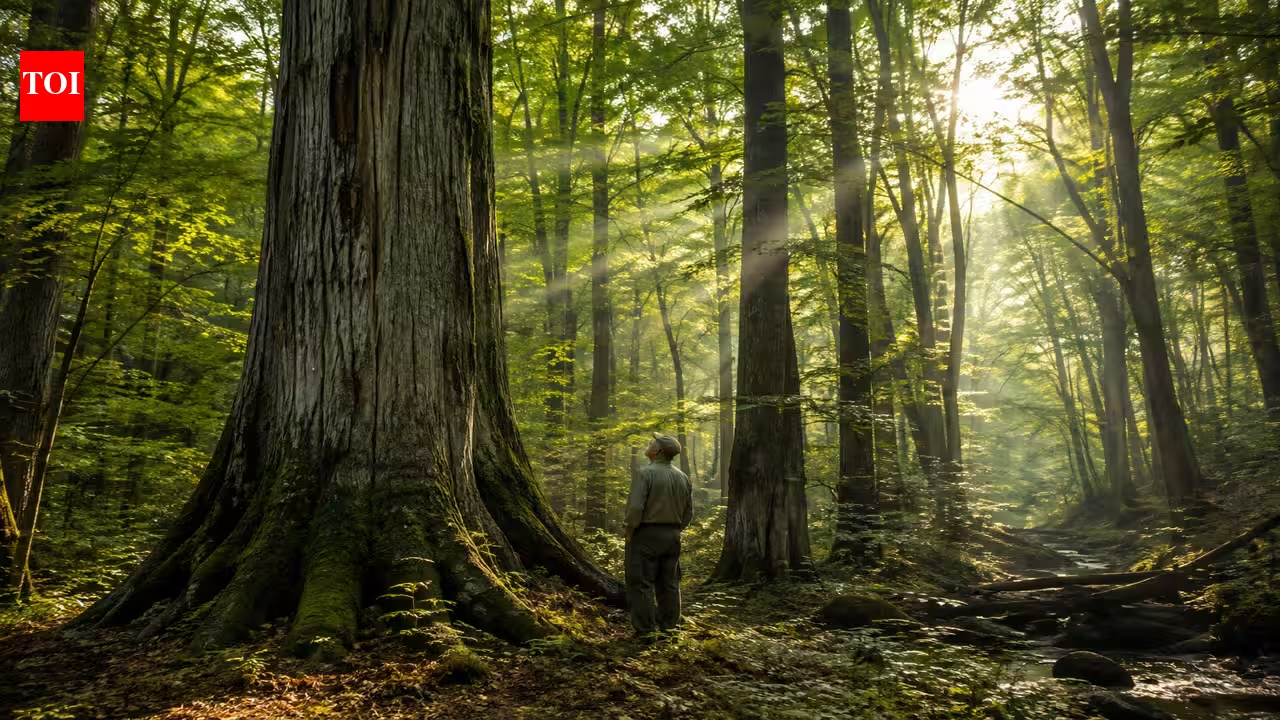
AI Representation: An ancient Kentucky forest stands preserved beneath towering trees. Image credits: ChatgptLilley Cornett Woods, located in Letcher County in eastern Kentucky, preserves approximately 252 acres of old-growth mixed mesophytic forest. According to Eastern Kentucky University’s article, Lilley Cornett Woods Appalachian Research Station Initiated into the Old-Growth Forest Network, the forest contains trees dating to as early as 1669, including a white oak that is more than 350 years old. It is also designated a National Natural Landmark.According to Eastern Kentucky University’s historical account, the woodland takes its name from Lilley Cornett, who purchased the property shortly after World War I and chose to protect its trees from timber cutters rather than allow them to be harvested. After he died, his family continued to preserve the woodland until it was sold to the Commonwealth of Kentucky in 1969. Afterwards, management was transferred to Eastern Kentucky University and it now runs this place as the Lilley Cornett Woods Appalachian Ecological Research Station.Cornett protected the woodland from commercial timber harvesting Cornett's decision to preserve the woodland was significant because much of eastern Kentucky had already been heavily timbered. The central portion of Lilley Cornett Woods, which makes up the old-growth area, has never been harvested, although parts of the forest have seen some human intervention. Livestock grazed in the understory until the 1950s. Some dead or dying American chestnuts were removed after chestnut blight affected the species. None of these interventions had caused commercial harvesting of the old-growth. After Cornett died, his family continued caring for the land until they found a way to preserve it. After the property was sold to the Commonwealth of Kentucky in 1969, Eastern Kentucky University took over management. The property now covers about 659 acres, including 252 acres of old-growth forest. The entire property is not old-growth forest.Topography shaped the forest's nine plant communities William H. Martin examined the ecological character of Lilley Cornett Woods in his 1975 study, The Lilley Cornett Woods: A Stable Mixed Mesophytic Forest in Kentucky. He identified nine forest communities and examined how their distribution related to the woodland’s topography. In Martin’s study, trees measuring more than 12.5 centimetres in diameter at breast height had an average density of 290 stems per hectare. Beech-dominated communities were widespread and represented approximately half of the upland stable segment of the Woods. Oak communities were second in area and occupied the more xeric sites. Topography helped shape these differences because changes in slope and landscape position created different environments. Eastern hemlock communities were found in the woodland, while more wind-protected areas contained sugar maple, basswood and tulip poplar. Martin’s study suggests that the significance of Lilley Cornett Woods cannot be judged by tree age alone.Old-growth conditions support woodland salamander research The forest has also served as a subject for studying the influence of old-growth forest conditions on wildlife. In an Ecology and Evolution study titled “Environmental Gradients in Old-Growth Appalachian Forest Predict Fine-Scale Distribution, Co-occurrence and Density of Woodland Salamanders,” scientists analyzed woodland salamanders at Lilley Cornett Woods. This research involved 102 hectares of old-growth forest land. The authors note that the area had no timber-harvest history, although livestock grazed there until the 1950s. The scientists studied how environmental factors affected salamander distribution, co-occurrence and density.The scientists used permanent sampling plots to assess vegetation, leaf litter, rocky cover and topography. The study found that variation in environmental conditions corresponded to variation in salamander distribution and density. These results offer another perspective on the woodland's ecological significance. Its importance lies not only in preserving old trees but also in maintaining the variety of environmental conditions created by the mature forest ecosystem.A white oak dating to 1669 is the oldest documented tree Eastern Kentucky University says a white oak dating to 1669 is the oldest recorded tree at Lilley Cornett Woods. By 2026, the tree would be more than 350 years old, approximately 357 years, assuming 1669 as the starting date. The tree's age shows that it existed long before the current landscape around the preserve took shape. This tree also gives scientists a very old example of the forests that once covered much of eastern Kentucky.An EKU flora study documented 516 vascular plant species at Lilley Cornett Woods, representing 92 families and 297 genera. This highlights the preserve's biological diversity. The old trees and diverse plant life have made the preserve a valuable site for scientific study. Martin studied the structure and distribution of the forest communities, while the salamander study examined how old-growth conditions affected wildlife.The protected forest helps preserve an older eastern Kentucky landscapeThe Lilley Cornett Woods Preserve now stands not only as a place of conservation but as a site of study as well. The old-growth component contains trees that have been growing there for hundreds of years, while the overall tract serves as habitat and a research area. Therefore, the memory of Cornett is connected with more than simply trees. Cornett's decision to protect the forest preserved a community that remained available for study after commercial logging elsewhere had ended. Today, Lilley Cornett Woods Preserve allows scientists to study one of the last remaining examples of old-growth Appalachia in eastern Kentucky.
In the 1950s, Lilley Cornett refused timber developers for his Kentucky forest; his legacy survives today at Lilley Cornett Woods among 400-year-old trees
Lilley Cornett Woods, located in Letcher County in eastern Kentucky, preserves approximately 252 acres of old-growth mixed mesophytic forest. According to Eastern Kentucky University’s article, Lilley Cornett Woods Appalachian Research Station Initiated into the Old-Growth Forest Network, the forest contains trees dating to as early as 1669, including a white oak that is more than 350 years old.
861 words~4 min read