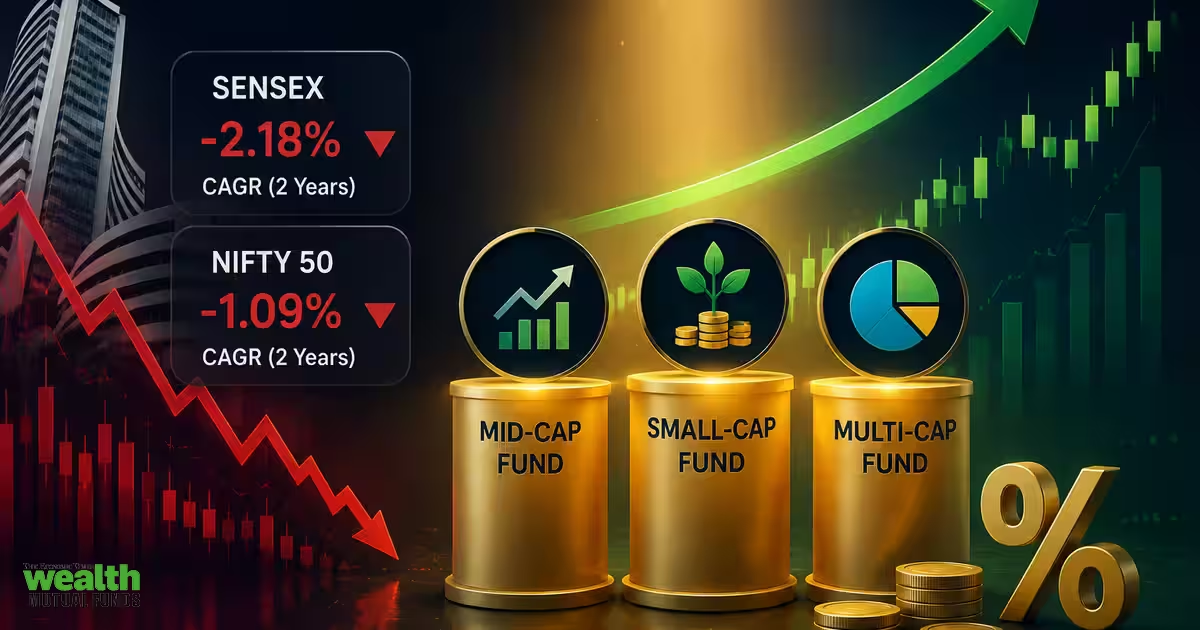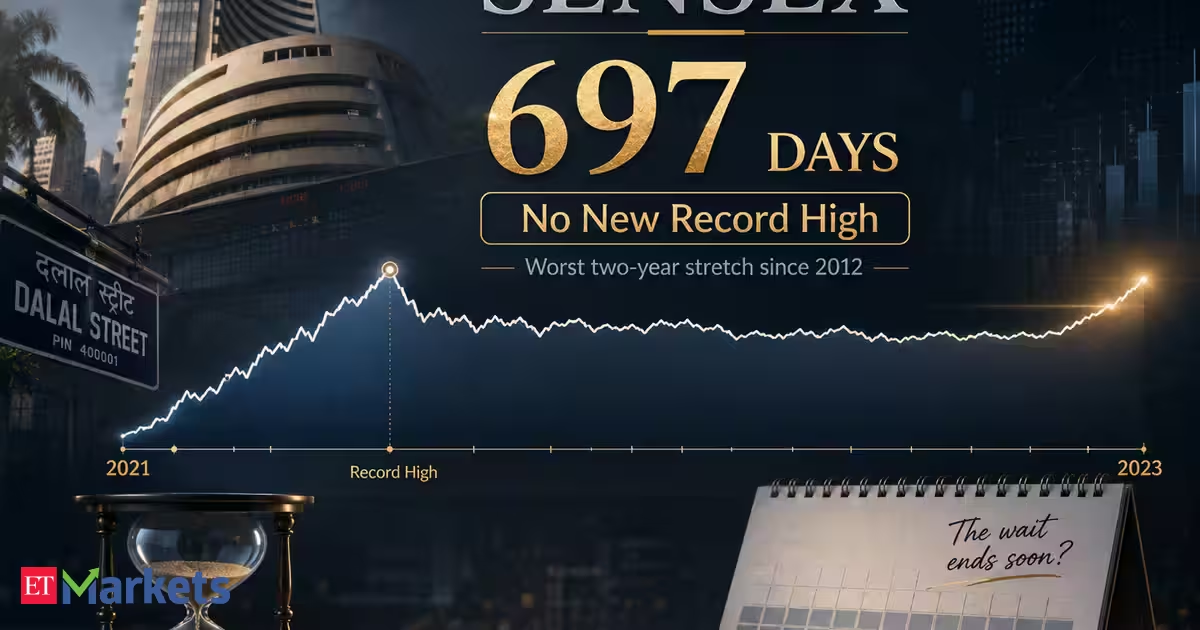
India’s stock markets are going through an unusually long stretch of weakness. The benchmark indices have delivered negative returns not just over the past one year, but also over a two-year period. The Sensex has now gone 697 days without hitting a new all-time high.In 2026 so far, 37% of Sensex trading days have ended with negative two-year returns, the highest share since 2012, according to an ET analysis. The weakness is even more pronounced over one year, with 62.3% of trading days this year ending with negative one-year returns, the highest in the dataset. The previous peak was 59% in 2012, followed by 58.3% in 2016 and 47.6% in 2008.The two-year picture is less severe than the worst periods on record, but 2026 marks the most significant deterioration since 2012.In 2012, 82.5% of Sensex trading days ended with negative two-year returns, followed by 75.7% in 2009. In 2008, the figure was 23.2%, while it stood at 20.2% in 2010 and 21.5% in 2011.What has troubled markets in 2026?India has replaced Indonesia as Asia’s least-preferred stock market in a survey of fund managers by Bank of America Corp., signalling growing caution toward a market that is among the world’s worst performers this year. This is the second time this year that India has been labelled the least favoured market.Indian stocks were last termed the least preferred in the BofA poll in May, as the country faced growth pressure from rising energy costs following the US-Iran war, which triggered a rally in global crude oil prices. With no sign of progress toward resolving the conflict, energy prices are climbing again, weighing on investor sentiment.Iran war - India, one of the biggest importers of oil, has been at the receiving end of a sharp selloff after the Iran war triggered massive oil shocks starting in February. Supply through the Strait of Hormuz is unlikely to return to normal any time soon, with Iran claiming total control over the passage, while the US is now claiming control of the waterway.Oil prices still have room to move higher. Brent is expected to climb towards $92-$95 per barrel, although the pace of the rally will depend on the intensity of the conflict. Any further escalation in hostilities could quickly push prices above $100 per barrel in the near term.FII exodus - Since the September 2024 market peak, FIIs have remained persistent net sellers, with cumulative outflows of nearly $60 billion, including almost $30 billion in CY26YTD. After four straight months of heavy selling between March and June 2026, FIIs finally turned net buyers in July, investing $2.5 billion, their highest monthly inflow in the past 13 months.Foreign investors had been cautious earlier in the year because of rich valuations, global uncertainty and changing expectations around interest rates. Their recent buying suggests some of that pressure has eased, though analysts remain watchful.El Nino worries - While oil has dipped 23% from its 2026 peak of $120, Indian equity investors hoping for a major market breakout are looking at the wrong indicator. As the global oil shock fades, a far more severe macroeconomic threat is building in the skies.A rapidly developing "Super El Niño" has triggered the weakest start to the monsoon in a decade, threatening 56% of India’s GDP tied to consumption and locking equity markets in a persistent holding pattern. With the last two-year return of the Nifty remaining flat, the risk matrix for Indian equities has fundamentally pivoted from global supply shocks to domestic demand destruction.Will Sensex, Nifty bounce back?“With the pace of earnings growth strengthening and the breadth of growth improving, we expect the risk-reward profile to become increasingly favorable, enhancing India’s attractiveness from an FII perspective,” analysts at Motilal Oswal said. “With FII selling now showing signs of moderation and domestic liquidity remaining resilient, we expect market performance to strengthen as geopolitical uncertainties ebb,” the brokerage added.Foreign institutional investors have started returning to select midcap and smallcap stocks after cutting their holdings for two straight quarters, according to data from Ace Equity. The buying comes as broader FII flows into Indian equities have also improved. After selling in most months earlier this year, FIIs turned net buyers in July and August. They bought Indian shares worth Rs 11,045 crore in July and Rs 13,123 crore in August.The pattern shows that foreign investors are not buying the entire market in the same way. They are returning selectively to companies where growth, liquidity, earnings visibility or stock performance appears to justify fresh exposure.India may be one portfolio rebalance away from attracting about $25 billion in foreign equity inflows, as global fund managers seek shelter from volatility in AI-heavy Asian markets, according to HSBC.More than 80% of active global emerging-market funds are underweight India. If those funds simply restore their allocations to neutral, the shift could generate around $25 billion of inflows, HSBC strategists Prerna Garg, Herald van der Linde and Yogesh Aggarwal said in a report.“FII outflows linked to AI rotation have largely played out,” the strategists said. A return to neutral by underweight funds alone “could drive around $25bn of inflows.”The potential reallocation would mark a significant reversal for Indian equities after foreign investors diverted capital toward markets benefiting more directly from the artificial-intelligence trade. HSBC now sees those positions becoming increasingly crowded, while sharp swings in AI-exposed markets are strengthening India’s appeal as a diversification play.Also read: Is the smallcap rally a trap? Only 37% of stocks are outperforming their benchmarkThe prospective return of foreign capital would add to persistent domestic demand. Systematic investment plan contributions to mutual funds continue to hold up, while net equity fund inflows recovered in June, with a large share directed toward small- and midcap funds. Even modest but consistent foreign buying could therefore provide meaningful support to the market, HSBC said.(Disclaimer: Recommendations, suggestions, views and opinions given by the experts are their own. These do not represent the views of The Economic Times)
697 days, no new record high: Sensex hits worst two-year return stretch since 2012. Will this end soon?
The Sensex has gone 697 days without a new record high, marking its longest stretch of weakness in years. In 2026, 37% of trading days have delivered negative two-year returns, the highest share since 2012. However, easing FII selling, resilient domestic flows and potential foreign inflows could support a recovery.
987 words~4 min read