Stock markets: Moving towards improved price discovery
| Photo Credit:
th-online Administrator
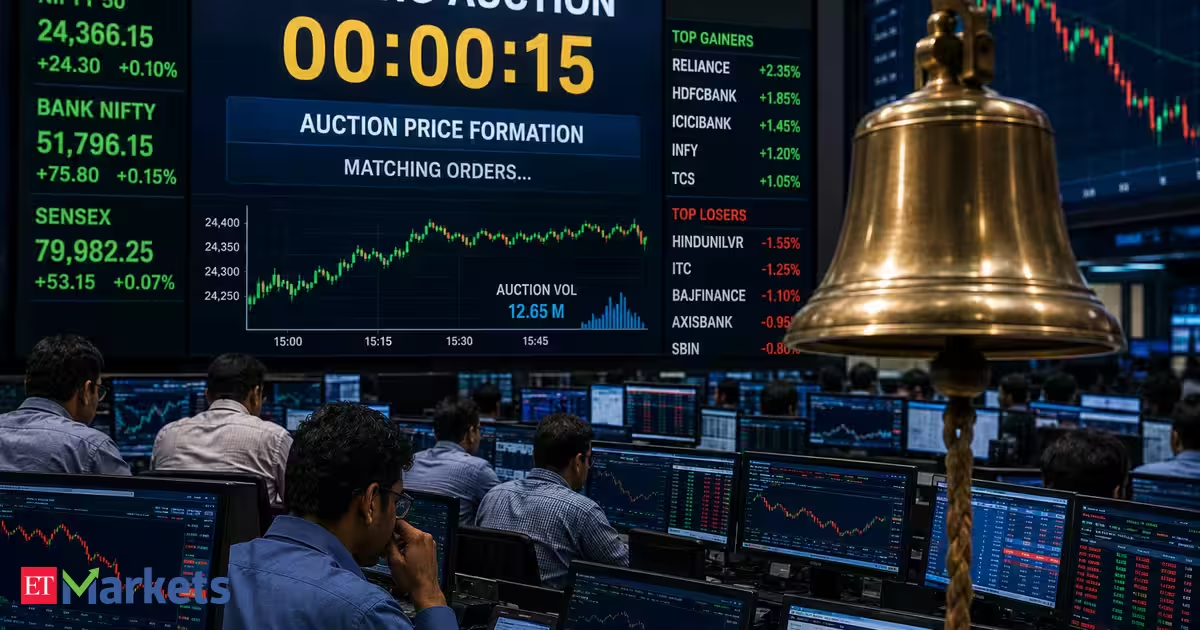
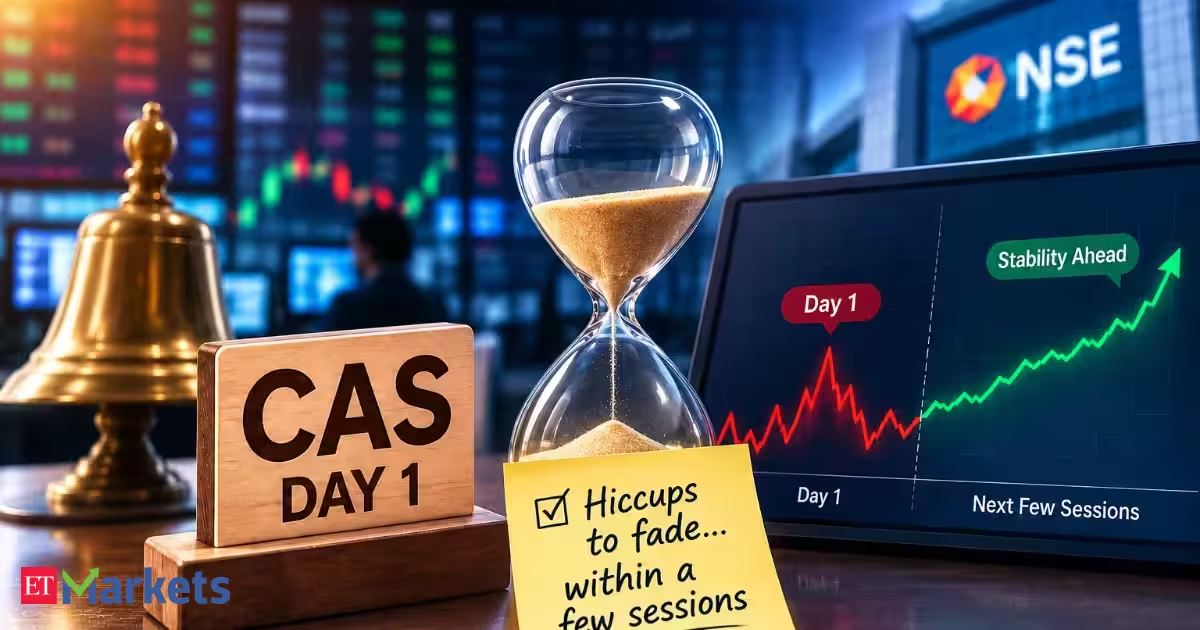
On August 3, 2026, Indian stock exchanges introduced closing auction session for stocks in the cash segment with derivative contracts linked to them. There were indications in July that the rollout could be rocky with several stockbrokers claiming that their turnover can take a hit due to the new mechanism and naysayers claiming that the Indian market was not ready for it.The first closing auction proved all the doomsdayers right with the Nifty 50 doing a pole vault, doubling the intra-day gain during the closing auction session. The second session was equally chaotic. But sanity returned from the third session.The market regulator stepped in, holding consultations with market participants, coaxing and nudging them to participate in the closing auction. Two intermediaries — Copthall Mauritius and Mansi Share and Stock Broking — were also hauled up for manipulating prices in the CAS on BSE, on August 13.Analysis of granular data of the closing auction session shows that volatility has subsided and there is no impact on the overall trading volumes due to the move. Volumes in the CAS could, however, continue to be muted since trading activity will be low in the closing session. SEBI must continue with this initiative, while watching out for wrongful activity.What and whyBefore we proceed further, a quick lowdown on why closing auction session was introduced.Until July, the closing prices of stocks in the cash segment were being determined using the volume-weighted average price (VWAP) method. What this means is that the closing price of a stock is the average price of all transactions done in the stock between 3.00 pm and 3.30 pm, with higher weights being assigned to the prices where more volume is transacted and vice versa for transactions with low volumes.The problem with VWAP is that it is an average price and does not represent a price at which actual transactions have been executed. Many passive fund managers have apparently complained to SEBI that the difference between the price at which transactions happen in the last 30 minutes and the VWAP, gives rise to tracking error when they buy stocks to emulate an index. VWAP was also found easier to manipulate by entering large orders towards the end of the trading session. This also increased price volatility in the last 30 minutes of continuous trading.The closing auction session is an improvement on VWAP because, here, the closing price is chosen from the orders placed in the session. Trading halts during the CAS and all the buy and sell orders punched in the session are pooled to discover the equilibrium price. This is the price at which the greatest number of trades can be executed, and this also serves as the closing price. This is found more tamper-proof and most of the major global stock exchanges including the NYSE, London Stock Exchange and Hong Kong Stock Exchange are using some variant of CAS to discover the closing price.CAS experience so farMarket participants have been quite wary about the closing auction session, preferring to close all the trades before 3.15 pm. This is borne by the fact that the average traded value in the NSE in the CAS has been between ₹1,000 and ₹1,500 crore through August. Trading on the BSE in the closing session has also been lacklustre.This has, however, not had any impact on the overall cash volumes on exchanges. Average daily turnover in cash segment of BSE was around ₹10,000 crore in July 2026; it remained around that level in August as well.The average turnover in the cash segment of the NSE was around ₹1.2 lakh crore in July and August this year. This implies that market participants are not cutting back on trading, but the last 15 minutes’ trading is being done in the earlier parts of the trading session.The good news is that price volatility in the CAS has subsided considerably. If we take a close look at NSE’s CAS on August 3, 2026, around 41 of the 208 stocks gained more than 1 per cent from the reference price. Several stocks including Divis Lab, Bajaj Auto and Grasim gained 3 per cent, while CG Power and SAIL lost close to 3 per cent. This shows that market participants seem to have been trigger-happy in the first session, punching trades at the maximum limit.But SEBI’s ire at this conduct along with the penalty meted out to two players for alleged manipulation of prices on the CAS seems to have made everyone toe the line.The average change from the reference price on August 21, 2026, was just 0.13 per cent. This indicates that deals are now being punched very close to the reference price in the CAS window.What nextThese are early days, and having begun the newer method of closing price discovery, there is no reason to stop it now. Market intermediaries have been given plenty of time to prepare for CAS, as multiple rounds of consultations have been done since December 2024. They had ample time to upgrade their infrastructure and educate their clients. Citing lack of preparedness as an excuse to halt CAS is not acceptable.That said, it needs to be understood that the design of the CAS suggests trading will be difficult in the last 20 minutes, which will impede trading and liquidity. Since there is no continuous trading during CAS, arbitrage trading becomes difficult. Many algo and high frequency trading strategies will be difficult to execute in the absence of continuous trading, stop loss and iceberg orders and in random closing of trading session. Liquidity in the session will have to be provided by institutional investors, long-term individual investors and perhaps, proprietary desks of stock brokers.With overall volumes being intact and the reference price discovered at 3.20 pm acting as a backstop for price discovery, there is no need to worry too much about CAS. SEBI can allow it to continue, while maintaining a vigil on possible price manipulations in the session.Published on August 25, 2026