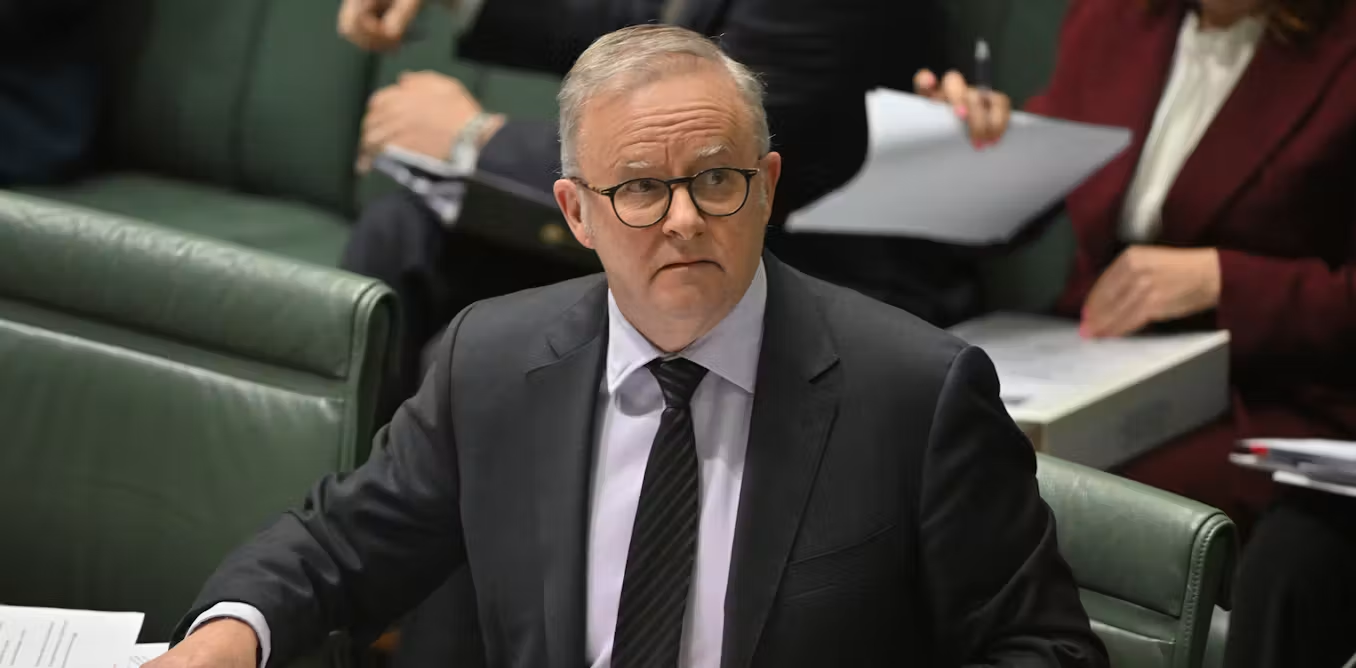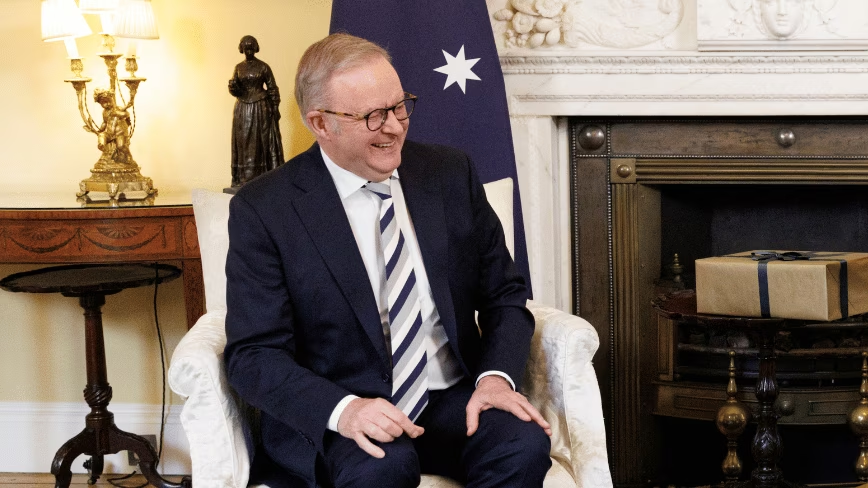
“It’s not just about creating new structures in government,” she says. “It’s really about growing recognition that AI needs clearer accountability, governance and a more co-ordinated approach.”Announcing the Office of AI in July, Albanese said: “This world leading framework is about Australia choosing to shape the future rather than letting the future of AI shape us.”The office has since been established within the Department of the Prime Minister and Cabinet, with responsibility for co-ordinating agencies as the government develops its new Australian AI standards.Lou Compagnone, director of artificial intelligence at Datacom Australia. For business, the same problem is becoming harder to ignore.From pilots to ‘AI confetti’The case for a dedicated executive has strengthened as AI has spread beyond technology departments and experimental projects.Datacom’s research found just 3 per cent of organisations were not using AI at all, while 41 per cent were scaling it across business functions. Yet fewer than half had a specific AI strategy.Compagnone says the danger is that experimentation spreads without changing the organisation itself.“Otherwise, I call it AI confetti. You see a lot of organisations having isolated pilots to improve pockets of work, but they’re not really having a significant change in how the organisation operates,” she says.The result can be duplicated projects, inconsistent governance and uncertainty over who is accountable for decisions. The problem becomes more pronounced as AI reaches into data, risk, operations, customer service and workforce planning.The CAIO, Compagnone argues, should therefore not be another technology chief.“It’s a horizontal role,” she says. “It changes how work’s done, how decisions are made, how services are delivered and, really, how value is created in an organisation.”That requires enough technical knowledge to understand the systems and work with technology teams, but Compagnone says much of the harder job is organisational.“The harder work is really organisational and in some ways operational,” she says. “It’s really about setting direction and being an orchestrator to align the different functions across the leadership team. This is a people and change role.“The chief AI officer role is ultimately about transformation: giving someone the mandate, authority and cross-functional reach to change how work gets done with AI.”The role is about transformation: giving someone the mandate, authority and cross-functional reach to change how work gets done with AI.— Lou Compagnone director of artificial intelligence at Datacom Australia.Datacom’s white paper argues that where AI sits in Australian organisations often reflects where existing technology leaders happen to sit rather than deliberate organisational design.The research found 88 per cent of respondents expected some or significant overlap between the CAIO and chief technology officer, but only 5 per cent thought the CAIO should fully absorb the technology remit.Opinion was also divided over reporting lines. Thirty-one per cent thought the CAIO should report to the CIO or CTO, 29 per cent favoured reporting to the chief executive and 28 per cent saw it as a standalone C-suite position.Compagnone says that putting the role beneath the technology function risks defining AI too narrowly. Her preference is for a direct line to the chief executive or, where that is impractical, the chief operating officer.“They’re thinking about how the whole organisation operates,” she says of the COO model. “I see that as a bit more horizontal and neutral than reporting into tech.”Authority matters more than the titleSimply appointing someone will not solve the problem.“If appointing a CAIO is just a title change, organisations will miss the point entirely,” Compagnone says.Datacom’s research found a clear mandate from the chief executive or executive team was the most commonly identified condition for CAIO success, nominated by 47 per cent of respondents. AI strategy and roadmap development was nominated by 60 per cent as the role’s top priority.Compagnone says organisations need to decide what they are trying to change before accumulating more use cases.“Without that, it’s just going to be lots of disconnected use cases and not a clear idea of what the organisation is shifting from and to as a result of AI,” she says.That means deciding whether the objective is better productivity, service delivery, customer experience, decision-making, risk management or workforce effectiveness, then prioritising AI projects according to their value, feasibility, risk and ability to scale.The issue has become more pressing as productivity replaces novelty as a reason to spend money on AI. The Datacom research found productivity was the biggest motivation for AI investment, cited by 38 per cent of respondents.At the same time, organisations remain wary of the risks. Fifty-five per cent described themselves as cautious or highly risk-averse in their approach to AI, while risk and governance concerns were the most commonly cited barrier to stronger AI leadership.That tension helps explain why responsibility cannot easily be handed to one existing function. A technology team may understand the systems, but legal, risk, finance, data, human resources and operational leaders all have a stake in how AI is used.The CAIO’s job is not to take those responsibilities away but to connect them.A job still being inventedThe speed with which the title has appeared can obscure how new the job remains.That is one reason Compagnone sees value in the Chief AI Officer Summit being held in Canberra, which will bring together AI leaders, technology executives and public sector officials as organisations work out what the position should actually do.“Chief AI officers are new in their roles, and they’re still really defining the role, trying to work out a blueprint for this role and what’s the blueprint for AI transformation in government,” she says. “No one’s really settled on that yet.”The clock is already running. Forty-six per cent of organisations surveyed expect a CAIO to demonstrate an impact within six to 12 months.“That’s going to go in a flash,” Compagnone says.The role may also become more specialised as it matures. Compagnone says the US market, where dedicated AI leadership emerged earlier, is already producing more specialised positions, including chief responsible AI officers and AI leadership roles within individual business functions.“We’re seeing even more granularity when it comes to AI leadership roles,” she says. “Now in the US, there’s not just a chief AI officer, but there’s a chief responsible AI officer as well, and it’s even starting to get more granular in terms of functions.”Separating responsibility for governance from the strategic and operational side of AI could ultimately prove useful, she says, particularly because concentrating governance solely within legal or risk functions can create tension between control and experimentation.Australia is still at an earlier stage. The immediate task for many organisations is more basic: deciding who owns the AI strategy, giving that person sufficient authority and working out how the role interacts with the rest of the executive team.The federal government has now made its own answer conspicuous. Its Office of AI centralises coordination at the heart of government, while the APS CAIO requirement puts senior AI leadership inside individual departments and agencies.Business will devise different structures. But with almost two-thirds of Australian organisations expected to have a dedicated executive AI leader by next year, the argument over whether AI needs senior ownership is giving way to a more practical one: what authority that leader should have, where the role should sit and what it should be expected to deliver.Download Datacom’s full white paper, The Emerging Role of the Chief AI Officer in Australia, to explore the research and findings in more detail.
PM’s AI push cements rise of the chief AI officer
Prime Minister’s decision to put a new Office of AI inside his own department raises a question: who is actually in charge of artificial intelligence?
1,219 words~6 min read