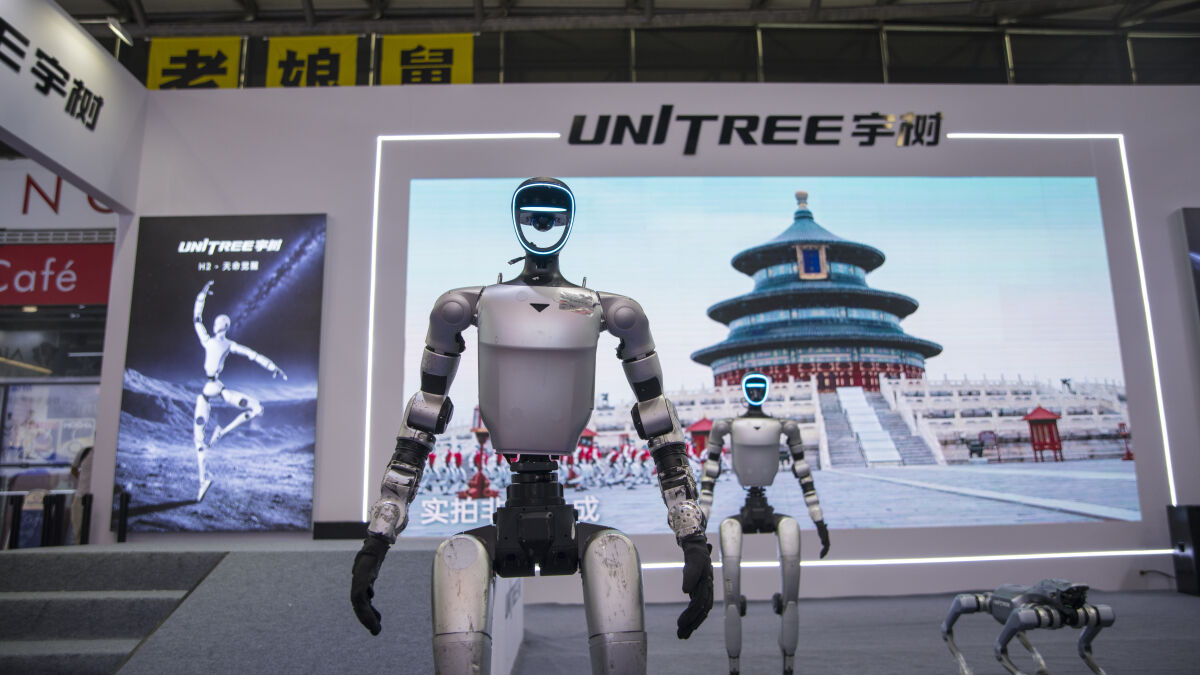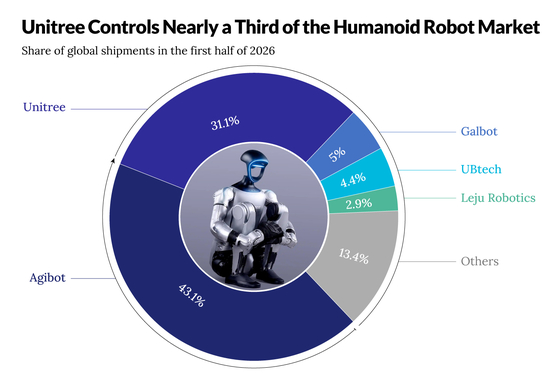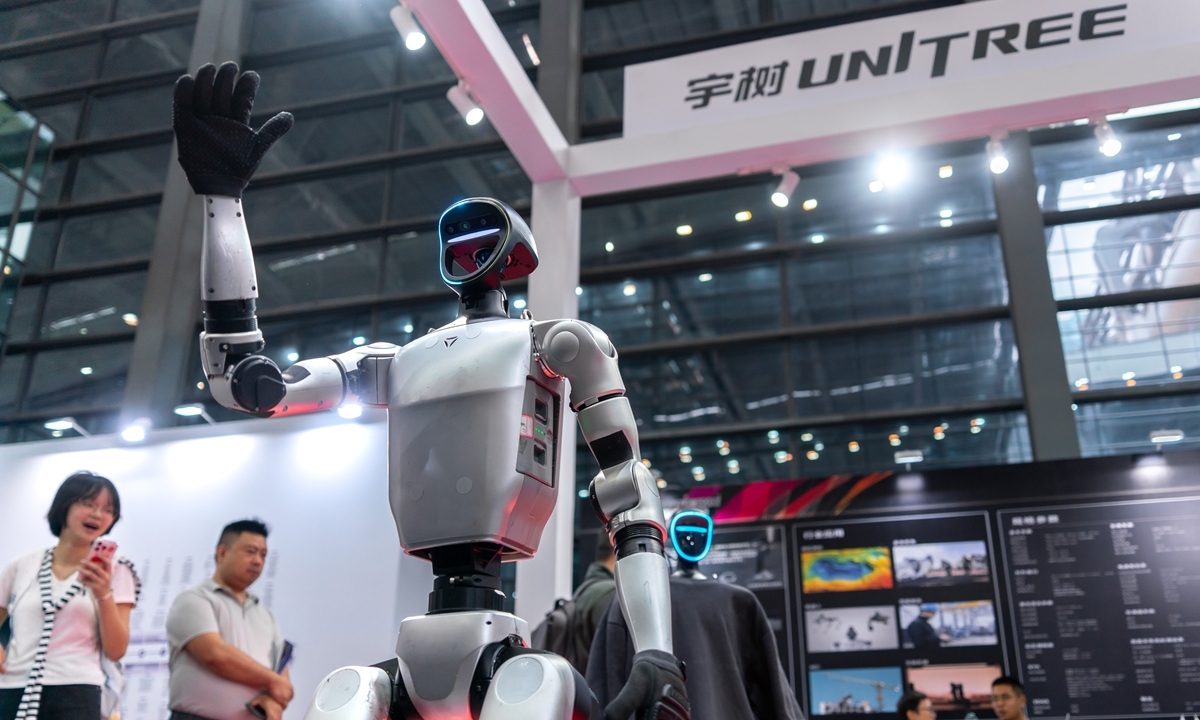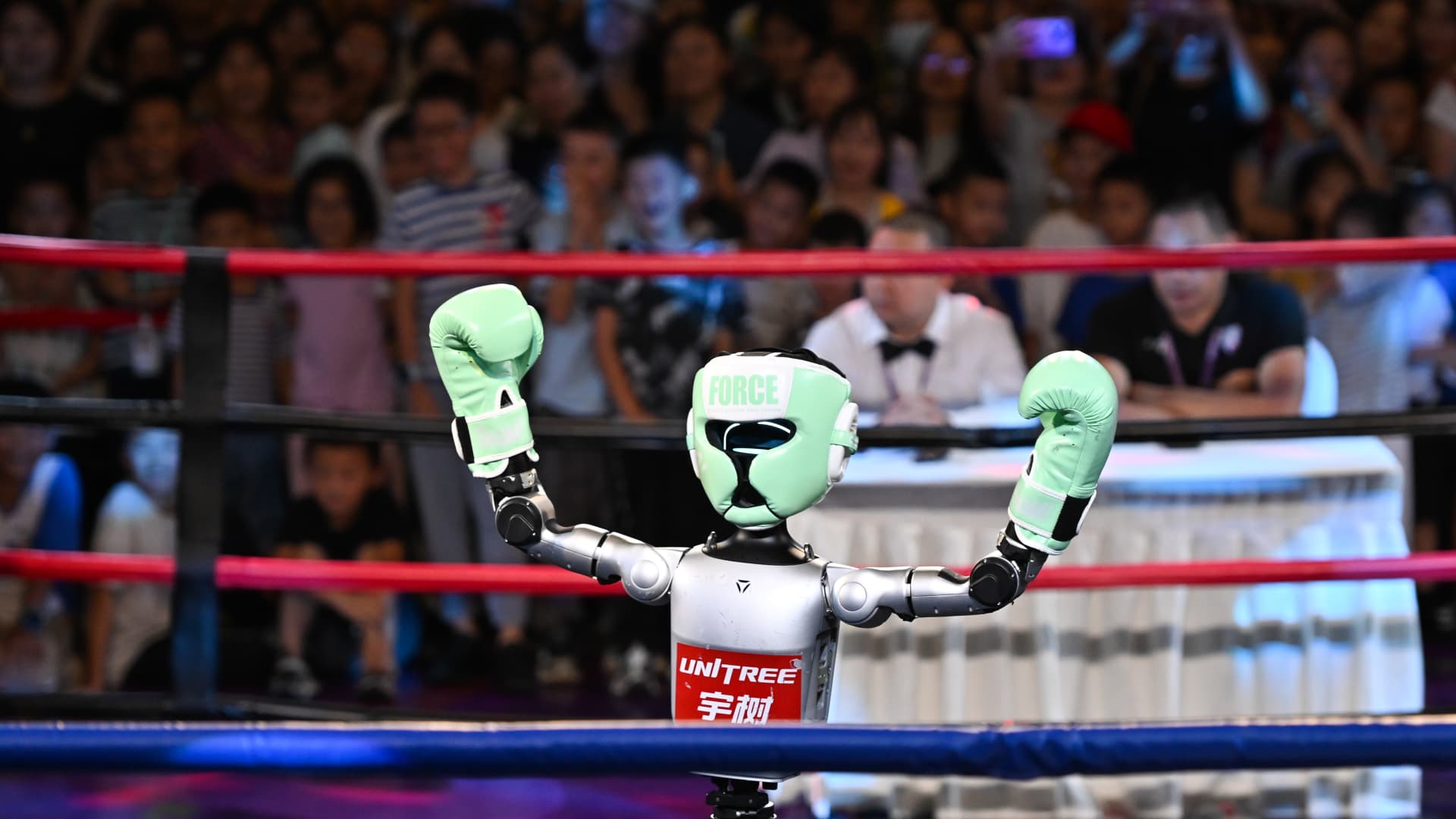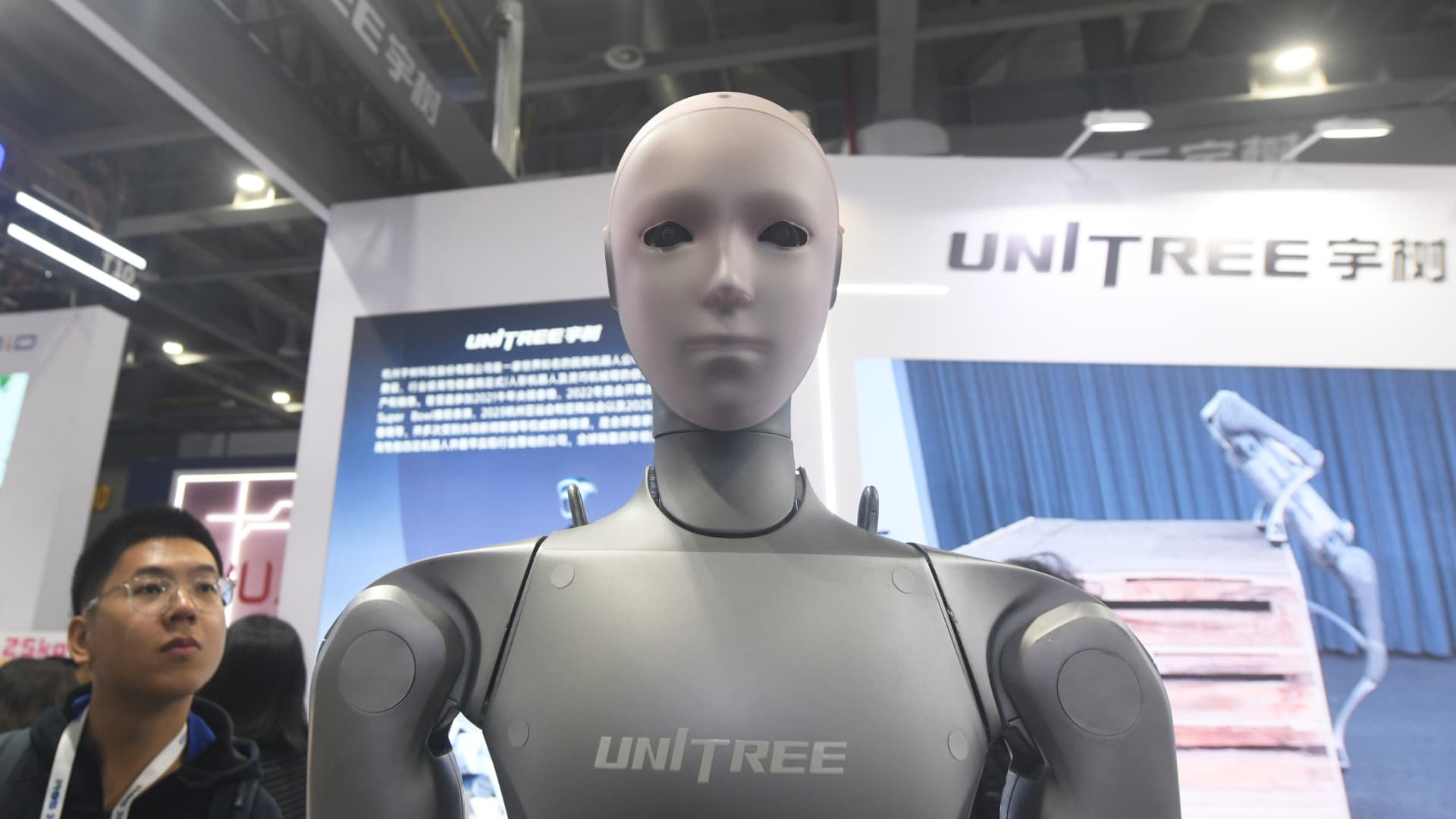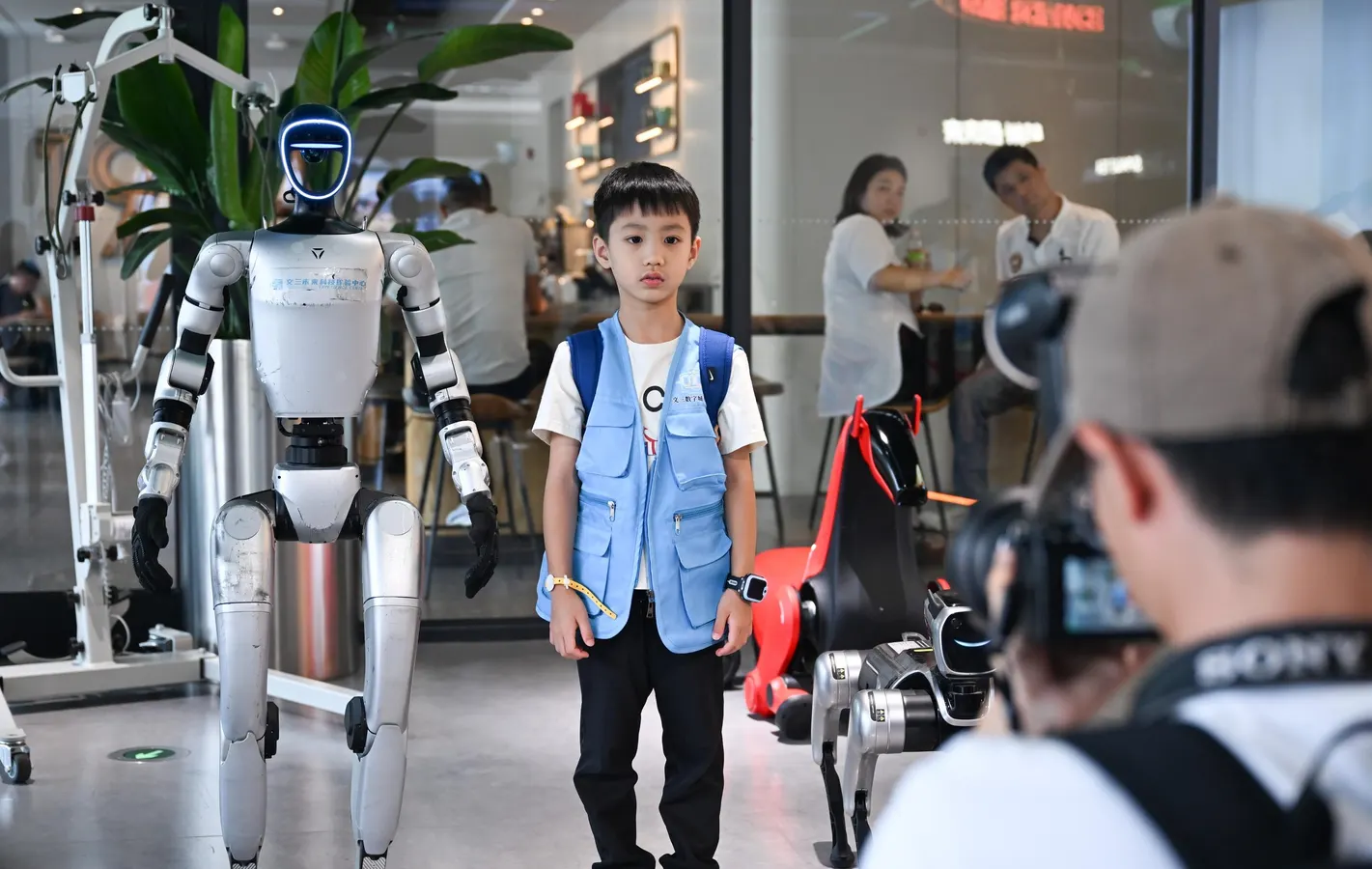
HANGZHOU, CHINA - AUGUST 19: A child poses for a photo with Unitree Robotics humanoid robot at the Wensan Digital Life Block on August 19, 2026 in Hangzhou, Zhejiang Province of China. The Hangzhou-based humanoid robot maker Unitree Robotics closed at 845 yuan on August 19, giving it a market value of around $50 billion. (Photo by Wang Gang/China News Service/VCG via Getty Images)China News Service via Getty ImagesLast Wednesday, a company best known for robots that can do backflips executed the most impressive acrobatic feat of its young life. Unitree Robotics priced its Shanghai IPO at a valuation of about $9 billion and ended its first trading day worth roughly $50 billion, after the shares opened up more than 600% and “settled” for a 460% gain. Retail investors oversubscribed the offering more than 8,000 times, a record for the tech-focused STAR Market, which worked out to lottery odds of 0.018% for winning an allocation. Investors who missed the lottery found a workaround: Unitree-linked perpetual contracts on a crypto derivatives exchange traded at roughly four times the IPO price before the stock opened.As an accountant, I have a professional weakness for moments when market enthusiasm and audited financial statements sit in the same room. Rarely have they sat so far apart at the table.The Robot That Ate The STAR MarketThe facts of the debut are straightforward, if not exactly sober. Unitree, formally Hangzhou Yushu Technology, raised 6.1 billion yuan ($904 million) and became the first humanoid robot maker listed on a mainland Chinese exchange. Its backers include DeepSeek, which put in about 140.8 million yuan as a strategic investor, alongside longtime shareholder Tencent. Founder Wang Xingxing, who started the company a decade ago, ended the day with a paper fortune north of $12 billion.The choreography around the listing was impeccable. Two days before trading began, Unitree unveiled a new humanoid dubbed “Superman,” which it says can jump 2 meters from a standing start and outrun Usain Bolt. The debut itself coincided with the opening of the World Robot Conference in Beijing, where more than 300 companies showed humanoids sorting parcels, packing phones and boxing one another. MORE FOR YOUNor was Unitree the first act: last month, memory chipmaker CXMT surged 466% on its STAR Market debut and briefly surpassed Tencent as the most valuable company listed on a mainland exchange. By Wednesday’s close, Unitree was worth more than Baidu, JD.com and America's most valuable robotics startup, Figure AI.A Green Eyeshade Read Of The ProspectusLet me give credit where it is due, because there is genuine credit to give. Unitree is a real business. Revenue more than quadrupled last year to roughly $250 million, and the company is profitable — a distinction shared by almost none of its humanoid peers, foreign or domestic. Last year Unitree shipped more than 5,500 humanoid robots, and together with rival AgiBot accounted for more than 70% of the roughly 13,000 humanoids shipped globally. This is not vaporware with a stock ticker.Now for the buts. Nearly three-quarters of Unitree’s humanoid revenue comes from research and education customers — universities and labs buying robots to study, not factories buying robots to work. Industrial deployments were less than 10% of sales in the first three quarters of 2025. First-quarter adjusted profit fell by more than half as R&D and marketing spending ramped. And in July, the U.S. Federal Communications Commission banned imports of new foreign-made humanoid and quadruped robots on national security grounds, closing off a market that supplied about 13% of Unitree's revenue.Then there is the matter of the founder’s own guidance. The morning after his stock rose 460%, Wang told the World Robot Conference that the industry’s breakthrough — its ChatGPT moment — could take “2 to 3 years at the fastest, and 5 or even 10 years at the slowest.” A year earlier he had promised five years at the outside. When a CEO marks down his own narrative the day after a 460% pop, the accountant in me reaches for a sharper pencil — and also tips my cap, because that is a rare act of expectations management. At Wednesday’s close, the market was paid roughly 200 times last year’s revenue for a company whose founder says the payoff is somewhere between 3 and 10 years out.Mania With Chinese CharacteristicsRobots have saturated Chinese daily life in a way that has no American parallel: humanoids staff dedicated robot malls, patrol city streets alongside police, and perform in shopping centers and tourist districts — heavily boosted by government at every level, and cheerfully embraced by the public even when the practical value is, shall we say, still of marginal utility. Beijing has made embodied intelligence a pillar of its latest five-year plan, as I wrote in January, and the capital has followed: Chinese investors have poured more than 100 billion yuan ($14.8 billion) into the sector this year, chasing a market Morgan Stanley pegs at $5 trillion by 2050.Last November, the National Development and Reform Commission cautioned publicly about hype and overcrowding in a sector where more than 150 companies were building nearly identical robots, and the leading robotics index promptly fell 20% from its October peak. The correction lasted roughly as long as a robot dance routine. The IPO pipeline behind Unitree has only thickened: AgiBot, Galbot, and X Square Robot have all filed confidentially for Hong Kong listings, feeding an exchange that raised HK$210 billion in the first half — up 92% from a year earlier — as I detailed in my recent look at China's AI listings wave.Two Theories Of The Robot FutureBeneath the ticker tape lies a genuine strategic divergence, one I first mapped in June when Nvidia put an American brain in a Unitree body. Call it the perfectionist school versus the iterationist school.Tesla embodies the perfectionist school. When Elon says Optimus will one day be worth more than the rest of Tesla combined, he is describing a general-purpose machine — a robot with human-equivalent capabilities that learns adaptively, acts independently, and can be dropped into any home or factory and figure things out. That is a moonshot aimed at the destination: do not ship until the robot can do nearly everything. America holds the frontier AI models, the simulation stacks, and the training compute that such a machine will require, which is why skeptics note that Chinese hardware still leans on Nvidia chips and software for its robots' reasoning.China is running the iterationist play: ship task-limited robots now, at consumer prices — Unitree's entry humanoid sells for under $6,000 — and let volume spin the data flywheel. Most of those 150-plus companies will end up as dead ends; the NDRC has said as much. But that is creative destruction working as designed. Every failed robot startup still trains a cohort of engineers, places orders for actuators and reducers, and thickens a domestic supply chain — including the rare-earth magnets of which China produces roughly 90% of global supply — that any eventual winner, foreign or domestic, will need to buy from.Both theories can be right. The perfectionist school may well win on capabilities: a robot that truly matches human adaptability is worth incomparably more than one that packs boxes. But by aiming for perfection, the American approach concedes the intervening decade — and in that decade, China is building the industrial base, the cost curve, and the deployment data. If Optimus one day triumphs, there is a fair chance it will be assembled, at least in part, from components that the Chinese robot mania paid to commercialize.The Price Is The QuestionWe have seen this movie before, in solar panels and electric vehicles: subsidy, swarm, shakeout, and then a handful of world-beating survivors standing atop a supply chain the losers financed. Investors who bought the whole sector at the peak of enthusiasm generally did poorly. The industries themselves did fine. The larger and more futuristic the opportunity, the more difficult it becomes for the market to discount future value with a sober gaze.My ledger reads the same way here. The robots are real. The industry is real. Some of the companies now filing for listings will matter enormously in a decade. Whether the ones trading at 200 times revenue will be among them is a question that first-day pops are spectacularly unqualified to answer — and as Wang Xingxing himself reminds us, the ChatGPT moment is still somewhere over the horizon. Until it arrives, I will keep watching the backflips. And the balance sheets.
China’s Robot Boom Tests Investor Discipline
China’s robot boom hits a frenzy as Unitree’s IPO jumps to a $50 billion valuation, raising questions about revenue, risk and how fast the humanoid market can mature.
1,413 words~6 min read