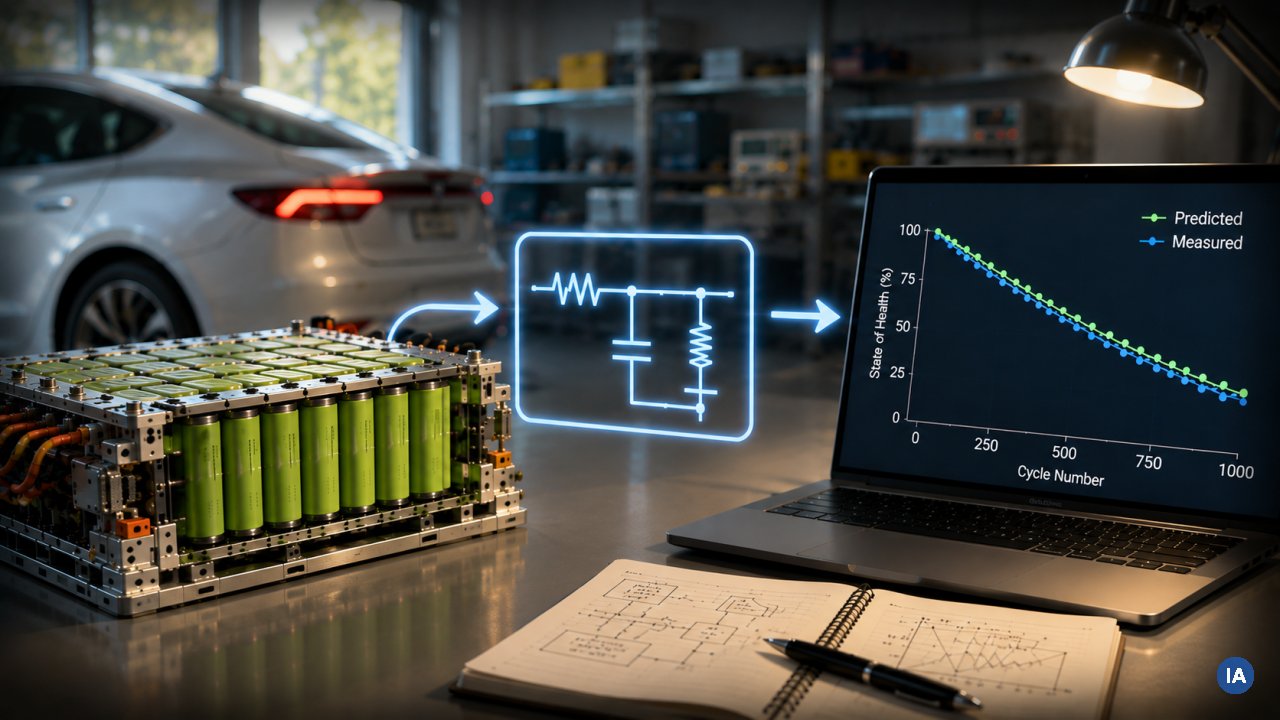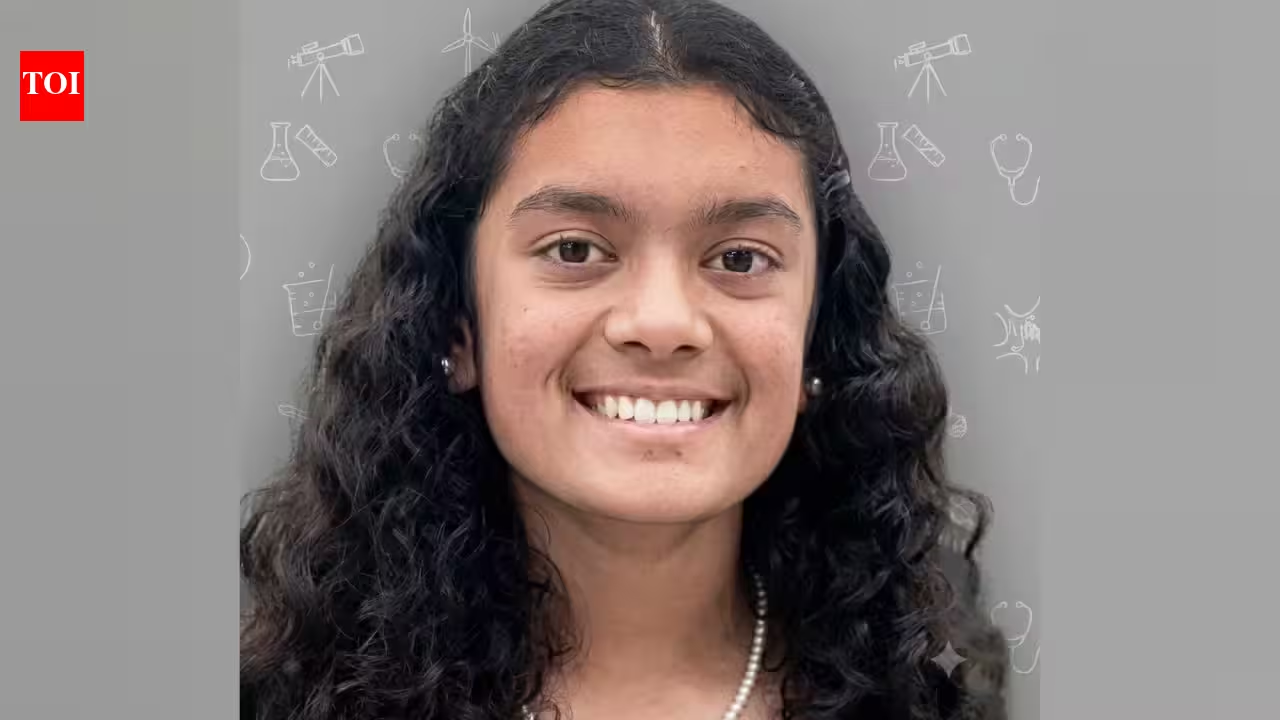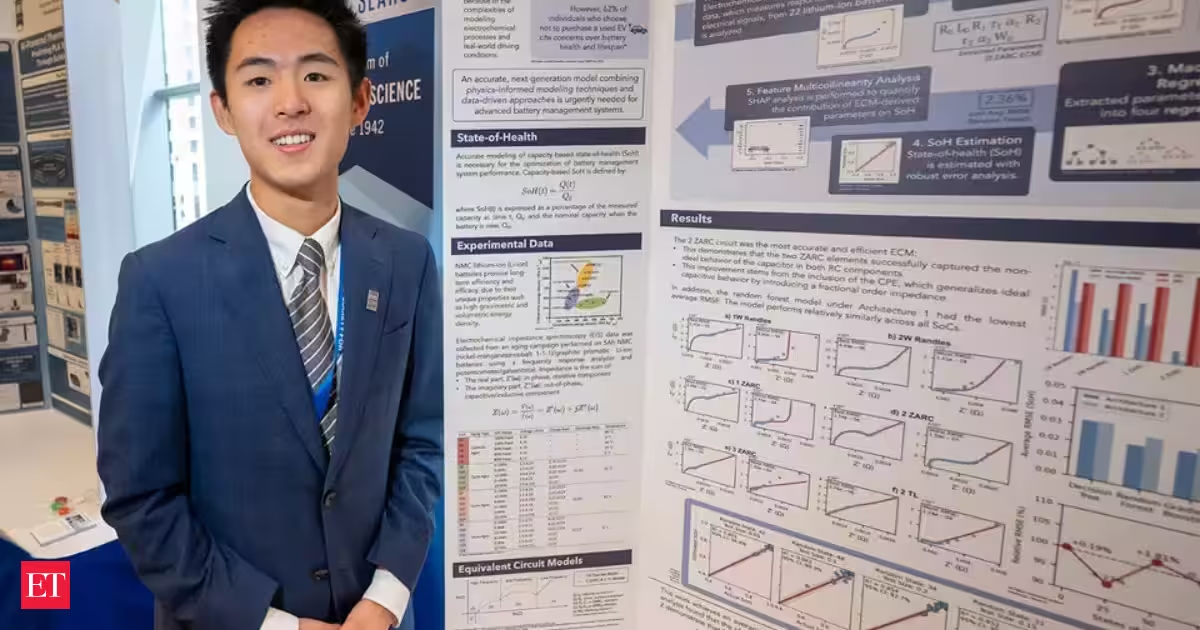
At just 18, Colin Jie Chu has spent two years tackling a problem that could become increasingly important as electric vehicles become more common: understanding how much useful life remains in an aging lithium-ion battery.The Palo Alto, California, student conducted his research through Stanford University's Young Investigators Program, working in Professor Simona Onori's Stanford Energy Control Lab alongside PhD student Sai Thatipamula and industry partner Nuvoton.ALSO READ: Jeff Bezos’ ex-wife MacKenzie Scott, who sold half of her Amazon stake, helped erase $40 billion in medical debt with $100 million in donationsHis research combined battery modelling and machine learning to estimate the state of health (SOH) of lithium-ion batteries under changing operating conditions. The resulting framework achieved a reported 2.36% error in state-of-health predictions.The project ultimately helped Chu earn a place among the 40 finalists in the 2026 Regeneron Science Talent Search, one of the leading science and mathematics competitions for US high school students.How Colin Jie Chu researched EV battery health at StanfordChu began his Stanford research in 2024 through the Young Investigators Program, which gives local high school students opportunities to work alongside university researchers.ALSO READ: World’s biggest citrus waste-to-energy plant is being built in Brazil: 2.1-million-square-foot facility to turn orange juice waste into 1.77 million cubic feet of biogas every dayAt the Energy Control Lab, his work focused on estimating the health of lithium-ion batteries. Instead of relying solely on machine learning, Chu combined an equivalent circuit model with machine-learning regression techniques.Equivalent circuit models simplify the complex electrical behaviour of a battery into components that can be mathematically analysed. Machine learning, meanwhile, can identify patterns in large amounts of battery data.By bringing the two approaches together, Chu developed a framework designed to estimate battery state of health even as operating conditions change.Stanford said Chu presented the research at the fourth Modelling, Estimation, and Control Conference in Chicago. The work was also published in the Journal of The Electrochemical Society.Why battery state-of-health estimation mattersAn EV battery does not simply stop working when it begins to age. Its usable capacity gradually declines, making it increasingly important to understand how much performance remains.ALSO READ: ‘Where to kill Barron Trump?’: After Melania Trump, Iran targets Trump's 20-year-old son in chilling video as $10 million bounty claim emerges amid US-Iran tensionsAccurate state-of-health estimation can help researchers better understand battery degradation and could eventually contribute to improved battery-management systems.Chu's reported 2.36% prediction error is therefore notable, but it does not mean the model can already predict the exact remaining lifetime of every electric-car battery.The framework was evaluated on research data, and broader testing across different battery chemistries, battery ages, driving conditions and vehicle platforms would be required before it could be considered a universal EV battery-life prediction system.ALSO READ: Labor Day 2026: When is the federal holiday, what day is it, why is it celebrated and what is the history behind the first Monday in September?From Stanford research to a major science competitionChu's battery research earned him a place among the 40 finalists of the 2026 Regeneron Science Talent Search.But the recognition did not end with becoming a finalist.At the competition's awards ceremony, Chu received the Glenn T. Seaborg Award, an honour selected by his fellow finalists. Stanford's Energy Control Lab confirmed the award in June 2026 and published a recording of his speech.His work at Stanford also continued beyond his initial battery-health project.In 2025, Chu began another research project involving parameter extraction and feature-importance analysis for battery kneepoint and lifetime estimation. He worked on that project with postdoctoral researcher Simone Fasolato, visiting scholar Jungwon Moon and industry partner Nissan.An 18-year-old working inside a university research labWhat makes Colin Jie Chu's story stand out is not simply the reported accuracy of his battery model.While still in high school, he became part of an active university research environment focused on battery engineering, machine learning, modelling and energy-storage systems.His work shows how high school research programs can give young students access to sophisticated scientific problems long before they enter college.
18-year-old California student Colin Jie Chu built a model to predict EV battery health with 2.36% error. His research wins top US science award
18-year-old California student Colin Jie Chu developed a model to predict the health and lifespan of electric vehicle batteries, achieving a reported 2.36% error in state-of-health predictions. His Stanford-linked research earned him a place among the 40 finalists of the 2026 Regeneron Science Talent Search and the Glenn T. Seaborg Award, selected by fellow finalists.
664 words~3 min read