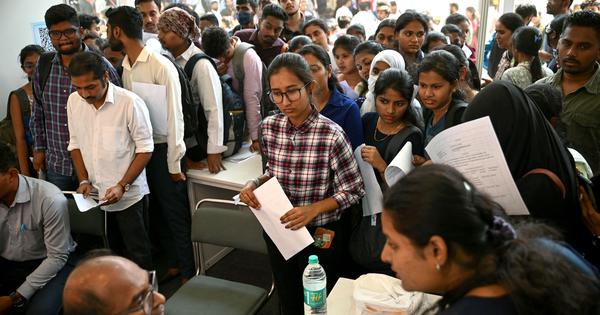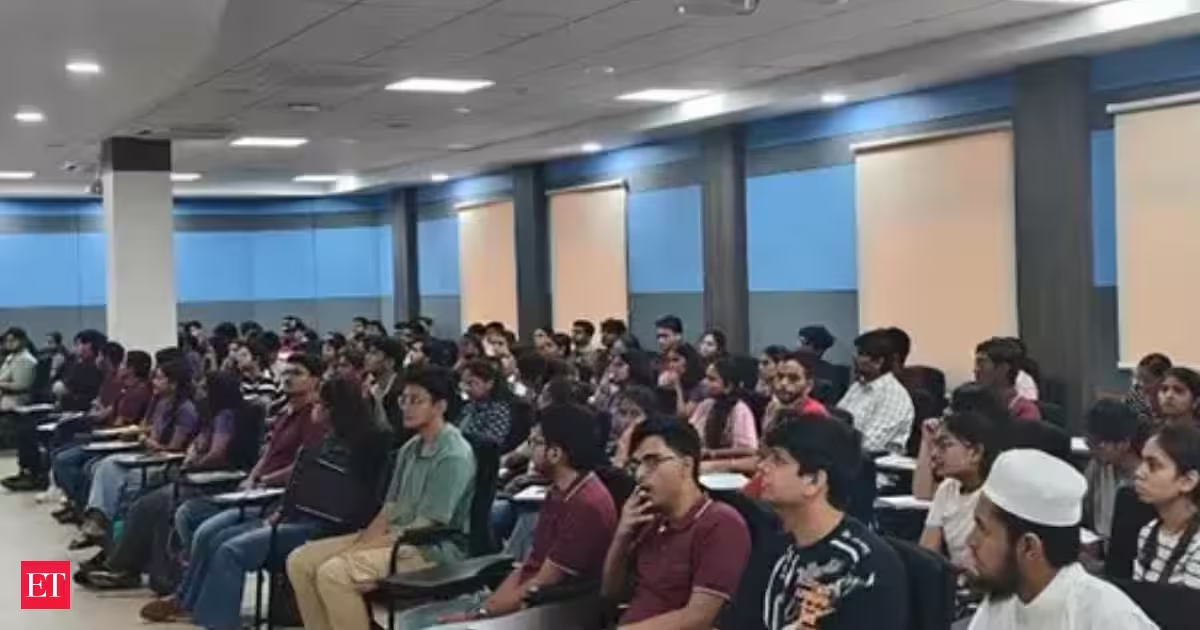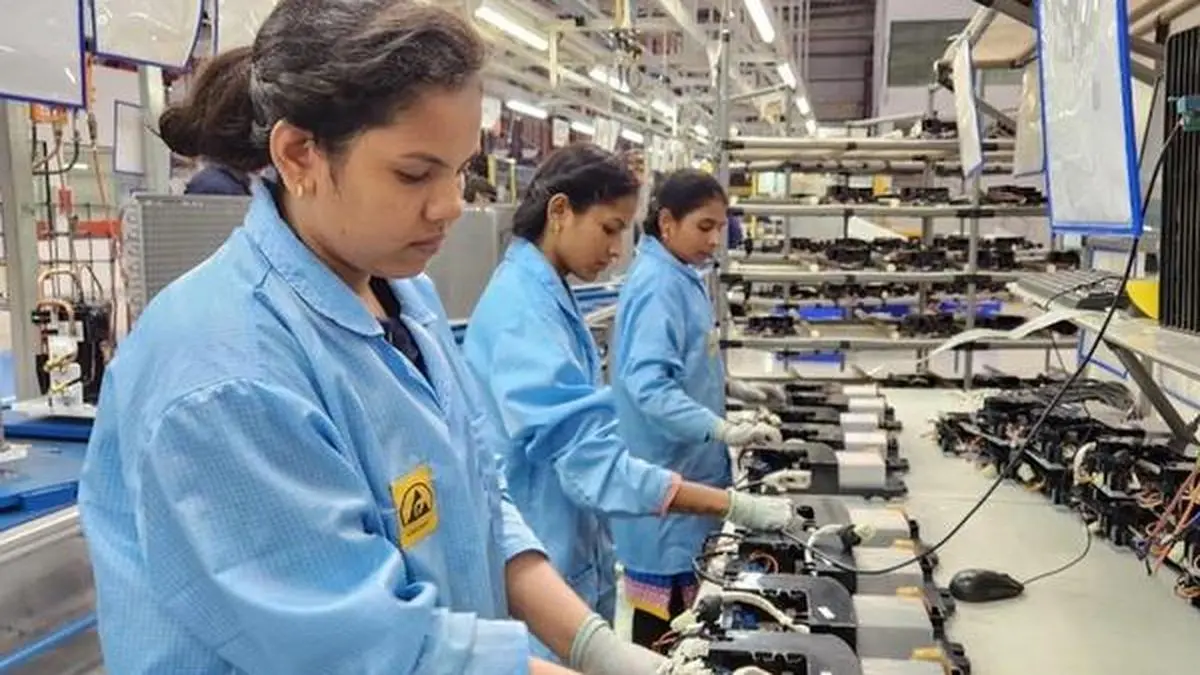
Women’s skilling gains are not translating into jobs and only 3 per cent are in formal employment, said a NITI Aayog report published recently.The report’s analysis says that among the women covered across its segments, only 3 per cent are in formal jobs, while 71 per cent are either in informal employment or the NEET segment — those Not in Education, Employment, or Training.This points to a much larger problem than merely women’s access to training: the labour market itself is not providing enough formal, accessible and flexible opportunities, the report named Reimagining Skilling for Viksit Bharat@2047 says.The finding sits at the centre of a broader diagnosis in the report: that training is running into a wall of structural barriers that keep women out of the workforce in the first place, and that even when women do skill and work, it rarely translates into stable, formal livelihoods.The report identifies a specific set of barriers that shape women’s ability to skill at all: caregiving responsibilities, safety concerns, lack of safe transport, lack of childcare, distance from training centres, rigid training schedules, and a lack of flexible employment options once training is complete.“For women, and especially mothers, access constraints are further shaped by caregiving responsibilities and household schedules,” the report says, adding that “fixed training formats are often incompatible with daily routines” and that enabling infrastructure such as “safe transport, secure childcare, and nearby training centres is often absent.”These constraints are not marginal — they define the outer limits of what most women can even consider. The report’s survey data show that around 75 per cent of women preferred skilling programmes within a 5 km radius, with anything beyond that, or in an unfamiliar location, becoming effectively inaccessible.Separately, 78 per cent of women said they preferred part-time courses that let them “manage household/caregiving responsibilities along with learning,” and 68 per cent specifically preferred part-time formats over full-day, full-time programmes.The report illustrates this through the case of “Sangeeta,” a woman married at 21 who wanted to learn a skill to supplement her household income. “Training centres that are more than a few kilometres away are effectively inaccessible,” the report notes.“Family expectations, safety concerns, and caregiving responsibilities mean she cannot travel beyond a familiar 3-5km radius, nor commit to fixed, full-day programmes.” It adds that “like Sangeeta, ambitions of many women are confined by geography and norms.”The report also carries a first-person account from a recently married woman in peri-urban Vijayawada, who told researchers: “I am unaware of the skilling programmes around me. I can’t ask in my neighbourhood. It doesn’t reflect well on me as a daughter-in-law.” This, the report suggests, is not just an information gap but a social one — women’s willingness to even seek out programmes is constrained by norms around visibility and propriety.To address these barriers, the report proposes women-focused interventions including “Sakhi Booths” — trusted, local spaces for awareness-building — “Community Women Circles” for mentorship, a women-centric app for safe and private access to information, and “Surakshit Saathi,” a public-private model to provide secure hostels and affordable transport for women near industrial and training hubs.Even where women do complete training, the report finds that skills acquisition alone is not enough. “Even after training, the lack of flexible and dignified livelihood options prevents skills from translating into sustained economic participation,” it states.As a result, many women end up in small, home-based self-employment — not necessarily by choice, but because it is one of the few options compatible with their circumstances. The report notes that this path “promises flexibility, but face[s] constraints related to autonomy, access to capital, and market linkages.” In other words, women who turn to self-employment after skilling often lack control over decisions in the enterprise, cannot access the capital needed to grow it, and struggle to connect their products or services to buyers beyond their immediate, local network.The report said that the skilling system has largely been designed around getting people trained, with far less attention paid to what happens after, whether that training leads to a job, a viable business, or nothing at all.Published on August 24, 2026
Only 3% women in formal jobs, skilling gains not translating into employment: NITI Aayog report
The report found that among the women covered across its segments, only 3% were in formal employment
683 words~3 min read