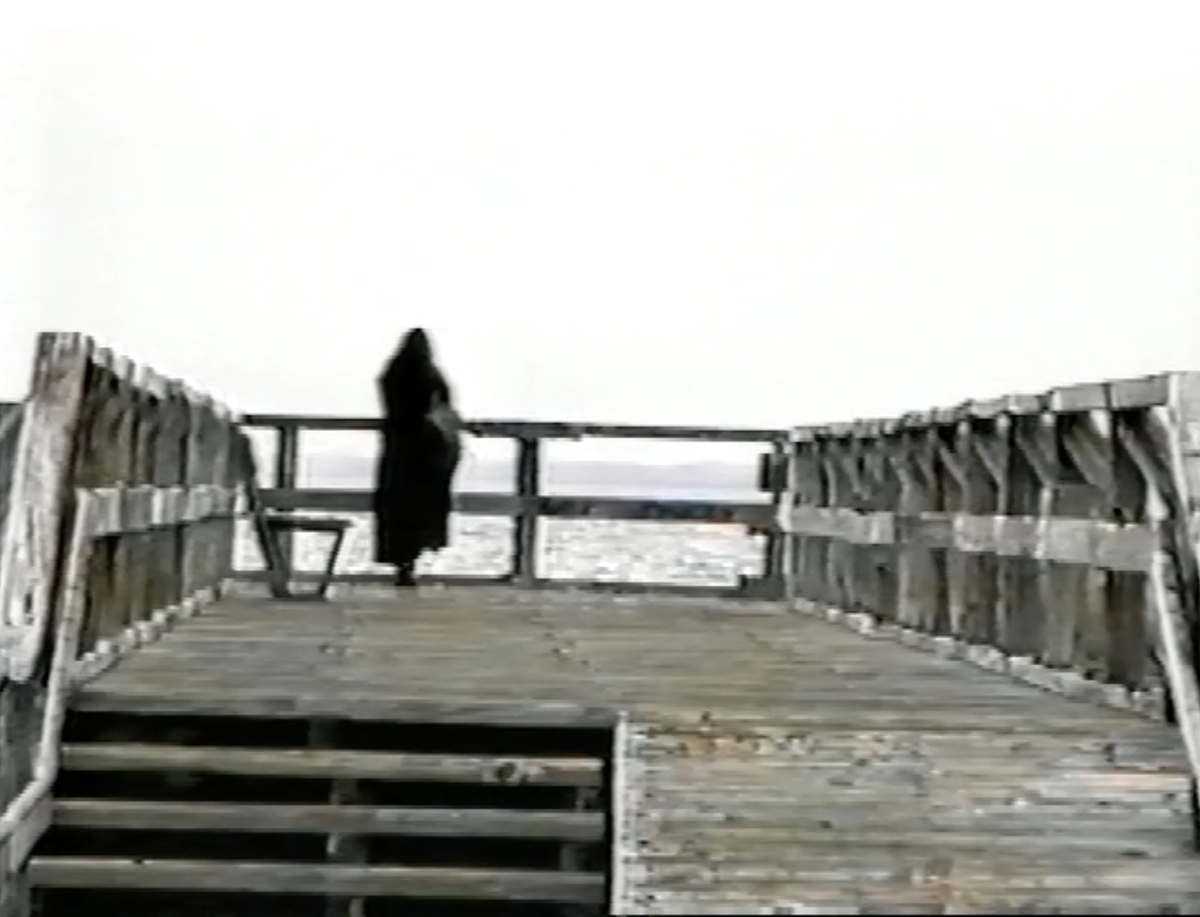
Viewing Sophie Calle’s survey at the Langson museum through the work of Hervé Guibert.Did you know LARB is a reader-supported nonprofit?LARB publishes daily without a paywall as part of our mission to make rigorous, incisive, and engaging writing on every aspect of literature, culture, and the arts freely accessible to the public. Help us continue this work with your tax-deductible donation today!IN THE OPENING SCENES of Sophie Calle and Greg Shephard’s film Double Blind/No Sex Last Night (1996), an autofictional account of a splintering romance and doomed American road trip, Calle mourns the death of her close friend, French photographer and writer Hervé Guibert, who died in Paris at the age of 36, after a period of declining health from AIDS complications, just seven days before she began filming. Lamenting her absence from his deathbed and funeral (implied here as an intentional evasion of sorrow), she stages a symbolic sea burial for him at the edge of a Delaware dock, timing it to precisely coincide with his actual interment on the Italian island of Elba. We hear the crackling static of his answering machine, which she called the day before to honor his wake. A sequence of still images follows. Calle tosses a bucket of flowers into the water, and as they disperse amongst the waves, she recounts: “I remember the day you bathed in my bathwater in Kyoto; you told me it was the most erotic experience you’d ever had with a woman. I’ve always wondered if that was true.” For Guibert, whose work so often ruminated on the entanglement of death and desire—“as though I were impregnated by death in my innermost being,” he wrote in his 1990 novel To the Friend Who Did Not Save My Life (as translated by Linda Coverdale)—Calle’s elegy was perhaps apropos.Guibert, a progenitor of French autofiction and self-proclaimed heir to the Marquis de Sade and Jean Genet, is best known for To the Friend Who Did Not Save My Life, which intimately traces the progression of his disease and famously chronicles the death of his friend Michel Foucault (referred to as Muzil in the text), who, unbeknownst to the French press at the time, had also succumbed to AIDS. Guibert’s novel briefly depicts Calle as the somewhat unsympathetic character Anna; their friendship later blossoms during a visit to a mossy Japanese temple. Calle, in turn, excerpted his novel in her artist’s book Exquisite Pain (2005), which includes several brooding portraits of Guibert as well as images of the temple and the aforementioned Kyoto bathtub, evocative of a wooden coffin when empty.While much of Guibert’s late work dissects his looming mortality in searing visual detail—he was remarkably prolific in a short span of time—he nursed an artistic predilection for death long before his 1988 diagnosis. His book La mort propagande (“Propaganda Death,” 1977) eroticizes, among other things, autopsies, mutilations, and dismemberments, flagrantly embracing revulsion. Mortality likewise informs Ghost Image (1981), one of his most striking books, an erogenous and occasionally melancholic treatise on photography written in response to his friend Roland Barthes’s Camera Lucida, published the year prior. A text on photography with nary a photograph, Ghost Image contains a series of first-person narrative vignettes that anatomize photography from a phenomenological perspective, revering, mourning, and at times detesting the photograph and its inherent material instability as if it were an extant body (now a nostalgic predigital conceit).When I visited Calle’s recent survey exhibition, Overshare, at the UC Irvine Langson Orange County Museum of Art, Ghost Image served as the running script that looped through my mind. Guibert’s candor and provocation, paired with his subtle undercurrent of conceptual detachment, make his and Calle’s oeuvres natural companions. Her disavowal of privacy, dismantling of bourgeois boundaries, and sporadic insistence on the objecthood of the image—underscored by her embrace of analog technology and use of collage-like installations that frequently recall the scheme of a book—enact many of the concerns intrinsic to Guibert’s text. Both position language and photography as antipodal yet inextricable, as two poles bound to the same body. They also, through image and text, invoke beds and tombstones—sites of sex, death, and respite—as malleable symbols for exploring the embodied potentiality of the photograph, often allegorized as a memento mori.For both Calle and Guibert, the cemetery functions as a site of first and last rites. In Concession, a short text and photograph from the series Autobiographies (2018), Calle reveals that she purchased a burial plot in a cemetery in Bolinas, California, where she took her very first photographs. Likewise, in To the Friend Who Did Not Save My Life, Guibert writes that he sought, in his youth, “the most spectacular attributes of death, […] wandering around cemeteries and breaking in [his] first camera with photographs of children’s tombs.” Calle has similarly engaged with languages of representation in the penumbral space of the graveyard, photographing unidentified headstones labeled with generic epitaphs such as “mother” or “father,” anonymous objects that calcify otherwise complex and intimate familial identities. As sepulchral, atypical family photographs, these images embody Guibert’s theoretical concerns with innocuous family pictures, which taxonomize significant life events and thus acutely map the onset of death, compressing the two together like “funereal lockets.” As he writes in Ghost Image, “[F]amily pictures remain in their little cardboard coffins where we can forget them; like crosses planted in the ground, they arouse a melancholy pleasure.”Calle’s photograph Mother-Father (2018) indulges in melancholic pleasure by injecting an otherwise somber image with wry gallows humor. A black wool curtain printed with the phrase “Because revenge is a dish best served cold” veils a framed photograph of two gravestones, one labeled “mother” and the other “father,” with the matriarchal stone looming over the other in both scale and ornamentation, as if performing a preference or settling a score. The work’s humor stems from Calle’s surgical insertion of language, which reorients the cold, buried corpse—implied, unseen—as both the adage’s punch line and the image’s true subject. By inviting the viewer to theatrically lift the image’s cloak, Calle emphasizes the photograph as a haptic object inseparable from the entropic body it memorializes.Embracing this logic, both artists often treat the photograph at once as relic and weapon. One of the defining tenets of Calle’s work is that she frequently wields photography as a gambit; Guibert’s writing similarly bears the residue of strategic calculation, shifting between moments of vulnerability, exposure, and manipulation. Their friendship, in fact, began with such an encounter. In Exquisite Pain, Calle recounts that she first met Guibert when he profiled her for Le Monde; during their initial meeting, she “decided to play the game,” calculating her omissions and revelations. Conflict arose when Guibert spotted a childhood portrait of Calle taken by her father and requested to use it for the article. She refused: “I loved the photograph and the negative had been mislaid,” meaning it was a singular, irreplicable object—something akin to the childhood image of Barthes’s mother that buttresses Camera Lucida, the photograph a private death or wound that resists publication. Guibert pressed her, and unlike Barthes, Calle relented to the image’s extraction. When the newspaper misplaced it, she angrily confronted Guibert at his home, where he slammed the door in her face—a scenario he also describes in To the Friend Who Did Not Save My Life. This moment bound these two artists in the exploitation of personal experience as artistic material. As Calle writes in Exquisite Pain, “I realized then and there that he would make me pay for this.” The photographic object, a tiny body exhumed for the newspaper, becomes a calibrated pawn of exposure and betrayal.This is precisely how photographs function in several of Calle’s most notable projects, particularly Suite Vénitienne (1980), which traces her experience following and covertly photographing a stranger from Paris to Venice, Italy, as well as The Hotel (1981), which documents the occupied rooms she cleans during her brief stint as a housekeeper at a Venetian hotel. In Ghost Image, Guibert similarly mulls over the rootless space of the hotel room, prying open the solipsistic fantasy of claiming it: “[T]he first thing to do is to take a picture of the room, as if to stake out a territory, […] as if to mark your temporary belonging, as if to attenuate the cost, as a testimony of your presence.” Here, Guibert theorizes the impulse that Calle’s work enacts. Photographing a space in order to mark it is a gesture that leaves no immediate physical trace, making Calle’s photographs of unmade beds and scattered belongings—always accompanied by a text that further exposes the intimate behavior of the unknowing occupants—all the more provocatively invasive, the photographer performing a haunting. These projects also establish a predator/prey relationship between the photographer and her subject, an idea that she realizes more explicitly in On the Hunt (2024), which pairs images of hunting towers and mammalian prey with poeticized excerpts from personal ads and dating profiles. Guibert seizes upon this conceit in Ghost Image as well. In describing his friend P., who, eerily like Calle, photographs strangers he stalks, Guibert compares the subjects to anonymous prey: “they are initially alive, before being laid out on the paper and dipped into the baths of acid.” By concluding that P.’s collection of clandestine images comprises “a secret little cemetery,” Guibert again equates the photograph with the tombstone, each enshrining an ossified body.While Guibert wasn’t alone in theorizing the photograph as a death object—both Barthes and Susan Sontag connected photography to mortality, the former through the private grief of “that-has-been” and the latter through photography’s compulsive replacement of lived experience—he was unique in his explicit invocation of the photograph as coextensive with the body itself. In Ghost Image’s titular chapter, he describes how, when he was 18, he intended to take a portrait of his mother that subverted his father’s control over her appearance (“Wasn’t it in fact my father’s death that I wanted to stage?”), dampening her overly fussy hairstyle and dressing her in a white slip before staging her in a sun-dappled armchair. In admiring “the purity of her features,” he compares her to “a queen before an execution,” reflecting, “I wonder now if it wasn’t her own execution she was expecting, for once the picture was taken, the image fixed, the process of aging would continue, and this time at a dizzying speed.” While he writes longingly of this experience, likening it to a transcendence, he also agonizes over it, as the film was unexposed—his rogue image now a fleeting ghost consumed by a “blank death.” Hyperbolically and with a heavy tinge of misogyny, Guibert writes that, after this photographic undoing, his mother suddenly aged exponentially, as if the ghost image had infected her body and hastened her mortality.Calle’s solemn, unsparing film Impossible to Catch Death (2007) also centers her mother’s demise, though quite literally in this case. The artist installed a camera at the edge of her mother’s deathbed, hoping to apprehend her final words. The resulting 11-minute film appears to be so imperceptibly still that it could be mistaken for a static image—the precise moment of her mother’s death, while interred within the footage, remains impossible to ascertain, reiterating it as a phenomenon unknowable to both living body and camera alike. In Overshare, the film was projected alongside footage of glaciers buoyed by icy waters. Often, the soft folds of Calle’s mother’s bedsheets would align with the sinuous curves of the glacier, connecting the intimate cadence of human mortality to deep time and the geologic unknown.That said, both Calle and Guibert seem more intrigued by the immediate site of death—the bed, the gravesite—than by its wider theological immensity. Like the photograph and the coffin, the bed also cradles a body in suspension. Echoing Ghost Image’s eponymous narrative of the latent image, Guibert, in To the Friend Who Did Not Save My Life, recounts that after Muzil’s (Foucault’s) death, their mutual friend requested that Guibert photograph Muzil’s apartment just as he had left it, the space beclouded by his absence. Guibert hesitated to photograph his mattress—an intimate object freighted with death—but when his friend insisted, the camera shutter failed to click, the indexical photograph refusing its own making. In many ways, Guibert’s anecdote serves as the antithesis to Félix González-Torres’s famed untitled billboards from 1991, which depict an empty, tousled bed delicately imprinted by the absent body of the artist’s late partner, Ross Laycock. In both instances, the image, or lack thereof, collapses the distance between photographic exposure (both a mechanical term and a gesture of unsheathing) and corporeal vulnerability.Calle’s work similarly rejects the bed as a symbolic abstraction, instead asserting it as a tangible bodily surrogate. While her most notable bed-related projects deploy it as a trope for engineering moments of detached intimacy—in both The Sleepers (1979) and Journey to California (2003), for example, she extends the use of her bed to others while remaining conspicuously absent from it—The Bed (from Autobiographies) unequivocally frames the object as a locus of death. In this work, she presents a photograph of a charred mattress laying askew in an apartment courtyard with a text panel that contextualizes it as a remnant of another’s violent demise: “It was my bed. The one in which I slept until I was seventeen. Then my mother put it in a room she rented out. On October 7, 1979, the tenant lay down on it and set himself on fire. He died. The firemen threw the bed out of the window.” While not explicitly stated, the curt tone of Calle’s text suggests that because this bed formerly embraced her body, its fiery fate somehow accentuates her proximity to mortality. Here—unlike the gravesite, which marks mortality but hides decomposition, or her mother’s filmed deathbed, which visualizes death as an intangible process of gentle respite—the photograph of the scorched bed forces us, both artist and viewer alike, to optically consume the unpleasant, volatile dregs of sudden death.This gesture of consumption, both visual and somatic, reverberates throughout Calle’s and Guibert’s work, emphasizing the photograph as an object ripe for ingestion. In one of the most carnal narratives in Ghost Image, detailed in a chapter titled “The Cancerous Image,” Guibert, in the most literal sense, physically absorbs an image. The author recounts how he stole a photograph of an anonymous young man and exhibited it on his bookshelf, where it eventually gathered dust, until, like a dying patient, it began to decay, its skin sloughing and erupting with pustules: “He looked syphilitic. The image was cancerous. My friend sick.” Enraptured by its entropic metamorphosis, Guibert embraced the image’s degradation and fantasized about expediting it; eventually, he attempted to consume it:I kept the image in my bed, beneath the sheet that welcomed my body; I crushed it and heard him whimper. […] I sewed him into my pillow. Then, after a while, I decided to wear him, directly against my skin, directly against my torso, attaching him with bandages and tape. […] He was like a dead younger brother attached to me, he was my heteradelphus.Guibert transfers the printed image directly onto his skin, absorbing it like a parasitic sponge. In doing so, he leaves the image’s original paper substrate bare—a process analogous to the blank death of the titular ghost image. Through this narrative, Guibert animates the interchangeability of body and image, performing the material fugitivity of each. At the same time, he fails to recoil from the existential tension intrinsic to his thesis, intoning: “Maybe I was going to have to bury him, but how do you bury an image?”Calle answers this inquisition through her work North Pole (2009), which consists of photographs, a video, and engraved porcelain plaques. Two years after her mother’s death, Calle buried her portrait (along with her jewels) at the base of an Arctic glacier, a rite that recalls her earlier eulogy for Guibert. In one of these photographs, the portrait of her mother peers out from beneath a sheet of ice, her visage now mummified by sea and salt. Perhaps, like Guibert’s cancerous image, it will be metabolized by the surrounding terrain—the image finally interred like a body in the earth.When Guibert died in 1991, photography had barely entered its digital infancy. I often consider how he would reconceptualize his philosophy today, with our visual culture so firmly bound to the slippery realm of the internet, now ventriloquized by AI. On one hand, the viral image has fulfilled his logic of the ghost image—a dematerialized photograph unmoored from its physical substrate, defined not by absence or disappearance but rather by its ability to infinitely replicate in the ether, devoid of authenticity or authorship. On the other hand, the camera, which Guibert refers to in Ghost Image as an “autonomous” yet “mutilated being” relegated to being “carr[ied] around with us like an infant,” has now become a physical extension of our bodies: a novel limb impervious to amputation. In this sense, the genre of photography has approached full embodiment, with our handheld screens functioning as our own little rectangular coffins—a mausoleum ad infinitum.¤Featured image: Sophie Calle and Greg Shephard, Still from Double Blind/No Sex Last Night, 1996. Image has been cropped.LARB ContributorJessica Simmons-Reid is an artist and writer based in Los Angeles.ShareLARB Staff RecommendationsSheer TendernessJessica Simmons-Reid visits Noah Davis’s posthumous survey at the Hammer Museum.The Savage Detective: On Sophie Calle’s “Address Book”Lauren O'Neill-ButlerOct 25, 2012
Beds and Tombstones | Los Angeles Review of Books
Viewing Sophie Calle’s survey at the Langson museum through the work of Hervé Guibert.
2,888 words~13 min read