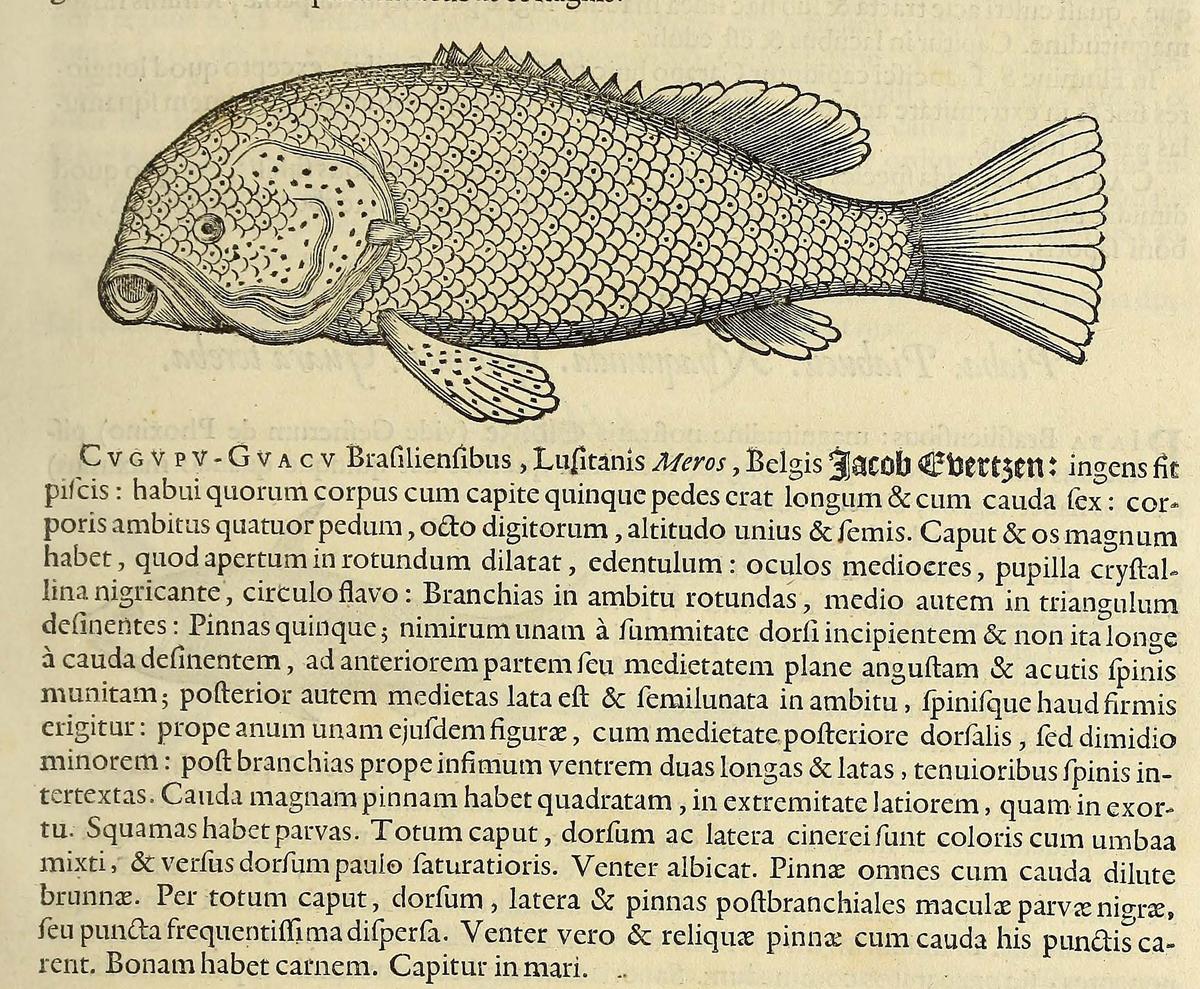
What a dead goliath grouper, killed by an industrial spill, tells us about cerebrocentrism and our denied kinship with other species.Did you know LARB is a reader-supported nonprofit?LARB publishes daily without a paywall as part of our mission to make rigorous, incisive, and engaging writing on every aspect of literature, culture, and the arts freely accessible to the public. Help us continue this work with your tax-deductible donation today!THIS SUMMER MARKS five years since Florida’s worst algae bloom in recent memory, a human-caused catastrophe that left over 600 tons of marine life dead. Karenia brevis, a dinoflagellate endemic to the Gulf, caused what is commonly called “red tide.” This tiny, two-tailed microorganism usually floats out at sea, but urbanization moves it closer to shore. The 2021 bloom followed an industrial spill at Piney Point, a retired phosphate plant just south of Tampa. To relieve stress on a cracked spoil reservoir, officials released 215 million gallons of waste into the estuary. K. brevis gobbled up the mineral-rich spill, oxygen levels in coastal waters plummeted, and area beaches became a putrid, suffocating mess.Dumpsters lined neighborhood parks all summer. Volunteers with buckets and municipal workers in bulldozers cleaned up the rot. I did my part, gathering swollen puffers, alewives, and eels interrupted en route to the Sargasso Sea. I tossed into the trash snook and snapper, sport fish prized for their fillets. I almost lost my breakfast trying to gather up a cow-nosed ray, smothered in flies. But the loss that hit me hardest, by far, was a goliath grouper.These deepwater giants, Epinephelus itajara, can reach 800 pounds. The scientific name comes from the Greek for cloud (“nephelē”), and “itajara” (“lord of the reef”) from the Tupi language family in Brazil. My wife Julie came across the goliath grouper one morning while walking the dog. It was a gruesome sight, fins up, corpse baking in the Florida sun. No way should a fish this size—smaller than a car, bigger than a refrigerator—have landed in the tidal flats by our home.Anyone familiar with Tampa Bay can explain what happened. K. brevis prefers a more saline environment, but a dry summer, a product of climate change, pushed the Gulf-dwelling dinoflagellate into the estuary. The grouper left its perch under the Sunshine Skyway Bridge, where Tampa Bay opens into the Gulf, and followed shipping channels to the sandbar near my neighborhood park, into the seagrass shallows.The dead grouper discovered in Tampa Bay. Courtesy the author.Maybe the fish washed up a corpse, or maybe he (or she or they) suffocated in the receding tide. Either way, the end was horrific. K. brevis releases a nasty neurotoxin unpleasant for humans, lethal for marine life. Fish cannot breathe. They gasp, contort, cramp up and paralyze, lose their orientation, swim in corkscrews, vomit, convulse, and then die.Only a psychopath would wish this fate upon another living being. Five years after the spill, I’m still haunted. Goliath groupers lead remarkable lives. They breed in aggregate, releasing sperm and eggs simultaneously at a single site during a late summer new moon. Many are believed to be protogynous hermaphrodites, meaning females transitioned from males, which often happens when a bull male dies or leaves. They speak in grunts and communicate by changing colors. They spook divers. Why? The same reason God made the Leviathan—“for the sport of it,” the Psalms claim.Technically identified as “opportunistic predators,” Epinephelus itajara almost went extinct in the 1980s, but with protection, their numbers have rebounded. Old salts used to call them “jewfish,” and you’ll hear that still, though the antisemitic name was dropped decades ago (ironically to honor King David’s nemesis). Local fishermen are now more likely to curse the “fucking grouper” who steals a snapper off their line. And anglers agree they’re crafty critters. You can visit the aquarium and see the wheels turning in their marbled, twitchy gaze.Groupers fall squarely within a current debate over animal sentience. When I asked a fisheries colleague what the dying grouper by my house must have felt, he answered: “Not much.” Groupers lack a prefrontal cortex, the expert explained, the part of the brain mammals use to process physical stimuli.Animal behaviorists like Jonathan Balcombe, meanwhile, regard this conclusion as “cerebrocentric.” Humans and fish share evolutionary paths, and while we err in projecting onto other species, humans are far fishier than we like to believe. All vertebrates, aquatic and land-dwelling, share some form of oxytocin, the “love hormone” tied to bonding and attachment. Vertebrates experience pain through nociceptors, nerve endings that send a complicated stew of sensations to the brain stem and spine. Science, in this view, has caught up with what language told us all along. We make decisions “from the gut”; a Puccini aria “sends chills down the back of my neck.” Henry David Thoreau wrote: “My head is hands and feet.” So why the disconnect?When, and why, did we humans begin to set ourselves apart from this shared ancestry? The answer is, of course, modernity, which takes us back to the early 17th century—and to the goliath grouper. The earliest European description appears in the 1648 Historia Naturalis Brasiliae, an encyclopedia of American wonders by the German-born natural philosopher Georg Marggraf and his collaborator Willem Piso. Equal parts gorgeous and strange, their lavishly illustrated volume was a product of violence waged on a planetary scale. Marggraf, who traveled to Brazil under the patronage of the Dutch West India Company, represented the research wing of a commercial operation that extracted slave labor from Africa to grow sugar in the Americas, generating an ill-gained return for investors in the Netherlands.Possessed of a keen eye for detail, Marggraf and Piso cast Brazilian exotics (leopards, grouper, sloth) as products for collection or potential commerce. They rendered nature through a static exterior, in sentences without verbs: “Branchias in ambitu rotundas, medio autem in triangulum definentes” (gills round in circumference but defining a triangle in the middle). Such phrasing peppered the Historia Naturalis Brasiliae, with the same verbless objectivity that drove imperial science for centuries. The Enlightenment’s Carl von Linné, or Linnaeus, tucking the entirety of creation into a binomial Systema Naturae (1735), exercised an equally terse Latin: “pinnis inferioribus flavis fusco-maculatis, cauda integra” (lower fins yellow with dark spots, tail intact). And from a gloriously bearded George Albert Boulenger, fellow of the Royal Society, in the 1895 Catalogue of the Perciform Fishes in the British Museum: “Teeth rather small, in narrow bands in the young, in broad bands in the adult; canines small, disappearing in old specimens.”The upshot? By force of habit, science perpetuates this imperial holdover, with the mindset taken for granted because it has been around for so long. In classical taxonomy, Europeans emphasize the external (Epinephelus, “cloudy”) while the Tupi descriptor (itajara, “lord of the reefs”) foregrounds habitat and personality. I don’t think we can underestimate the importance of this foundational, colonial moment.One year after Marggraf sailed for Brazil, his better-known peer René Descartes, living in the Netherlands at the time, coined his famed blueprint for modernity: “Je pense, donc je suis.” Just as the famed “cogito ergo sum” identified “the human” as abstract thought, a merchant class ramped up a triangular trade linking African slavery, Brazilian sugar, and Dutch profit. European empire simultaneously defined thought-as-abstraction and nature-as-inert.This was no accident. Plantations, the slave trade, and natural philosophy all valued the same cold, calculating eye. Dutch commerce was the “impetus for the rise of modern science,” as Marggraf’s biographers H. J. Zuidervaart and Oscar Toshiaki Matsuura explain. Marggraf’s no-nonsense investors sought merchandise and information, and wanted descriptions that appealed to external know-how (the Dutch “kennen”) over interior exploration (“weten,” or why). Feigned objectivity became de rigueur.Herein lie the origins of cerebrocentrism. My colleague in marine sciences cautions me against anthropomorphizing. But what happens, animal ethicists ask, when we flip the equation? Rather than projecting our cranial capacities onto other species, maybe we should reassess our shared and vestigial patterns of response. We should see bits of ourselves in the grouper, and the grouper in us.The equation of thought with abstraction, starting with Descartes’s cogito and continuing to our current data-heavy abstracted moment, rejects what we know in our bones and feel in our gut. It denies instinct. If we turn back the clock to before the 1630s, perhaps we might recover what Indigenous people have told colonizers for centuries now: nature is alive, plants and animals communicate and talk, and all life is sentient in some form.We are worse off if we ignore this commonsense truth. Over a million pounds of marine life worse. Humans and animals share the mechanics of trauma. To modify Thoreau, our heads are hands and fins and feet. Our thoughts descend from fish. We do better in this world, perhaps, by claiming this cognitive kinship.¤Featured image: Willem Piso, goliath grouper, from Georg Marggraf and Piso’s Historia Naturalis Brasiliae, 1648, is in the public domain. Accessed August 7, 2026. Image has been cropped.LARB ContributorThomas Hallock teaches English at the University of South Florida, mostly on the St. Petersburg campus. This essay comes from a book in progress, tentatively titled “Dead Fish in a Drowning State: Florida’s Lessons to the World.”ShareLARB Staff RecommendationsScience on IceNeil Shubin’s stories of polar exploration tell us about the losses ahead.Seeing Like a WormJessica Riskin’s Lamarckian (history of) science is a remarkably transformative work.Henry M. CowlesApr 16
Hands and Fins and Feet | Los Angeles Review of Books
What a dead goliath grouper, killed by an industrial spill, tells us about cerebrocentrism and our denied kinship with other species.
1,555 words~7 min read