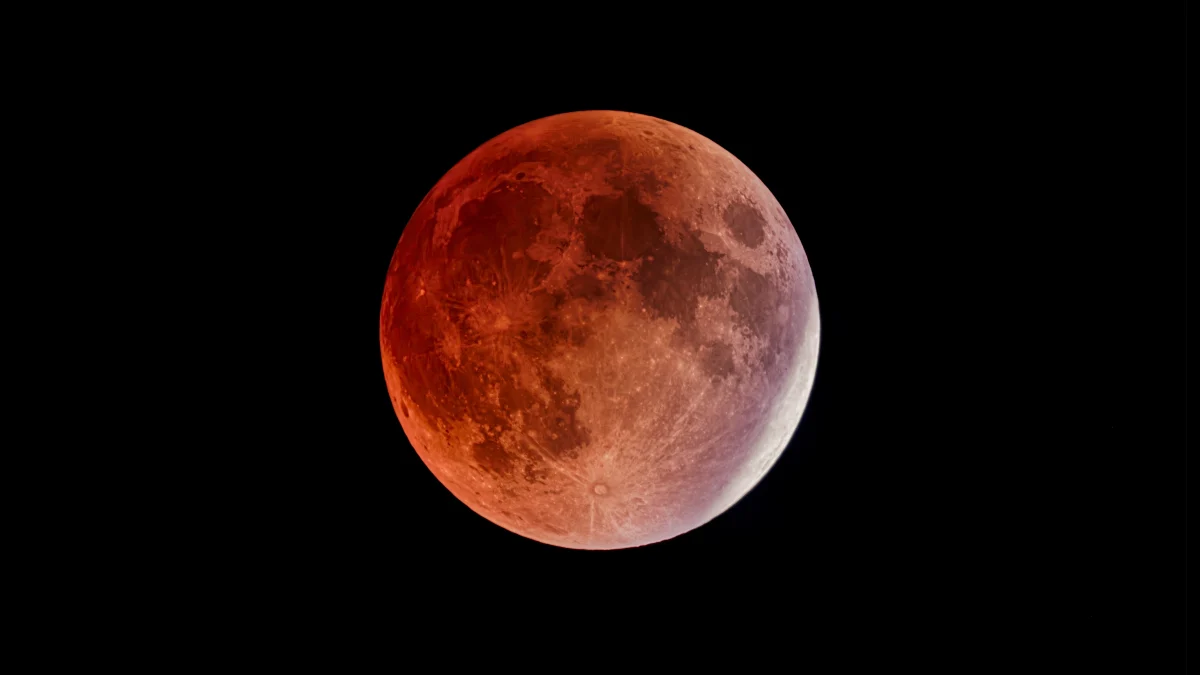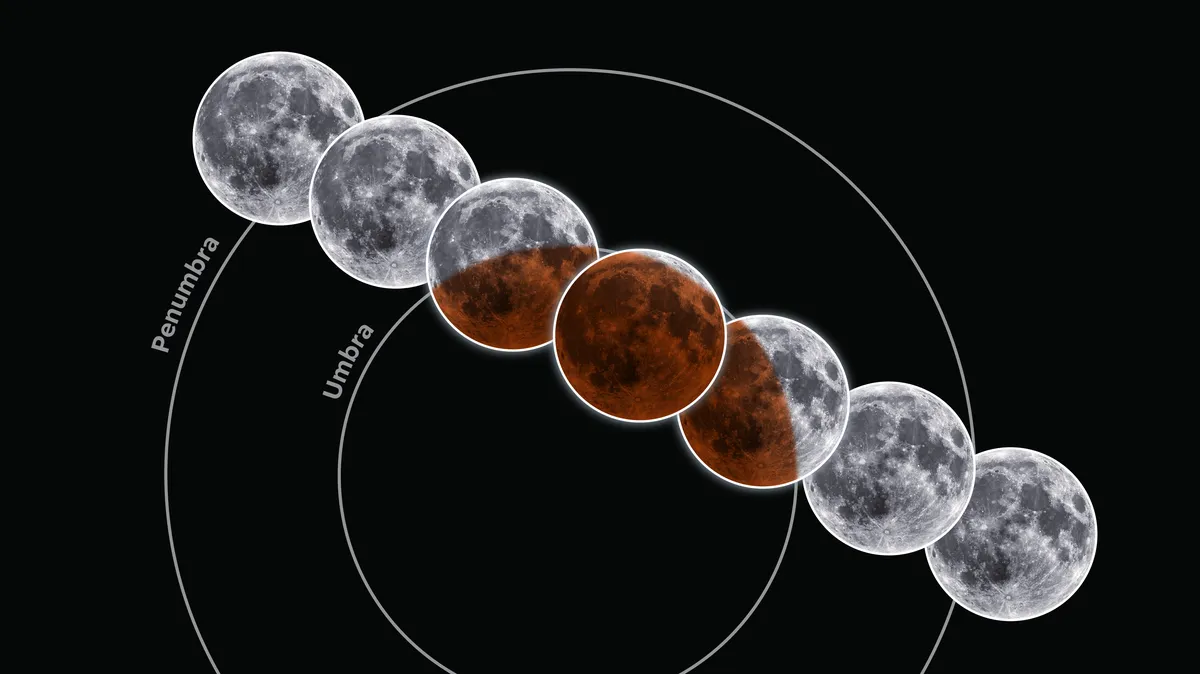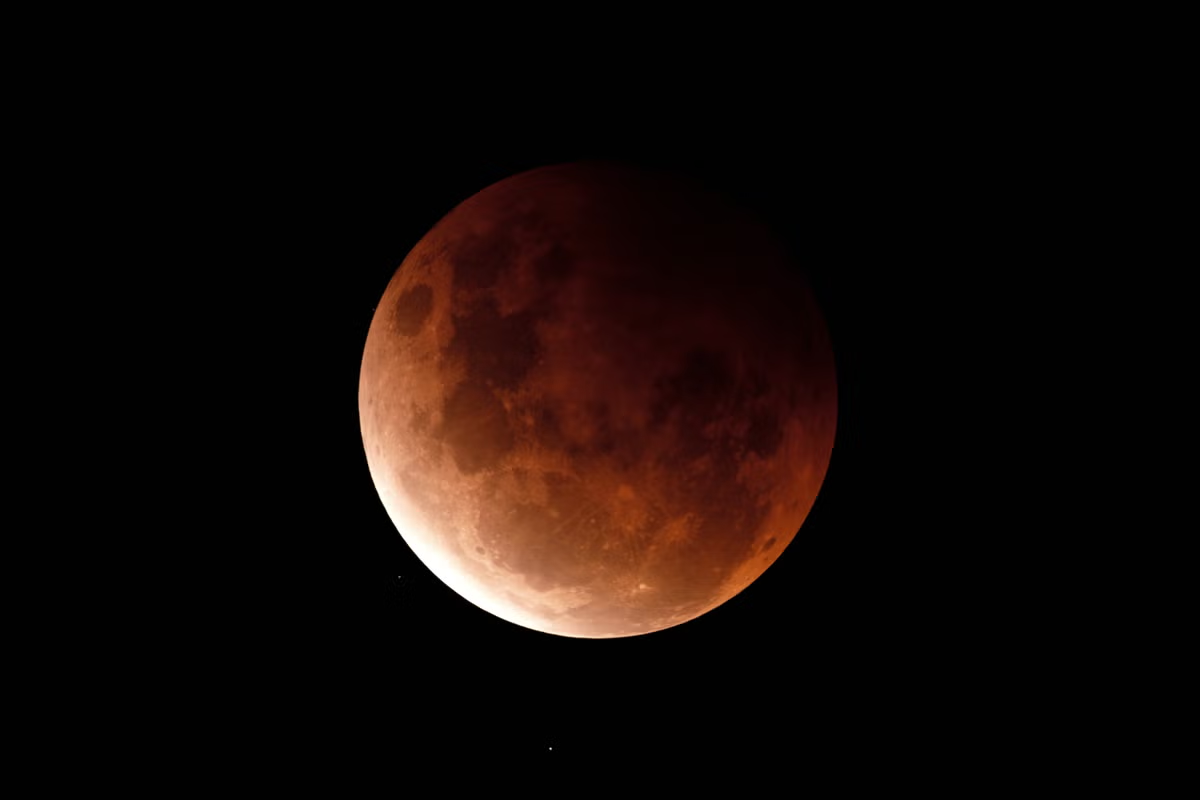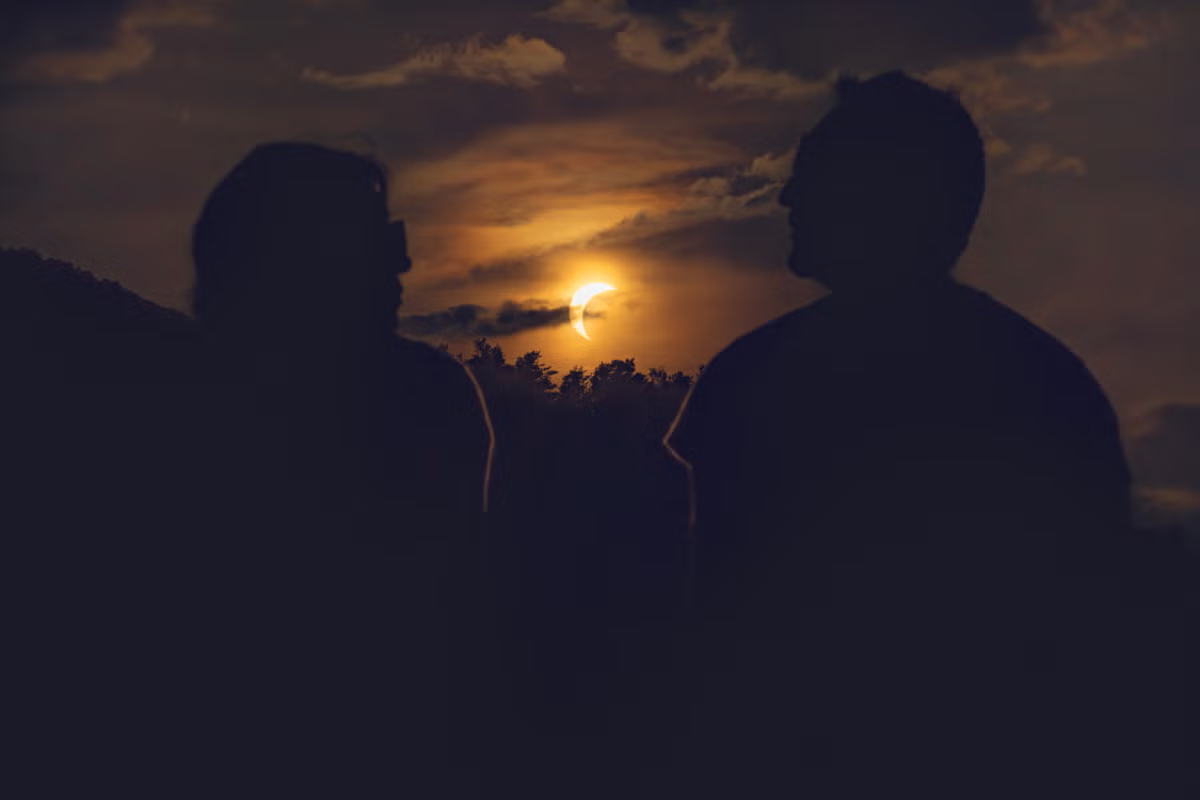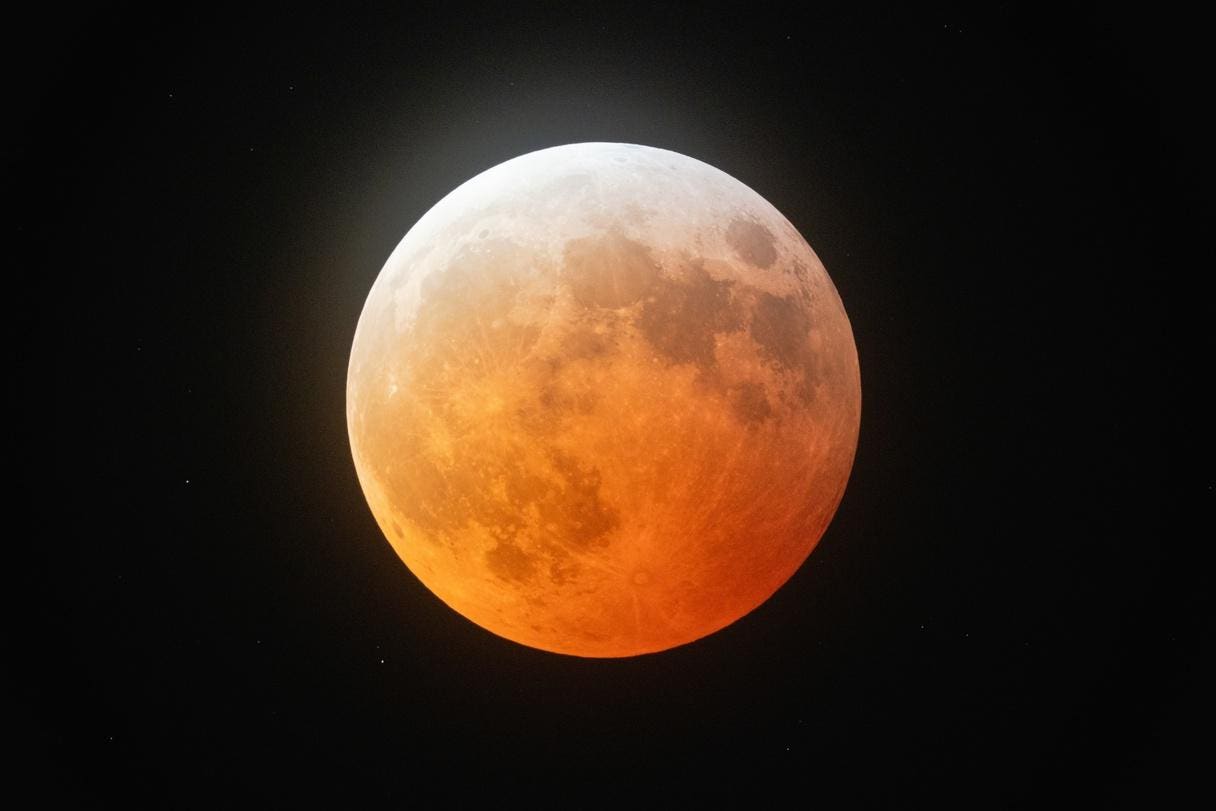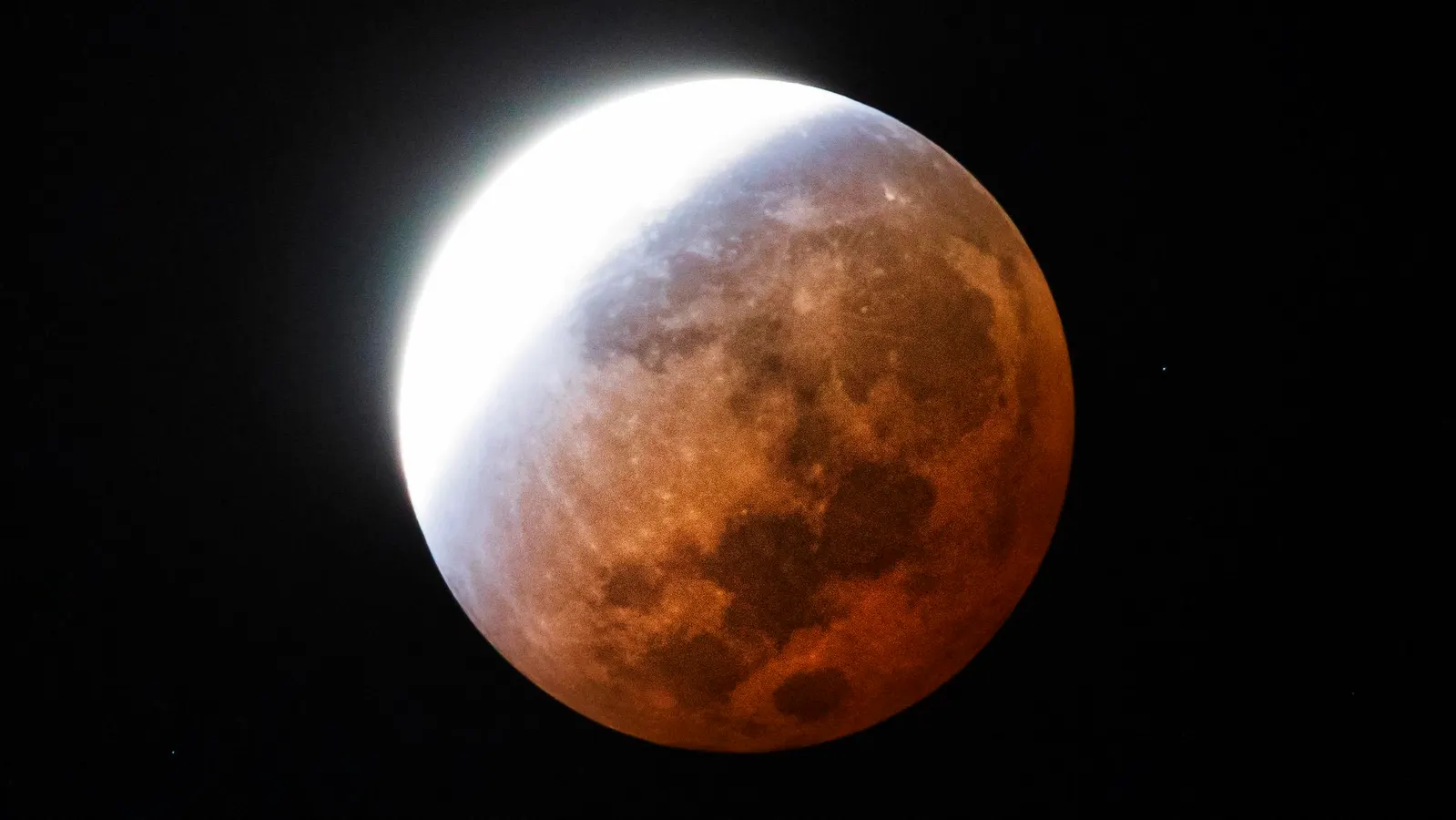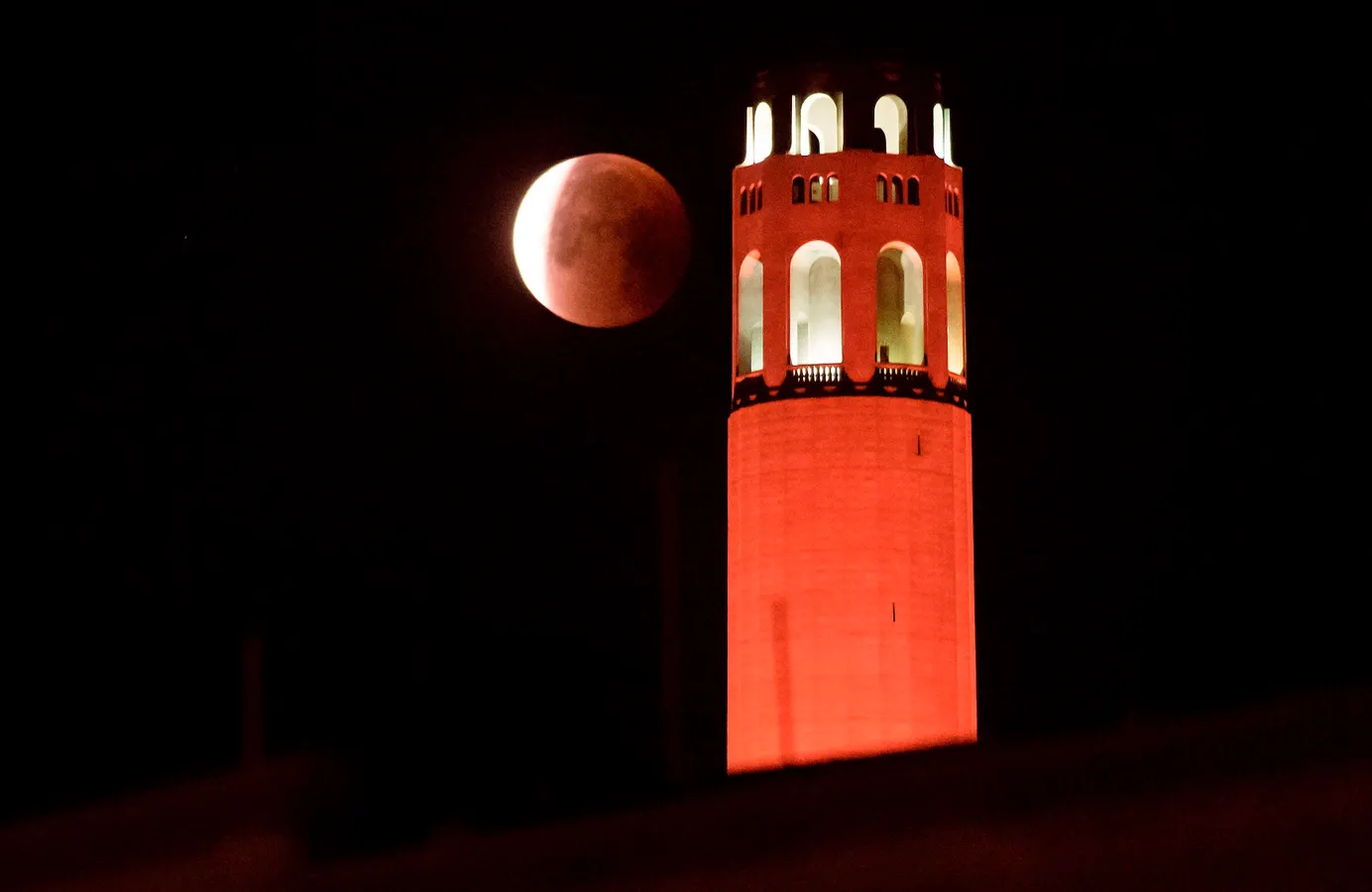
ToplineAfter a month defined by a total solar eclipse and the Perseid meteor shower — both blink-and-you’ll-miss-them events — here comes a sky event that’s much slower, but equally as revealing. Overnight on Thursday and Friday the full moon — the Sturgeon Moon — rises and will be partially eclipsed by Earth. A long, evolving event (and one of the astronomical highlights of summer), it will reward repeated observation rather than a single moment of spectacle. Saturn will shine nearby as the sky turns from bluish to black and the full moon's light takes on a reddish hue. This week is also a moment of transition. Summer constellations still hold the sky, but darkness is arriving earlier, and the rhythm of observing is shifting with it — stargazing is becoming easier. Here’s everything you need to know about the night sky from Aug. 24-30, 2026.A "blood moon" is seen during a partial lunar eclipse near Coit Tower in San Francisco, California before dawn on January 31, 2018. (Photo credit: Josh Edelson/AFP via Getty Images)AFP via Getty ImagesTimelineMonday, Aug. 24-Wednesday, Aug. 26The waxing gibbous moon rises before sunset and dominates the evening sky, reducing visibility of faint stars. Venus will shine brightly just after sunset in the southwest.Thursday, Aug. 27Mercury — recently visible during the total solar eclipse — is today at superior conjunction, which is when it passes around the far side of the sun.Thursday, Aug. 27-Friday, Aug. 28A deep partial lunar eclipse unfolds over a few hours as 96% of the moon passes into Earth’s dark central shadow.A LUNAR ECLIPSE IN SLOW MOTIONThis week’s eclipse is not total, but it comes very close. At maximum, around 96% of the moon’s diameter will be immersed in Earth’s umbra, the darkest central part of its shadow. That will make it a visually striking event, though in a quieter way than a total lunar eclipse. Instead of the entire moon turning red, you’ll see a large, darkened portion creeping across the lunar surface, often with a subtle copper or brown tint, while a bright sliver remains in direct sunlight. The key to appreciating this event is to watch the curved side of Earth’s circular shadow move across the lunar surface — a demonstration that Earth is round.Maximum eclipse occurs simultaneously at 12:12 a.m. EDT on Friday, Aug. 28, which is 9:12 p.m. PDT on Thursday, Aug. 27. Look an hour either side for maximum effect.The eclipse will unfold gradually over 5 hours 38 minutes. Unlike the total solar eclipse on Aug. 12, this event is completely safe to watch with the naked eye. You don't need eclipse glasses or special equipment.NASA's Scientific Visualization StudioVENUS CONTINUES ITS CLIMB TO BRILLIANCEEach evening, one object becomes harder to ignore. Low in the west after sunset, Venus now shines with a steady, unmistakable intensity. Having passed greatest elongation on Aug. 15, it is now entering the phase where its brightness increases rapidly. As Venus moves closer to Earth, its apparent disk grows larger while its illuminated portion shrinks into a crescent. The net effect is a steady rise in brightness. By mid-September, Venus will reach peak brilliance, becoming the third brightest object in the sky after the sun and moon.Constellation Of The Week: CapricornusCapricornus sits low in the southern sky after dark, and at first glance, it barely seems there at all. Its stars are faint, its shape subtle, and it lacks the obvious patterns of earlier summer constellations. However, be patient, and you’ll see a broad, shallow triangle becomes visible only when you stop scanning and start studying. The moon will be just to its east during the lunar eclipse, making it an ideal time to look for the “sea goat.” As part of the zodiac, Capricornus also lies along the ecliptic, the path followed by the sun, moon and planets.The partially eclipsed full moon will be close to the constellation Capricornus. gettyWhat’s Next In The Night SkyOn Sept. 11, a new moon restores dark evening skies, ideal for observing the Milky Way as it begins to shift westward earlier each night. On Sept. 18, Venus reaches peak brightness, dominating the western sky after sunset. On Sept. 23, the September equinox marks the start of astronomical autumn in the northern hemisphere, bringing rapidly lengthening nights — and possibly a peak in auroral activity. On Sept. 26, the famous full Harvest Moon rises at sunset, the closest full moon to the equinox.The times and dates given apply to mid-northern latitudes. For the most accurate location-specific information, consult online planetariums like Stellarium.Further readingForbesYour Full Moon Guide For 2026 — All 13 Dates For Your DiaryBy Jamie CarterForbes19 Years From Today, A Total Solar Eclipse Will Return To The U.S.By Jamie CarterForbesMissed The Total Solar Eclipse? Now See A ‘Blood Moon’ Across The U.S.By Jamie CarterForbes7 Spectacular Stargazing Events To See This SummerBy Jamie CarterForbes‘Exciting’ Earth-Like Planet Found Close To The Solar SystemBy Jamie Carter
See A Rare ‘Blood Moon’ Eclipse Beside Saturn: The Night Sky This Week
North America’s celestial highlights for the week ahead, which also apply to mid-northern latitudes in the northern hemisphere.
817 words~4 min read