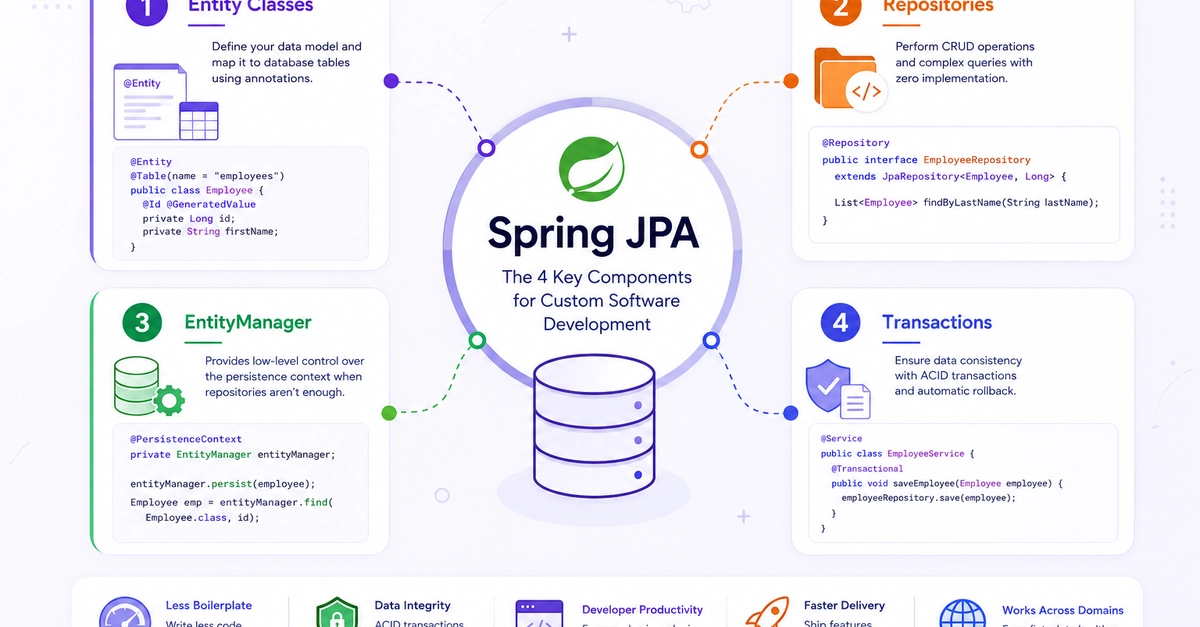
Here's the mechanism, before the war story: every EntityManager keeps a first-level cache, an identity map of every entity it's touched in the current persistence context. Call find() (which is what loadById resolves to, directly or through Spring Data's derived findById) for an entity that's already managed, and Hibernate doesn't ask the database anything. It just hands you back the object it already has. That's not a bug. It's the entire point of the first-level cache, and most of the time it's exactly the behavior you want. The problem is that a green @DataJpaTest can’t tell the difference between 'I verified this round-trips through the database' and 'I got the same Java object reference back.' And I’ve watched teams ship code confident in tests that were only ever validating L1 cache state - right up until a missing constraint violation or a column mapping bug blew up in production because the data was never actually flushed and re-hydrated.
In this chapter of the Evolutionary Architecture series, we're tearing down the illusion of the default Spring Data test. We'll look at exactly where the first-level cache hides bugs, and build a testing architecture around explicit EntityManager clearing, generic test fixtures, and in-memory isolation - so a green test means what you think it means.