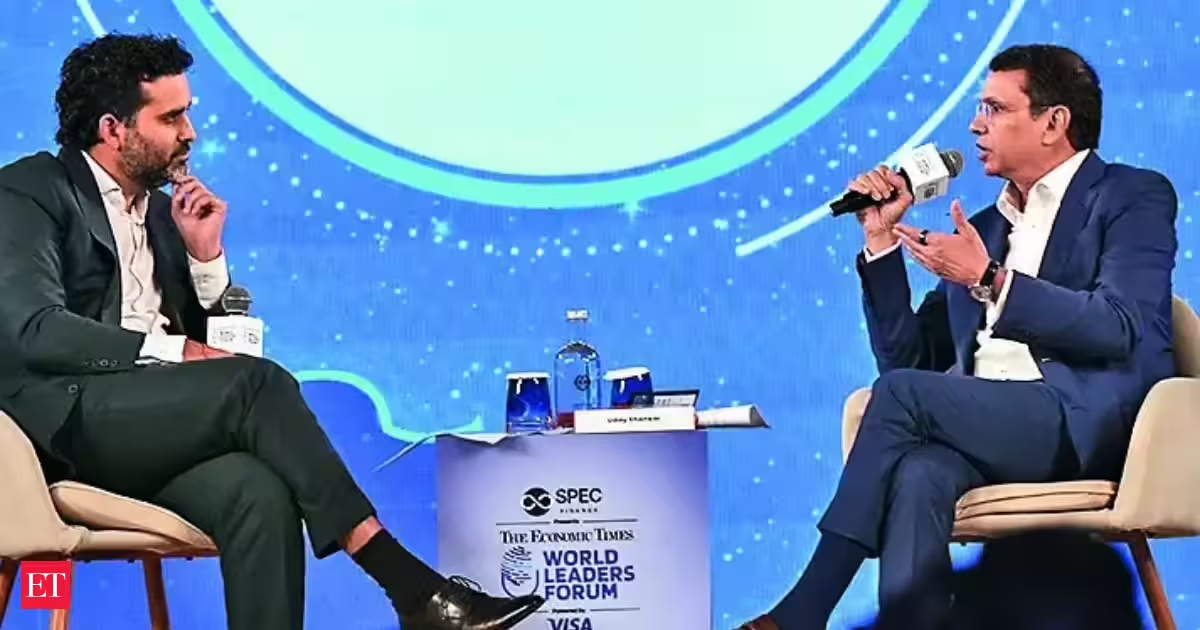
Sports, particularly cricket, has been a "great investment" for JioStar because of its ability to aggregate audiences at enormous scale and convert a significant portion of its sports audience into entertainment consumers, said vice chairman Uday Shankar. The company, which combines the former Disney Star and Viacom18 businesses, now has 600 million monthly active users on digital."That kind of vertical take-off can happen only with sports," Shankar said.The challenge, he said in a conversation with Times Internet chairman Satyan Gajwani, is that acquiring audiences through sports comes at a steep cost.ALSO READ | PM Modi stood by Trump in tough times, says US ambassador Sergio GorJioStar has committed billions of dollars to major cricket properties, including the Indian Premier League (IPL), ICC events and BCCI bilateral cricket.However, the economics of cricket media rights have become increasingly challenging, with the company now feeling like the "only one standing" in a market that was once fiercely contested by multiple broadcasters, Shankar said. "Financially, sports, especially (in) cricket, prices have run out of control. And that's a real challenge," Shankar said. "Ten years ago, there were at least four media companies always vying for sports rights. Today, it feels like we are the only ones standing. There's something broken."ALSO READ | ET WLF 2026: Private players discuss India’s path from defence importer to global powerShankar said the company is now focused on two priorities: improving the content experience, both in storytelling and visual presentation, and finding a new business model for media.He argued that the traditional advertising-and-subscription model is no longer sufficient for premium video businesses, as advertising comes under pressure from technology platforms and other competitors."You cannot build a business in the 21st century with a business model that was created in the 19th century," he said.The pressure on traditional media models is likely to intensify as artificial intelligence drives a sharp increase in the volume and variety of content, Shankar said."I think most people think that there's too much content and I think they haven't seen all of it yet. I think there's going to be way more content and the level of innovation that will come in content with AI is pretty phenomenal and people should get ready for that," he said. He also said brand power will become increasingly important as the market is inundated with content. Shankar also said cricket's future would increasingly be shaped by shorter formats, pointing to the IPL and the emergence of T20 leagues globally."Consumers like crisp, short formats. They like the IPL. The success of the IPL is not an accident," he said, arguing that the league had simplified the game, made it faster and given fans teams they could identify with.Traditional bilateral contests involving major cricketing nations such as India, England and Australia would continue to matter. But he cautioned that stadium attendance alone was not a reliable measure of the health of the sport. Cricket's long-term viability, he said, depends on the broader economics of media rights and the ability of boards to generate enough revenue to pay players and invest in infrastructure.Shankar was also bullish on women's cricket. JioStar holds the media rights to the Women's Premier League, a five-year deal originally awarded to Viacom18 for ₹951 crore.He said the BCCI and ICC had taken the right steps in promoting the women's game but argued that the wider cricket ecosystem needs to be developed to create a deeper talent pool, like men's cricket.On the ICC's ambition to expand cricket into new markets, Shankar said the governing body needed a more structured pathway for emerging countries, with stronger club cricket and a system through which teams could progressively move up competitive levels. "That's how you will give it a sane structure that's sustainable and it'll throw up talent," he said. Shankar, who began his career as a journalist and later headed Star India and Disney's Asia-Pacific operations, is also the co-founder of Bodhi Tree Systems with James Murdoch.
ET World Leaders Forum: Cricket is a great investment but rights costs have run out of control, says JioStar's Uday Shankar
JioStar vice chairman Uday Shankar said sports, particularly cricket, has been a major investment for the company, helping it build a digital audience of 600 million monthly active users. However, he said soaring cricket media rights costs have made the business increasingly difficult.
657 words~3 min read