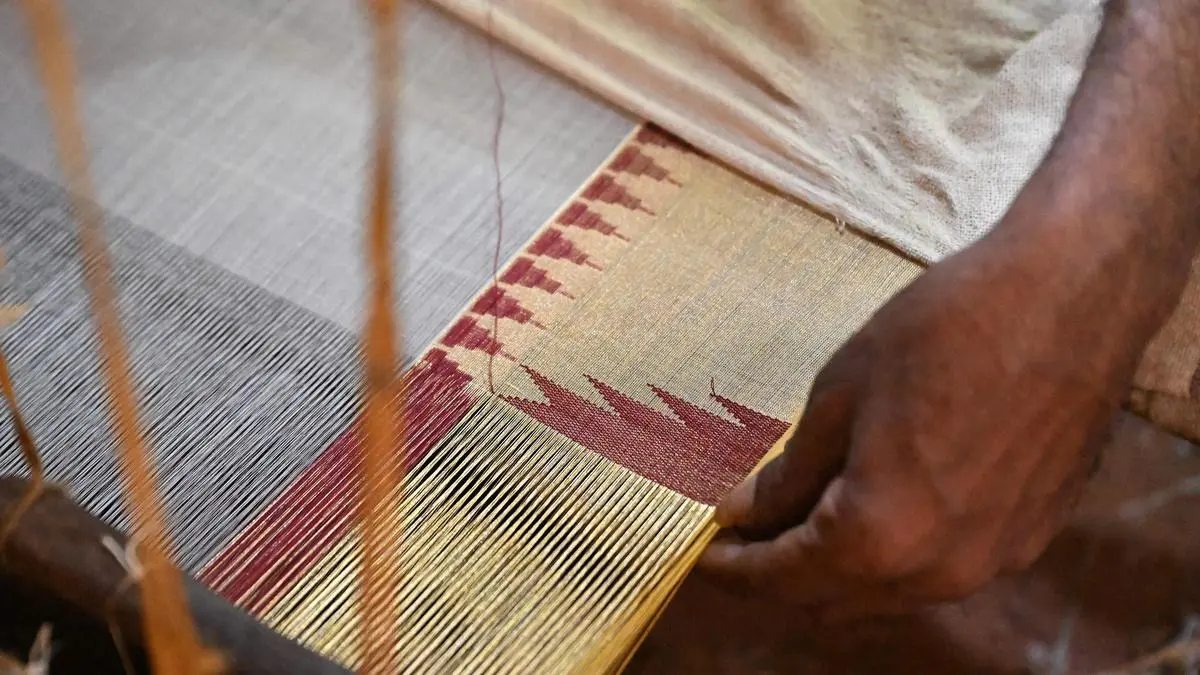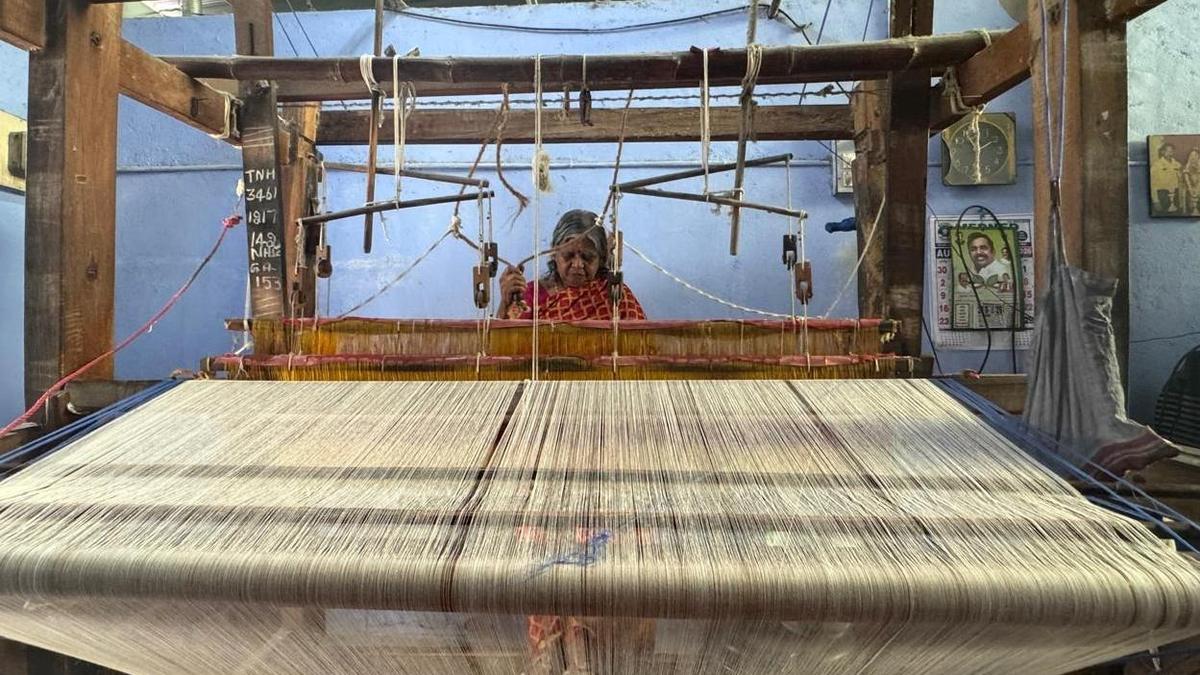
An artisan engaged in weaving a dhoti at her house in Vadasery area in Kanniyakumari district.
| Photo Credit: SPECIAL ARRANGEMENT
Handloom and pedal loom weavers from in and around Nagercoil region have raised concern over the changes in quality specifications of dhotis set to be distributed by the government for Pongal.The weavers said that the changes in length, weft density and other specifications would make it difficult for handloom and pedal-loom units in the district to produce them, compared to the powerloom units.The district has several hundred artisans currently engaged in weaving, with a majority of them registered with different weavers’ societies across the district. These societies receive raw materials supplied by the government for the production of dhotis, which are later distributed to the public under the government’s welfare schemes.Baskaran, a 76-year old weaver from Vadasery pointed out the difficulties that the change in size and other specifications could cause for handloom weavers in the district.Explaining the previous specifications, he said the weavers in the district used to weave dhotis with a length of 3.65 and breadth of 1.27 metres, producing an 8 cubit dhoti in a 72-inch mould. “We usually make dhotis with a weft density of 72 threads per inch. However, the government has now advised us to weave with a weft density of 68 threads per inch in a four-cubit dhoti. In handloom weaving, this would make the dhoti more transparent and affect its quality.”He added that the majority of the weavers in the district were above 40s and 50s, with women accounting for a significant share of those engaged in weaving dhotis for the government. Each weaver is paid between ₹130 and ₹150 per dhoti by the societies.“However, the government has now stopped supplying weft thread to societies as we were unable to achieve the prescribed specifications using handloom techniques. This has affected the livelihood of several weavers in the district,” Mr. Baskaran said.While the revised specifications could be achieved using machine looms and powerlooms, the government had overlooked the limitations faced by the handloom weavers, he added. He urged the government to allocate the old-pattern dhotis for production in the district, as several weavers in the district were solely dependent on handlooms for their livelihood.He further stated that societies in the district currently have hundreds of old-pattern dhotis in stock. Officials had informed that these dhotis would be procured for distribution as part of relief measures and old-age pension related schemes, he noted.Chitra (name changed), a 64-year old weaver from Vadasery said that as most of the weavers in the area were above 50 years of age, it would be difficult for them to adapt to the new specifications. The changes would also require the modernisation of handlooms, which could cost at ₹10,000 per loom, she added.Mr. Baskaran highlighted that the handloom weavers across Kanniyakumari district shared similar concerns and questioned the availability of livelihood opportunities for them if new specifications were implemented.A senior official of Kanniyakumari district administration told The Hindu that the specifications were part of a policy decision. However, the concerns and demands of the handloom weavers would be brought to the attention of the government, he said.The official added that there are plans in the cards to provide subsidies to weavers to modernise the handlooms according to current specifications, besides offering training to help them adapt to the revised specifications. Published - August 23, 2026 08:23 pm IST