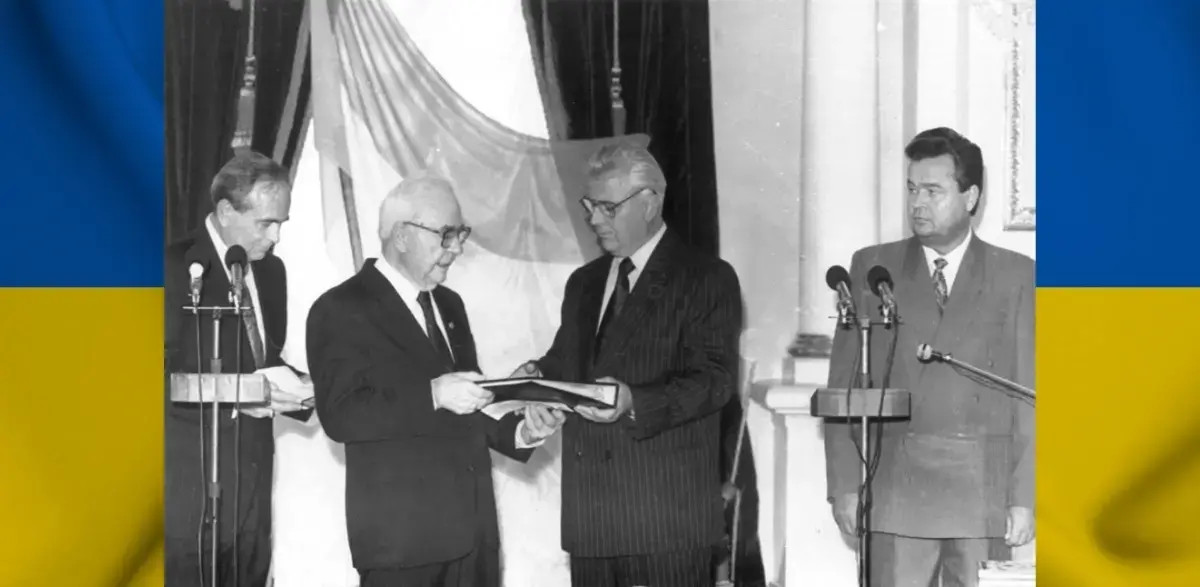
As Ukraine marks the 35th anniversary of its restored independence, its foundational documents affirm that modern Ukrainian statehood is not a Soviet residue or a post-Cold War accident, but the fulfillment of a long constitutional and political trajectory. Nowhere is this continuity clearer than in a side-by-side reading of Ukraine’s two modern declarations of independence: the Fourth Universal of the Ukrainian Central Rada (Ukraine’s de facto parliament at the time) proclaimed on Jan. 22, 1918, and the Act of Declaration of Independence of Ukraine, adopted on Aug. 24, 1991, by the republic’s parliament, the Verkhovna Rada.JOIN US ON TELEGRAMFollow our coverage of the war on the @Kyivpost_official. Separated by 73 years of Soviet suppression, forced famine, and totalitarian violence, these two texts read like sequential chapters of a single constitutional manifesto: crises engineered from Moscow, an unbroken lineage of Ukrainian state-building, a rejection of imperial rule in favor of uncompromised sovereignty, legitimacy grounded in the democratic will of the people. But between them is silence that tells us as much about the fragility of independence as the declarations themselves do about its legitimacy. Here's another to place in the text: Fourth Universal Of the Central Rada, Jan. 22. 1918. Photo: public domain
Reaffirming the Unbroken Canon in Ukraine’s 35 Years of Modern Independent Statehood
Ukraine’s founding texts in 1918 and 1991 show that statehood was reclaimed, not invented.
1,808 words~8 min read