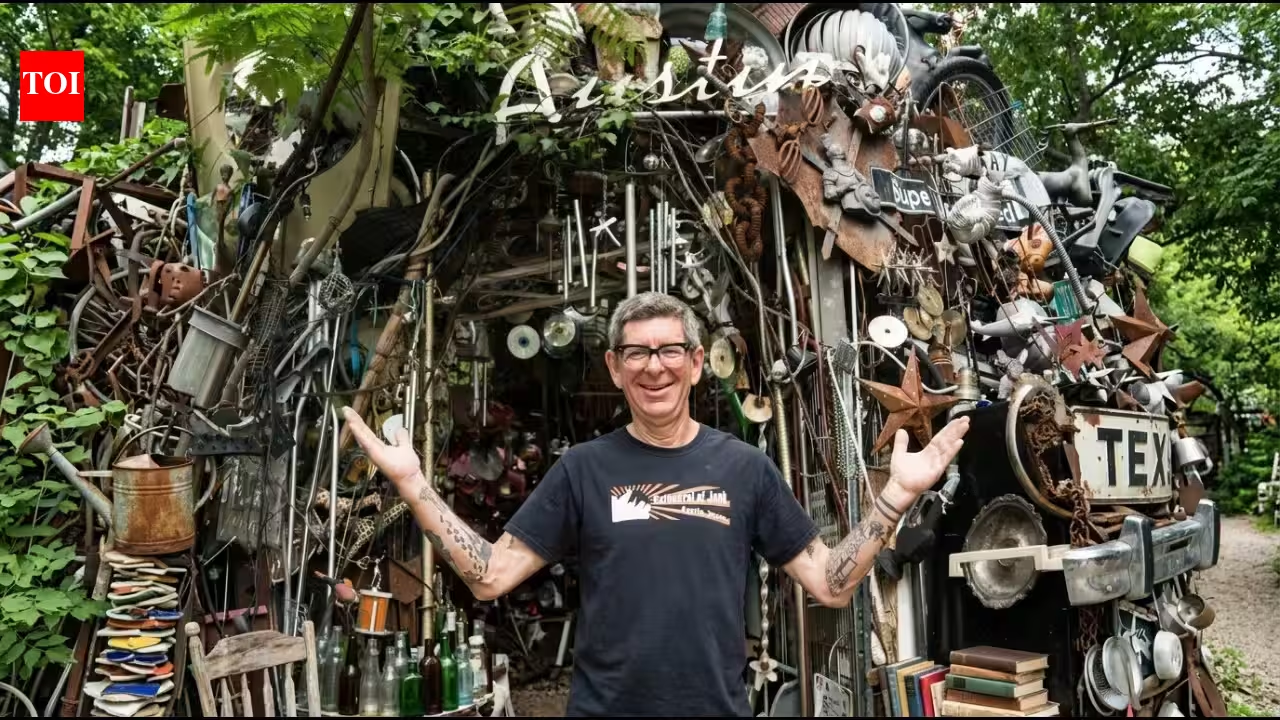
The Cathedral of Junk in Austin, Texas, created by Vince Hannemann, transforms discarded everyday objects into an ever-growing maze of art, architecture and found-object history. Image Credits: Lorie Shaull/FlickrA broken bicycle, an old television, a shopping trolley and a collection of battered signs might seem destined for a scrapyard. In a South Austin backyard, however, thousands of such objects became something altogether different. For decades, artist Vince Hannemann has been wiring, stacking and fitting discarded objects together to create the Cathedral of Junk, a three-storey maze of towers, arches, rooms and walkways that is now one of the city’s most unusual landmarks.What began as Hannemann’s personal backyard experiment gradually became a project shaped by the wider neighbourhood. As the structure grew, neighbours began bringing him unwanted possessions they thought could be incorporated into it. Over time, the supply of material became so abundant that Hannemann no longer had to search for much of it himself. People simply turned up with objects they believed might find a place in the expanding maze of towers, arches and passageways. By the 2010s, the cathedral was estimated to contain about 60 tons of discarded material.From backyard pile to cathedralThe early structure was far less elaborate than the one visitors see today. Hannemann gradually connected pieces of metal, household objects, bicycle parts, car components, signs and other cast-offs, using wire and other fasteners to hold the growing construction together. There was no conventional architectural blueprint. Instead, the cathedral developed through accumulation. One object suggested another, and new sections were added around existing ones. The result was less a conventional building than a continually evolving installation.The structure eventually reached roughly 30 feet in height and developed multiple rooms, narrow passages, bridges, stairways and towers. Objects that would normally be separated by function or era became part of the same visual landscape. Old appliances sit beside toys, bicycle wheels and licence plates, while arches and openings turn what could have been an enormous heap into something visitors can actually walk through.According to a study in Arts and Design Studies, artists can transform discarded materials into aesthetic works by shifting them from their original context and giving them new creative purposes. The study notes that waste and found objects can become alternative artistic materials rather than simply being treated as unwanted objects. The Cathedral of Junk takes this approach beyond an individual artwork, turning thousands of discarded objects into a walk-through environment.When junk met the cityAs the Cathedral grew, its unusual scale eventually attracted attention in the surrounding residential neighbourhood. Although much of the structure stood behind the house and trees rather than directly along the street, its height and sprawling form made it visible from neighbouring properties. In 2010, a complaint prompted Austin officials to inspect the structure, raising concerns about electrical wiring, access and other safety issues. Engineers examined the construction, and Hannemann began making changes to meet the city’s requirements. The dispute became serious enough that demolition appeared possible. In June 2010, Hannemann briefly began dismantling parts of the Cathedral, arguing that the changes required by the city were altering too much of the work’s character. He later reconsidered, and an agreement allowed the Cathedral to remain under certain restrictions. Some parts of the installation had to be removed, including material that extended into the property’s setback, but the central structure was preserved.Vince Hannemann's backyard folk art environment built out of cast-offs, dross, and debris. Image Credits: Wikimedia Commons.A living piece of outsider artUnlike a conventional sculpture meant to remain fixed, the Cathedral of Junk grew through the continual addition and rearrangement of discarded objects. This approach also places Hannemann’s work within the broader tradition of junk and found-object art. A study in ShodhKosh: Journal of Visual and Performing Arts traces how artists have used discarded and industrial materials to create new forms of art, giving ordinary objects new contexts and meanings. This connection helps explain what makes the Cathedral distinctive: its materials are not hidden or merely used as structural elements. Old bicycles, car parts, signs, household objects and other discarded items remain recognisable, allowing their previous identities to become part of the artwork while contributing to the constantly changing character of the structure.The Cathedral of Junk is an artwork that visitors experience from within rather than simply view from a distance. Its narrow passages, rooms and towers encourage people to move through the structure, discovering objects and details from different angles and heights. Over the years, it has also hosted weddings, parties and other gatherings, adding a social dimension to the installation. What began as a personal collection of discarded objects gradually became a place that invites visitors to reconsider the boundary between waste and art. For Hannemann, that transformation did not happen all at once. It took shape over decades, as each new object found a place within the growing structure.
In 1988, a Texas man began wiring discarded objects together behind his small home; decades later, more than 60 tons of junk had become a walk-through cathedral
A broken bicycle, an old television, a shopping trolley and a collection of battered signs might seem destined for a scrapyard. In a South Austin backyard, however, thousands of such objects became something altogether different.
809 words~4 min read