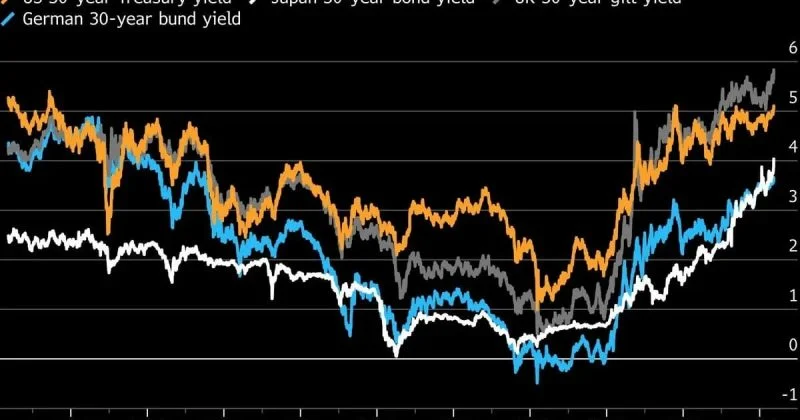
The pain of bond investors in recent years is captured by the TLT ETF, which invests in government bonds maturing in 20 years or later.
James Carville, lead strategist for former US President Bill Clinton, famously remarked that if reincarnation exists, he would want to come back as the bond market because it can intimidate everybody. History provides ample evidence of this power. Past spikes in bond yields have triggered the bursting of asset bubbles and even ousted world leaders, as seen with former UK Prime Minister Liz Truss. Hence, it would be a mistake to view last week’s efforts by US Treasury Secretary Scott Bessent to calm the US government bond market — the world’s most liquid market — as routine.Coinciding with a surge in US’ long-term bond yields, with the 30-year yield hitting 5.3 per cent on Monday, its highest since June 2007, or in nearly 19 years, the US Treasury made a surprise announcement last Wednesday on intervention in the bond market. In what some bond market veterans viewed as a sign of panic, it said that, starting September 9, it double its buybacks of 10-20-year and 20-30-year government bonds to provide liquidity support. According to experts, to fund the buyback, the Treasury is likely to issue new shorter tenor bonds, and total debt will remain unchanged.The numbers appear small relative to the size of the market, but the signalling effect was supposed to be strong. The subsequent bond market reaction, however, indicates an emerging challenge that investors need to watch — macro pressures are building as bond investors express concern over inflation, government debt, and probably waning effectiveness of policy signals.Losing control of narrativeThe 10-year and 30-year bonds which began the week at yields of 4.69 per cent and 5.26 per cent, respectively, initially reacted positively to the Treasury’s move by falling to 4.65 per cent and 5.19 per cent by Wednesday. They subsequently reversed course, ending the week at 4.73 per cent and 5.27 per cent — higher than their starting levels.Gold gained 5.2 per cent during the week as investors sought alternatives to the US dollar and a hedge against inflation (see charts). The pain of bond investors in recent years is captured by the TLT ETF, which invests in government bonds maturing in 20 years or later (see chart). The ever-expanding US national debt, meanwhile, hit the $40-trillion milestone on Tuesday — just a trillion dollars away from the Congress-set debt ceiling. The federal budget deficit remains elevated at around 6 per cent of GDP, even as the economy continues to show strength (see chart).Bessent may have downplayed the market intervention as merely a measure to bolster liquidity. But against this backdrop, the bond market’s U-turn last week points to a growing trust deficit in the signalling power of government agencies.Experts view the Treasury’s initiative as a band-aid for a structural problem and as ‘buying time’ ahead of the mid-term elections. According to Peter Boockvar, CIO at OnePoint BFG Wealth Partners, the buybacks also tie the Fed’s hands on interest rates. Raising policy rates to contain inflation could make short-term treasuries cost more — the very ones that the Treasury plans to issue more of to buyback longer dated bonds. On the other hand, if the Fed stands by as prices continue to rise, the long-dated bond yields could go up again and even more as inflation expectations get unanchored.To top it all, the move by the US Treasury is at odds with what Fed Chair Kevin Warsh has been advocating — letting economic data determine bond prices, reducing the market’s reliance on central bank guidance, and ending policies that artificially subsidise government deficits.Waning credibilityMarket’s paranoia is not without reason. President Trump campaigned on reducing debt and deficit. He set up the Department of Government Efficiency (DOGE) under Elon Musk for that objective. He even advocated increasing crude oil production to help lower energy costs.A year and a half into his term, however, national debt has risen by about $4 trillion, budget deficits show little sign of meaningful fiscal consolidation, and oil prices are higher. This comes as the US Fed has failed to bring inflation back to its 2 per cent target for 64 consecutive months.Why this mattersJeffrey Gundlach, the DoubleLine Capital CEO often referred to as the ‘Bond King’ recently stated that the US national debt “is no longer your grandchildren’s problem. It is our problem.” Given that bond yields have been spiking not just in the US but also across other heavily indebted developed economies (see chart), there is a growing case that the ample global liquidity that powered equity markets since the global financial crisis may be a thing of the past.Valuations will begin to matter even more, while the relative attractiveness of equities vs bonds for FIIs will be a dominant factor.Another risk to watch is the waning effectiveness of government signalling as fundamental market forces begin to dominate. The US government’s attempts to influence bond, oil and currency markets — including the recent coordinated intervention to buy the yen — appear to be producing diminishing returns.Market fatigue is reflected in bond yields. Even the yen, which strengthened to 155 to the dollar from a recent multi-decade low of 164, has since weakened to around 159. Investors need to watch for the risk of a similar dynamic playing out in equity markets.All in all, last week’s market moves indicate mounting macro pressures for investors and reinforce the view that the days of an easy path to stock-market wealth may be behind us. Gold, meanwhile, is likely to remain in the spotlight.Published on August 22, 2026