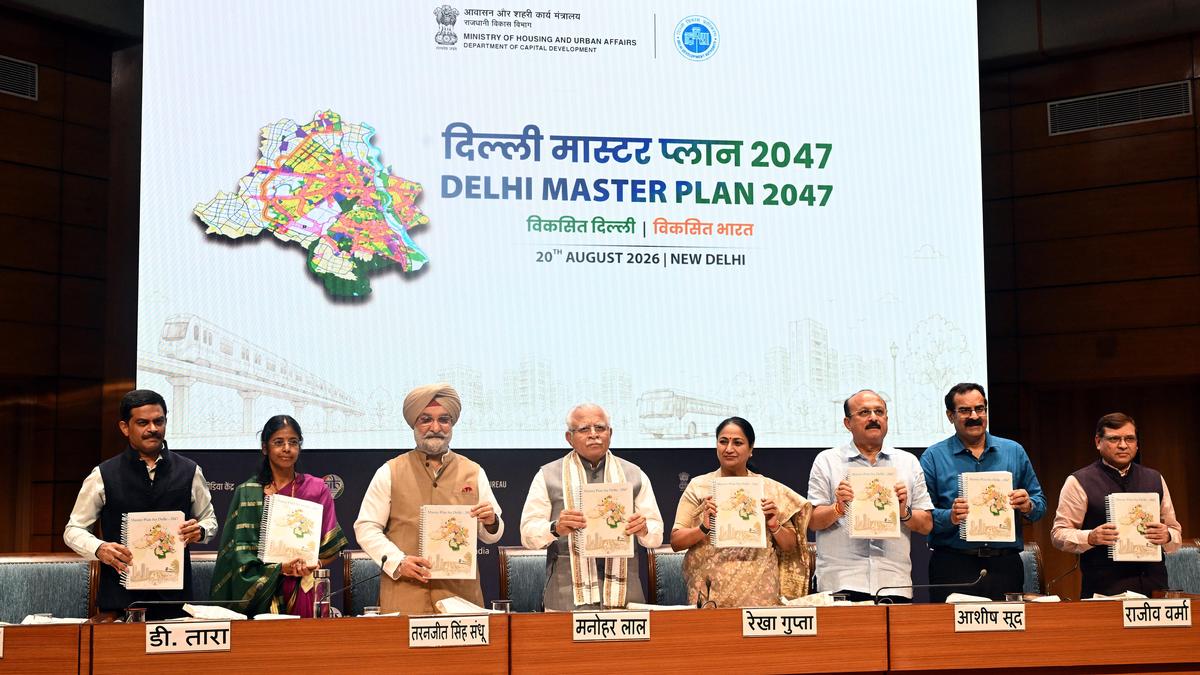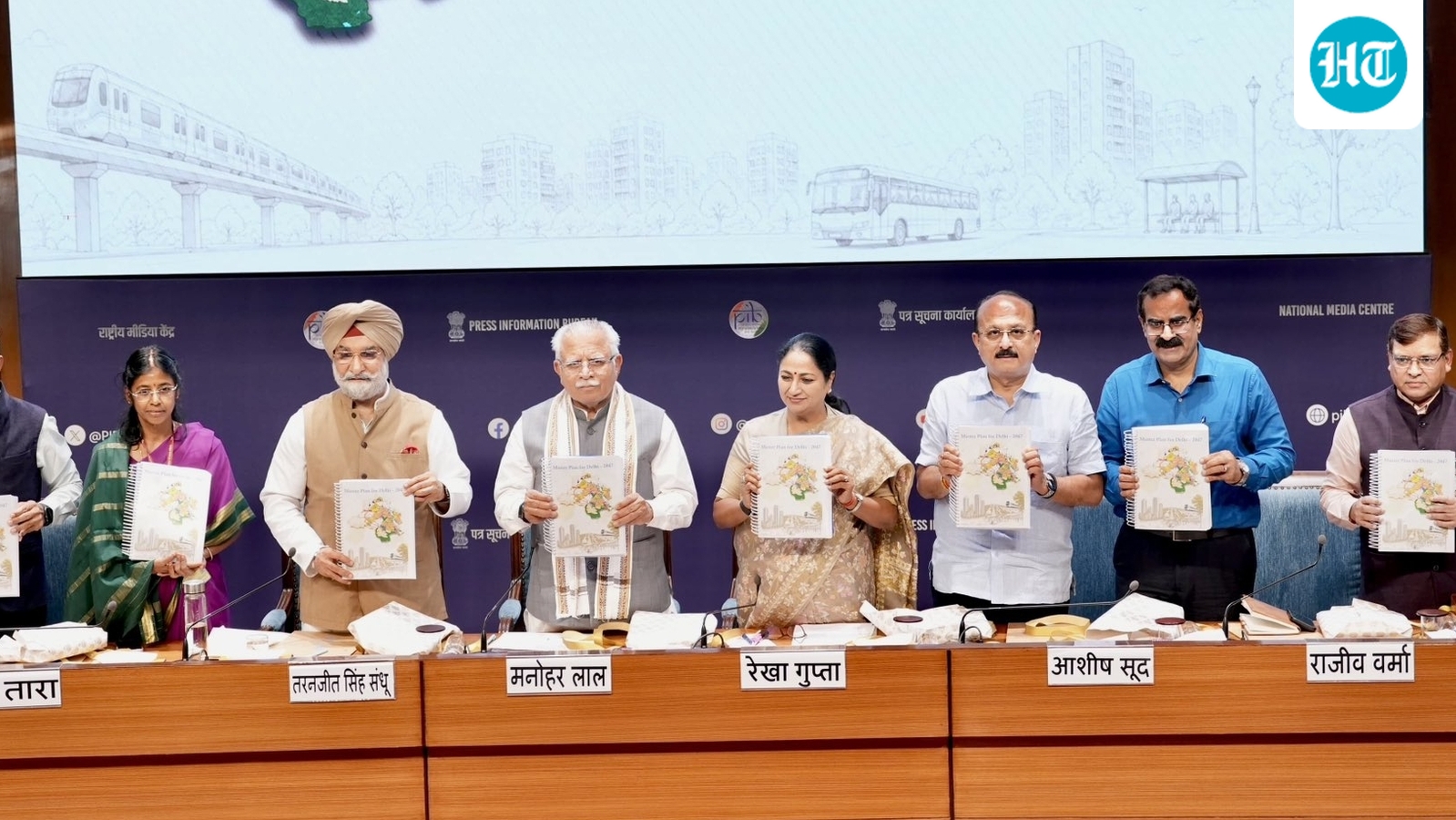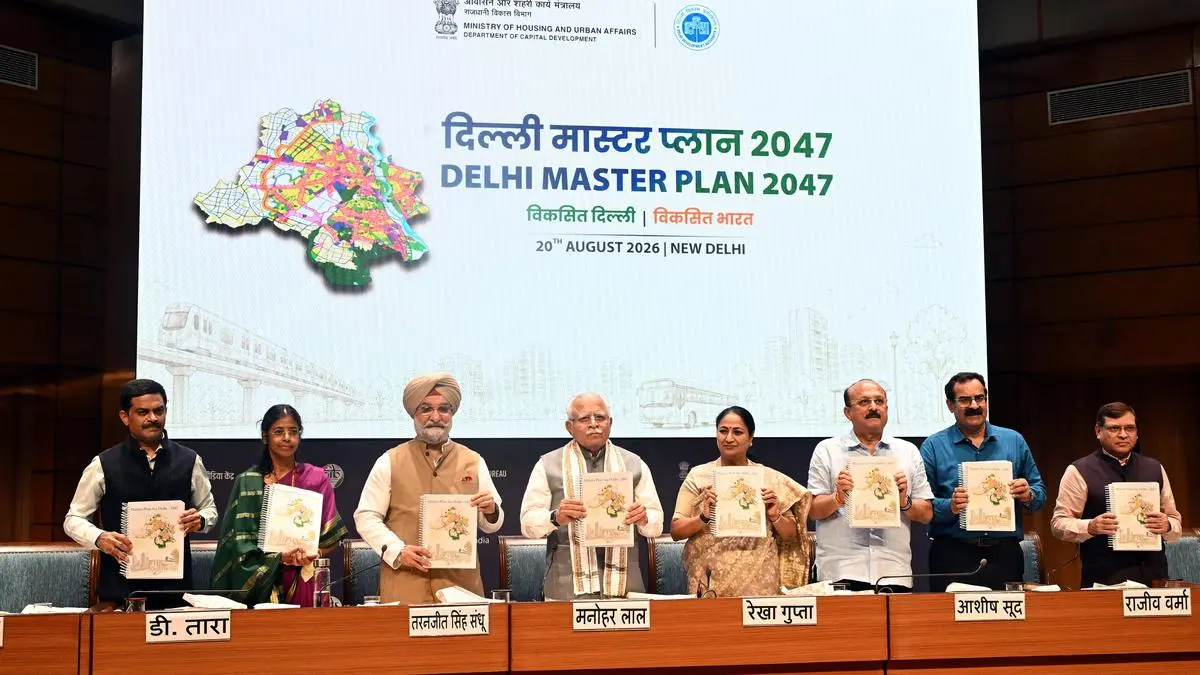
Union Minister of Urban Development and Housing Manohar Lal with Lt. Governor of Delhi Sardar Taranjit Singh, Delhi Chief Minister Rekha Gupta and Delhi Education Minister Ashish Sood seen during a Press Conference on Delhi Master Plan 2047, at National Media Centre, in New Delhi on Thursday.
| Photo Credit:
Delhi is set to get a significantly expanded and more decentralised healthcare network under the Master Plan 2047, with the city planning six neighbourhood health centres and three hospitals for every one lakh population, along with sub-city hospitals, de-addiction and rehabilitation centres, geriatric and paediatric facilities, diagnostic centres and medical colleges. The plan also provides for nursing and paramedical institutes, long-term care facilities and local testing laboratories and sample-collection centres for future pandemics.The Master Plan 2047 proposes an integrated healthcare system in which facilities are distributed across residential areas and connected to public transport. Rather than focusing only on large hospitals, it seeks to strengthen primary and community healthcare while expanding secondary and tertiary care.At the neighbourhood level, the plan brings maternity homes, nursing homes and polyclinics, dispensaries, family welfare centres, paediatric and geriatric centres and diagnostic centres under a common “Health Centre” category. This would allow agencies to develop the facility most needed in an area instead of requiring separate land-use provisions for each type.The plan also permits healthcare and other social infrastructure through vertical mixing within buildings and allows identified public and semi-public facilities within residential plotted developments under specified provisions. This could help densely populated areas where large plots are difficult to find.Six health centres, three hospitals per lakh populationMPD-2047 proposes six health centres per one lakh population, with an indicative minimum plot size of 1,000 square metres each. It also provides for three hospitals per one lakh population, with an indicative minimum plot size of 2,000 square metres each.At the sub-city level, it proposes three sub-city hospitals for every five lakh population, with an indicative minimum plot size of 1.5 hectares each, and one de-addiction and rehabilitation centre for every five lakh population.The document makes clear that these are indicative planning norms, not sanctions for a fixed number of hospitals. They can be modified according to local requirements, land availability and planning considerations.More focus on rehabilitation and elderly careThe healthcare provisions extend beyond conventional hospitals. The plan provides for de-addiction and drug rehabilitation centres, after-care centres, early-intervention centres, transitional care homes and respite-care facilities.It also provides for healthcare facilities for persons with disabilities, people with special needs and the elderly, while geriatric and paediatric centres are included under the Health Centre category.Medical colleges and paramedical institutesAt the city level, the plan provides for city medical colleges/nursing and paramedic institutes, with the number to be determined according to requirements and regulatory norms.Medical college campuses could include laboratories, diagnostic and R&D facilities, rehabilitation and de-addiction centres, staff and patient-attendant accommodation, hostels and crèches or day-care facilities.Pandemic preparednessThe plan incorporates provisions for future health emergencies, allowing local sample-collection centres and testing laboratories during pandemics.At the sub-city level, it proposes disaster management units, while a city-level Disaster Management Centre is envisaged. These facilities could include dispensaries, clinics, pathology laboratories, first-aid facilities, shelters and isolation units during emergencies.MPD-2047 also allows reduced plot-area and setback norms for essential facilities such as primary healthcare in unplanned areas. This could help densely populated and lower-income neighbourhoods where land availability has traditionally limited the creation of public facilities.The plan does not identify individual hospitals or specify construction timelines or bed capacities. Instead, it establishes a framework for a tiered healthcare network, from neighbourhood health centres and primary care to sub-city hospitals, tertiary facilities, medical colleges and emergency infrastructure.Published on August 22, 2026