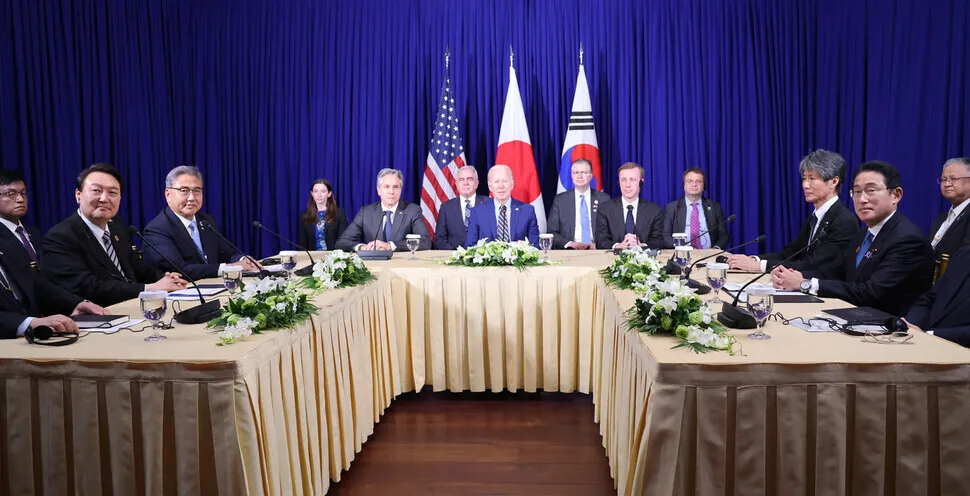
President Yoon Suk-yeol of South Korea (left) takes part in a summit with President Joe Biden of the US (center) and Prime Minister Fumio Kishida of Japan (right) in Phnom Penh, Cambodia, on Nov. 13, 2022. (Yonhap)
The relationship between South Korea and Japan is likely to undergo a “fundamental change” following a trilateral summit with the US at Camp David on Aug. 18, as indicated by US President Joe Biden last weekend.Seoul and Tokyo’s relationship is expected to be upgraded to a “quasi-alliance” in which they cooperate on a military level to pressure China and contain North Korea. The two countries have never cooperated on that level since they normalized diplomatic relations in 1965.There are concerns that demands for a just resolution to historical issues will be disregarded in that process.Following 35 years of Japanese rule, South Korea began talks to normalize diplomatic relations with its former colonial overlord in October 1951, when the flames of war still raged on the Korean Peninsula.The Korean War, which broke out soon after World War II, pitted the US against the Communist bloc of North Korea, China and the Soviet Union (today’s Russia). The US sought to level the playing field by quickly normalizing South Korea’s relationship with Japan.But it wasn’t easy to surmount Korea and Japan’s historical grudge. The two sides finally agreed to normalize relations in June 1965, following 13 years and 8 months of drawn-out negotiations.Japan agreed to aid South Korea’s economic development by providing US$300 million in grants and US$200 million in loans to cover any outstanding claims. But the two countries glossed over fundamental historical issues, such as the question of whether Japan’s colonial rule of Korea had been legal or illegal.But owing to a combination of South Korea’s deep-seated distrust of Japanese military expansion and Japan’s own pacifist constitution, which renounces the possession of a military and the right of belligerency, relations between the two sides remained fundamentally confined to an “economic cooperation” framework.Military cooperation would eventually come about through US mediation with the South Korea-US Mutual Defense Treaty in 1954 and the US-Japan Security Treaty in 1952. For Washington, trilateral military cooperation with Seoul and Tokyo has been a long-awaited development that has been delayed by over half a century.